Bouras Hamza, Bouaziz Ahmed, Choukr-Allah Redouane, Hirich Abdelaziz, Devkota Krishna Prasad, Bouazzama Bassou
Department of Crop Production, Protection and Biotechnology, Hassan II Institute of Agronomy and Veterinary Medicine, Rabat 10101, Morocco.
African Sustainable Agriculture Research Institute (ASARI), Mohammed VI Polytechnic University (UM6P), Laayoune 70000, Morocco.
Plants (Basel). 2021 Nov 28;10(12):2608. doi: 10.3390/plants10122608.
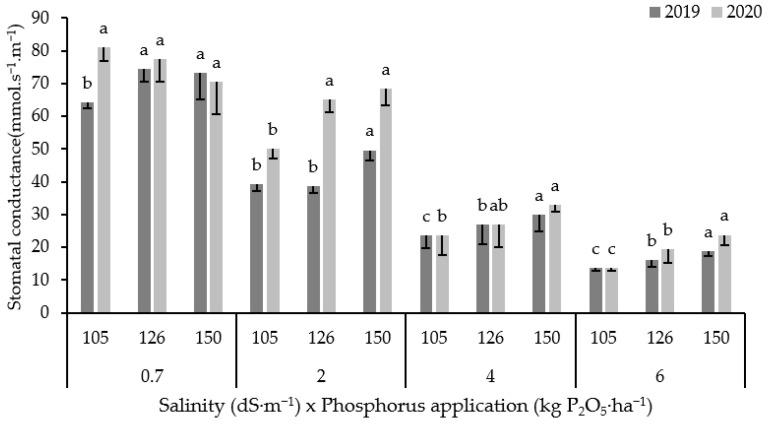
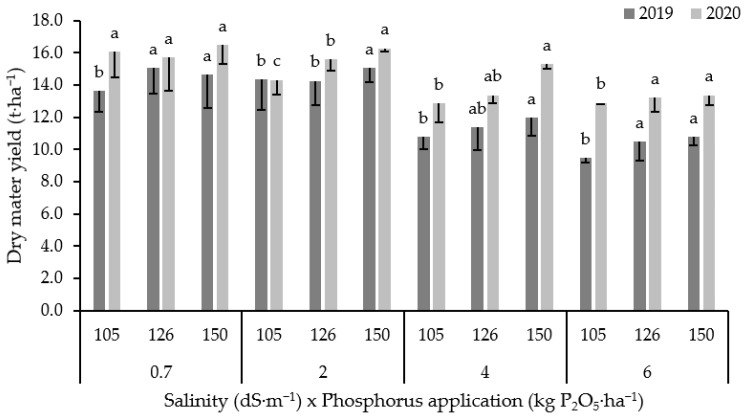
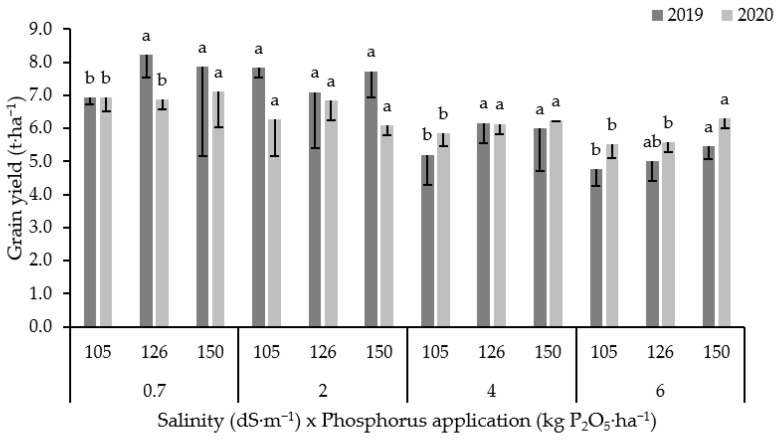
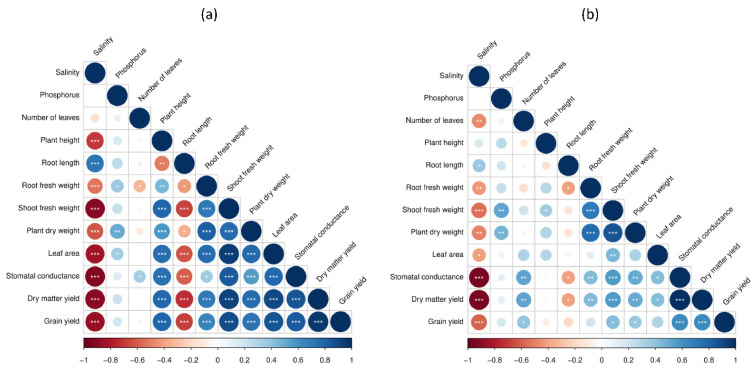
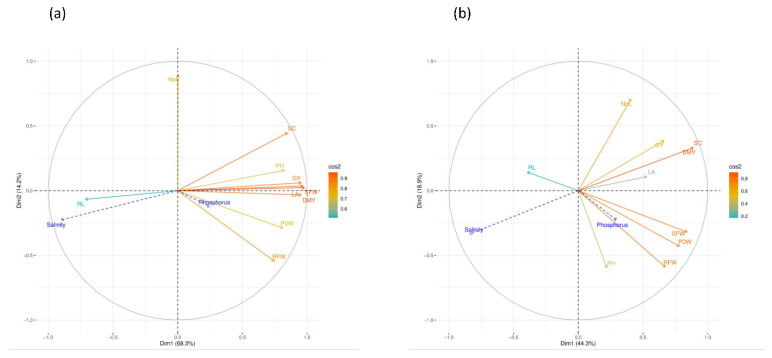
Salinity is a major problem affecting crop production in many regions in the world including Morocco. Agricultural practices such as fertilization could be useful to overcome this problem and improve crop productivity. The objective of our study was to evaluate the combined effect of phosphorus fertilization and irrigation water salinity on growth, yield, and stomatal conductance of forage corn ( L.) cv. "Sy sincerro". Field experiments were carried out for two years testing four levels of irrigation water salinity (ECw = 0.7; 2, 4, and 6 dS·m) and three rates of phosphorus (105, 126, and 150 kg PO·ha) fertilization conducted in a split-plot design with three replications. The obtained results show that irrigation water salinity had a negative effect on all monitored parameters. For instance, the dry matter yield reduced by an average of 19.3 and 25.1% compared to the control under saline irrigation with an EC value equal to 4 and 6 dS·m, respectively. The finding also showed that phosphorus applications tend to increase root weight, root length, stem length, leaf stomatal conductance, grain yield and dry matter yield under salinity conditions. For example, the addition of phosphorus with a rate of 126 and 150 kg PO·ha respectively improved dry matter yield by an average of 4 and 9% under low salinity level (ECw = 2 dS·m), by 4 and 15% under medium salinity (4 dS·m), and by 6 and 8% under a high salinity level (6 dS·m). Our finding suggests that supplementary P application could be one of the best practices to reduce the adverse effects of high salinity on growth and development of forage corn.
盐度是影响包括摩洛哥在内的世界许多地区作物生产的一个主要问题。施肥等农业措施可能有助于克服这一问题并提高作物生产力。我们研究的目的是评估磷肥和灌溉水盐度对饲用玉米(品种为“Sy sincerro”)生长、产量和气孔导度的综合影响。进行了为期两年的田间试验,测试了四个灌溉水盐度水平(ECw = 0.7、2、4和6 dS·m)以及三种磷肥施用量(105、126和150 kg P₂O₅·ha),试验采用裂区设计,重复三次。所得结果表明,灌溉水盐度对所有监测参数均有负面影响。例如,与对照相比,在EC值分别为4和6 dS·m的咸水灌溉条件下,干物质产量平均降低了19.3%和25.1%。研究结果还表明,在盐度条件下,施用磷肥往往会增加根重、根长、茎长、叶片气孔导度、籽粒产量和干物质产量。例如,在低盐度水平(ECw = 2 dS·m)下,分别施用126和150 kg P₂O₅·ha的磷肥,干物质产量平均提高了4%和9%;在中等盐度(4 dS·m)下提高了4%和15%;在高盐度水平(6 dS·m)下提高了6%和8%。我们的研究结果表明,补充施用磷肥可能是减少高盐度对饲用玉米生长和发育不利影响的最佳措施之一。