Department of Cognitive, Linguistic, and Psychological Sciences, Brown University, Providence, Rhode Island, United States of America.
Carney Institute for Brain Science, Brown University, Providence, Rhode Island, United States of America.
PLoS Comput Biol. 2021 Dec 28;17(12):e1009737. doi: 10.1371/journal.pcbi.1009737. eCollection 2021 Dec.
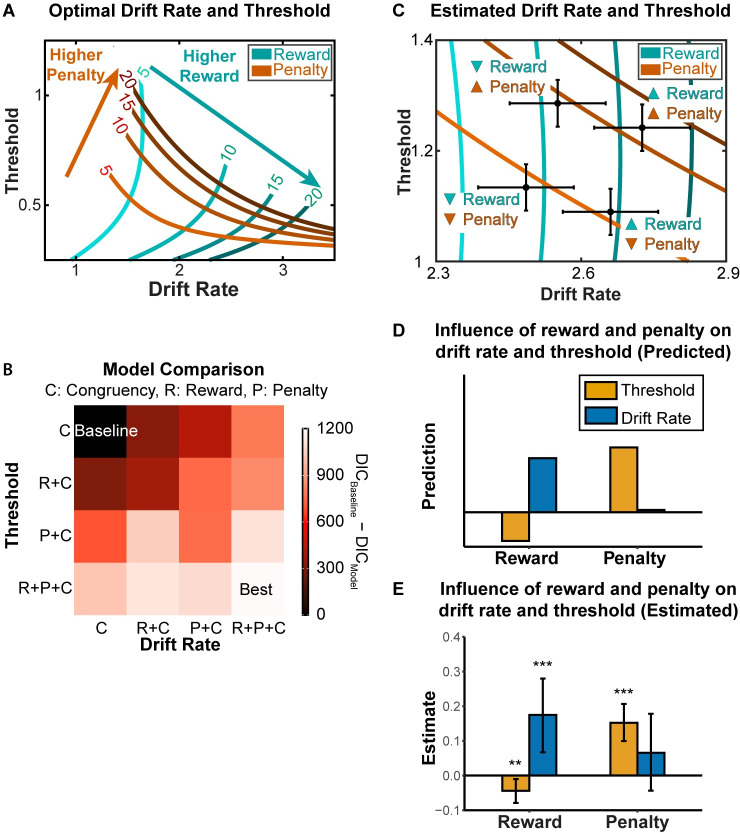
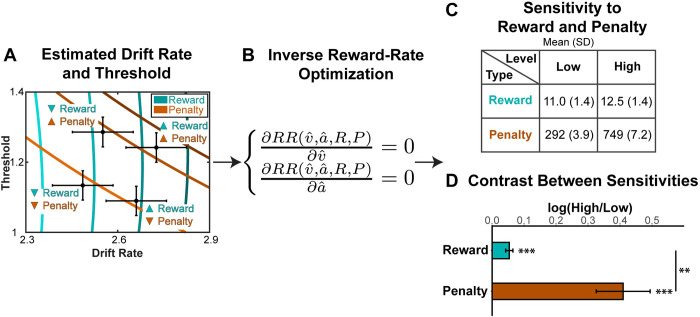
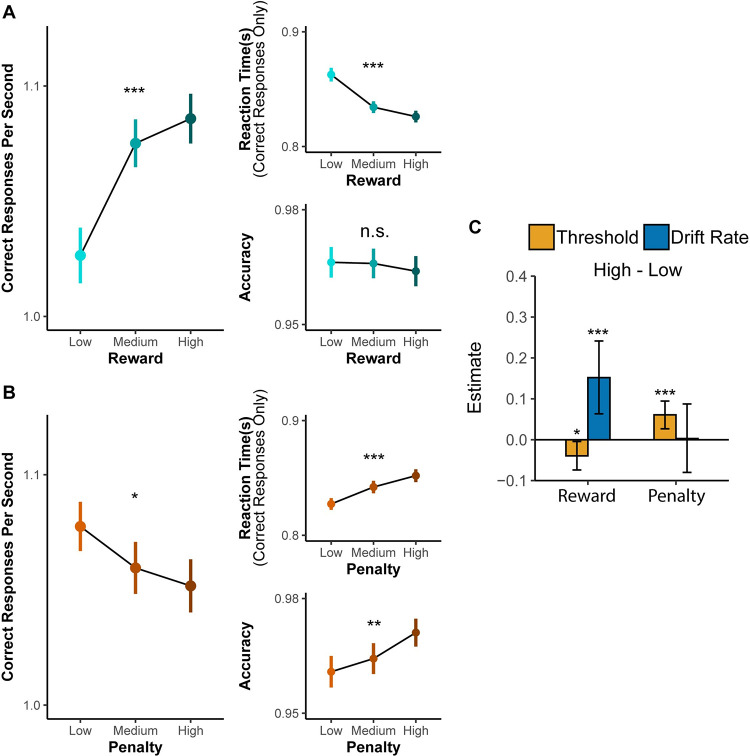
To invest effort into any cognitive task, people must be sufficiently motivated. Whereas prior research has focused primarily on how the cognitive control required to complete these tasks is motivated by the potential rewards for success, it is also known that control investment can be equally motivated by the potential negative consequence for failure. Previous theoretical and experimental work has yet to examine how positive and negative incentives differentially influence the manner and intensity with which people allocate control. Here, we develop and test a normative model of control allocation under conditions of varying positive and negative performance incentives. Our model predicts, and our empirical findings confirm, that rewards for success and punishment for failure should differentially influence adjustments to the evidence accumulation rate versus response threshold, respectively. This dissociation further enabled us to infer how motivated a given person was by the consequences of success versus failure.
要投入精力完成任何认知任务,人们必须有足够的动力。虽然之前的研究主要集中在完成这些任务所需的认知控制是如何被成功的潜在奖励所激发的,但人们也知道,控制投入同样可以被失败的潜在负面后果所激发。之前的理论和实验工作尚未研究积极和消极激励因素如何不同地影响人们分配控制的方式和强度。在这里,我们在不同的积极和消极绩效激励条件下开发和测试了一个控制分配的规范模型。我们的模型预测并得到了我们的实证发现的证实,即成功奖励和失败惩罚应分别影响对证据积累率和响应阈值的调整。这种分离进一步使我们能够推断出一个人是如何被成功和失败的后果所激励的。