Department of Epidemiology and Biostatistics, College of Public Health, Zhengzhou University, Zhengzhou, Henan, PR China.
Sun Yat Sen University Sun Yat Sen Univ, Sch Publ Hlth, Dept Epidemiol, Guangzhou 510080, PR China.
J Psychosom Res. 2022 Feb;153:110709. doi: 10.1016/j.jpsychores.2021.110709. Epub 2021 Dec 23.
To evaluate the association between mask wearing practice and the risk of anxiety symptoms during the COVID-19 epidemic among Chinese students aged 12-18 years old.
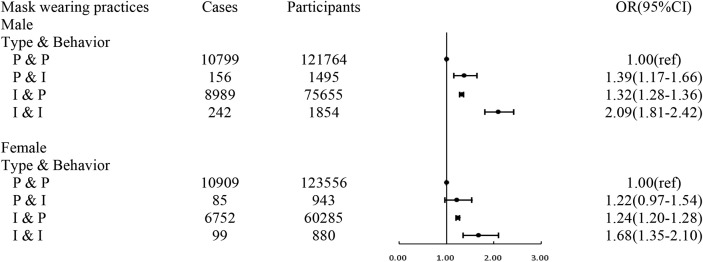
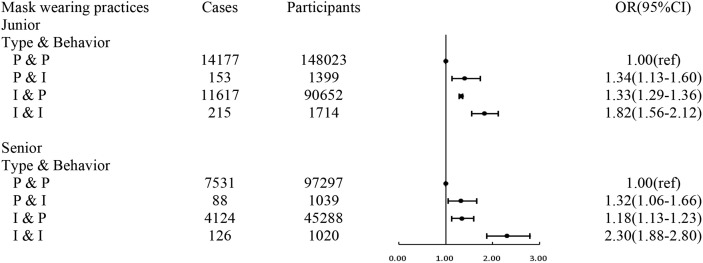
Totally, 386,432 junior and senior high school students were recruited using a cluster sampling method across three cities of Henan Province in China during February 4-12, 2020. Mask wearing practice was defined according to its type and the behavior exhibited in relation to wearing a mask. Presence of anxiety symptoms was determined by Generalized Anxiety Disorder tool (GAD-7). Multiple logistic regression was performed to estimate the association between mask wearing and anxiety symptoms.
Among the participants, compared with students who completely adhered to the all the mask wearing practice, students who did not adhere to all the mask wearing practice had 1.97 times more likely to suffer from anxiety symptoms (adjusted odds ratio (aOR) = 1.97; 95% confidence interval (CI): 1.74-2.22). Furthermore, compared with students who did not know the proper type of mask, students who knew the proper type of mask had a lower risk of anxiety symptoms (aOR = 0.78; 95%CI: 0.76-0.80). Students who adhered to proper behavior of mask wearing was associated with 34% decreased odds for anxiety symptoms (aOR = 0.68; 95%CI: 0.62-0.74).
To conclude, proper mask wearing may be an important attribute that play a significant role in reducing the risk of anxiety symptoms among junior and senior school student. However, since this study is a cross-sectional study, prospective studies are needed to further verify.
评估在 COVID-19 疫情期间,中国 12-18 岁学生戴口罩行为与焦虑症状风险之间的关系。
采用整群抽样方法,于 2020 年 2 月 4 日-12 日在河南省三个城市招募了 386432 名初中和高中学生。根据口罩类型和佩戴口罩行为来定义戴口罩行为。采用广泛性焦虑障碍量表(GAD-7)来确定是否存在焦虑症状。采用多因素 logistic 回归来评估戴口罩与焦虑症状之间的关系。
在参与者中,与完全遵守所有戴口罩行为的学生相比,不遵守所有戴口罩行为的学生患焦虑症状的风险高 1.97 倍(调整优势比(aOR)=1.97;95%置信区间(CI):1.74-2.22)。此外,与不知道正确口罩类型的学生相比,知道正确口罩类型的学生患焦虑症状的风险较低(aOR=0.78;95%CI:0.76-0.80)。遵守正确佩戴口罩行为的学生患焦虑症状的风险降低了 34%(aOR=0.68;95%CI:0.62-0.74)。
总之,正确佩戴口罩可能是降低初中和高中生焦虑症状风险的一个重要因素。但是,由于本研究为横断面研究,需要进一步开展前瞻性研究来验证。