Department of Epidemiology and Health Statistics, College of Public Health, Zhengzhou University, 100, Science Avenue, Gaoxin District, Zhengzhou, Henan 450001, PR China.
Department of Epidemiology and Health Statistics, College of Public Health, Zhengzhou University, 100, Science Avenue, Gaoxin District, Zhengzhou, Henan 450001, PR China; Department of Science and Laboratory Technology, Dar es salaam Institute of Technology, P.O. Box 2958, Dar es Salaam, Tanzania.
J Affect Disord. 2021 Feb 15;281:574-580. doi: 10.1016/j.jad.2020.11.113. Epub 2020 Nov 25.
There is a limited information on mask wearing in relation to anxiety. The aim of this study was to evaluate the association between mask wearing practice and the risk of anxiety during the COVID-19 epidemic among teachers in Henan province, China.
We enrolled 88,611 teachers in an online cross-sectional survey across three cities of Henan Province in China. A total of 94.75% of study participants completed an online questionnaire between February 4, 2020 and February 12, 2020. Mask wearing practice was defined according to its type, how it is worn, and the behavior exhibited in relation to wearing a mask. We used the Generalized Anxiety Disorder tool (GAD-7) to assess anxiety levels among study participants. Odds ratios (OR) with 95% confidence intervals (CI) were used to estimate the association between mask wearing practice and anxiety by using multivariable logistic regression models.
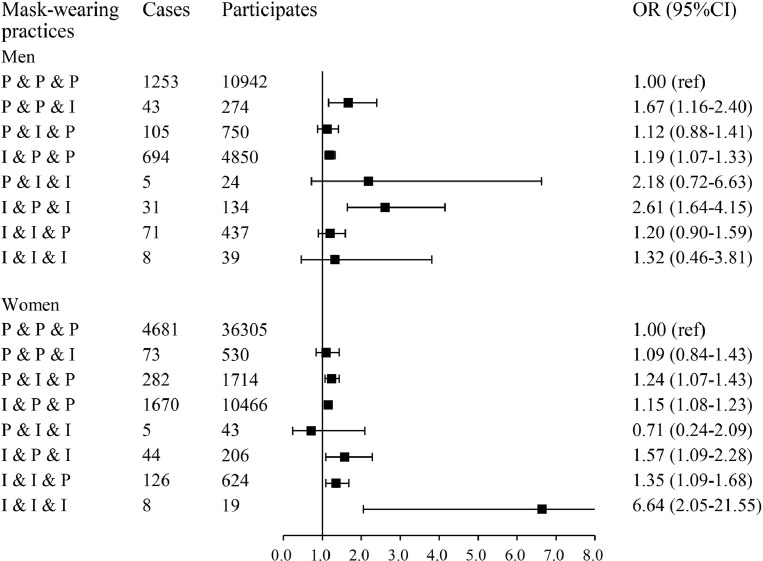
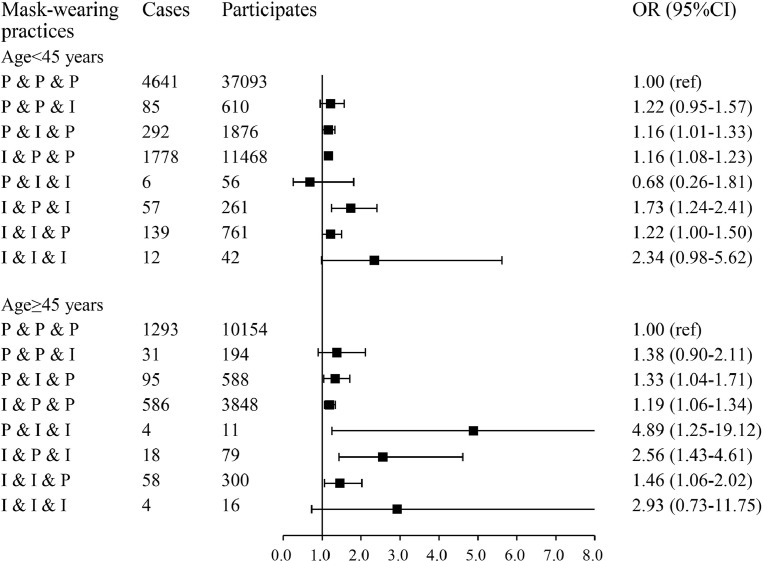
A total of 67,357 registered teachers (25.91% men) were included in this study. After adjusting for potential confounders, participants who knew the wrong type of mask had 17% increased odds of having anxiety compared to those who knew the proper type (Aor = 1.17; 95%CI: 1.11-1.24). Odds for anxiety were higher for teachers who did not know the proper way of wearing mask compared to those who knew it properly (aOR = 1.18; 95%CI: 1.07-1.30). Not adhering to proper behavior of mask wearing was associated with 39% increased odds for anxiety (aOR = 1.39; 95%CI: 1.18-1.64). The odds for anxiety for teachers who did not adhere to all the three parameters of proper mask wearing was about 2.55 times as much compared to those who reported full compliance to the parameters (aOR = 2.55; 95%CI: 1.22-5.35). We observed similar ORs on stratified analyses across gender and age groups.
Our findings suggest that improper mask wearing is another important attribute that play a significant role in increasing the risk of anxiety during the COVID-19 epidemic situation. However, these results should be considered as exploratory and hence interpreted with caution.
关于戴口罩与焦虑之间的关系,相关信息有限。本研究的目的是评估在中国河南省,教师在 COVID-19 疫情期间戴口罩的实践与焦虑风险之间的关联。
我们在中国河南省的三个城市进行了一项在线横断面调查,共招募了 88611 名教师。共有 94.75%的研究参与者于 2020 年 2 月 4 日至 2 月 12 日之间完成了在线问卷调查。口罩佩戴实践是根据其类型、佩戴方式以及佩戴口罩时的行为来定义的。我们使用广泛性焦虑障碍量表(GAD-7)评估研究参与者的焦虑水平。使用多变量逻辑回归模型,通过比值比(OR)及其 95%置信区间(CI)来估计口罩佩戴实践与焦虑之间的关联。
共有 67357 名注册教师(25.91%为男性)纳入本研究。在调整了潜在混杂因素后,与知道正确口罩类型的参与者相比,知道错误口罩类型的参与者出现焦虑的几率增加了 17%(AOR=1.17;95%CI:1.11-1.24)。与正确佩戴口罩的教师相比,不知道正确佩戴方式的教师出现焦虑的几率更高(aOR=1.18;95%CI:1.07-1.30)。不遵守正确的口罩佩戴行为与焦虑风险增加 39%相关(aOR=1.39;95%CI:1.18-1.64)。与报告完全遵守佩戴参数的教师相比,不遵守适当口罩佩戴的三个参数的教师出现焦虑的几率大约高出 2.55 倍(aOR=2.55;95%CI:1.22-5.35)。在按性别和年龄组进行的分层分析中,我们观察到了相似的 OR。
我们的研究结果表明,不正确的口罩佩戴是另一个在 COVID-19 疫情期间增加焦虑风险的重要因素。然而,这些结果应该被视为探索性的,因此应谨慎解释。