Department of Mathematics and Geosciences, University of Trieste, Trieste, Italy.
DAI, Emergenza Urgenza ed Accettazione, Azienda Sanitaria Universitaria Integrata di Trieste, Trieste, Italy.
J Clin Monit Comput. 2022 Oct;36(5):1499-1508. doi: 10.1007/s10877-021-00792-z. Epub 2021 Dec 29.
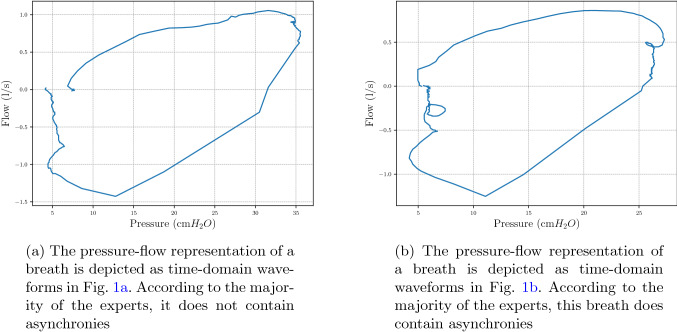
Breathing asynchronies are mismatches between the requests of mechanically ventilated subjects and the support provided by mechanical ventilators. The most widespread technique in identifying these pathological conditions is the visual analysis of the intra-tracheal pressure and flow time-trends. This work considers a recently introduced pressure-flow representation technique and investigates whether it can help nurses in the early detection of anomalies that can represent asynchronies. Twenty subjects-ten Intensive Care Unit (ICU) nurses and ten persons inexperienced in medical practice-were asked to find asynchronies in 200 breaths pre-labeled by three experts. The new representation increases significantly the detection capability of the subjects-average sensitivity soared from 0.622 to 0.905-while decreasing the classification time-from 1107.0 to 567.1 s on average-at the price of a not statistically significant rise in the number of wrong identifications-specificity average descended from 0.589 to 0.52. Moreover, the differences in experience between the nurse group and the inexperienced group do not affect the sensitivity, specificity, or classification times. The pressure-flow diagram significantly increases sensitivity and decreases the response time of early asynchrony detection performed by nurses. Moreover, the data suggest that operator experience does not affect the identification results. This outcome leads us to believe that, in emergency contexts with a shortage of nurses, intensive care nurses can be supplemented, for the sole identification of possible respiratory asynchronies, by inexperienced staff.
呼吸不同步是指机械通气患者的需求与机械通气提供的支持之间不匹配。识别这些病理情况最广泛的技术是对气管内压力和流量时间趋势进行视觉分析。这项工作考虑了一种新引入的压力-流量表示技术,并研究了它是否可以帮助护士早期发现可能表示不同步的异常。二十名受试者——十名重症监护病房(ICU)护士和十名非医疗实践经验的人员——被要求在由三名专家预先标记的 200 次呼吸中找出不同步的情况。新的表示方法显著提高了受试者的检测能力——平均敏感性从 0.622 飙升至 0.905——同时降低了分类时间——平均从 1107.0 秒降至 567.1 秒——但错误识别的数量略有增加,特异性平均从 0.589 降至 0.52。此外,护士组和非经验组之间经验的差异并不影响敏感性、特异性或分类时间。压力-流量图显著提高了敏感性,并缩短了护士进行早期不同步检测的响应时间。此外,数据表明操作员经验不会影响识别结果。这一结果使我们相信,在护士短缺的紧急情况下,为了仅识别可能的呼吸不同步,经验不足的人员可以补充重症监护病房护士。