Clinical Trials and Statistics Unit (ICR-CTSU)- Division of Clinical Studies, The Institute of Cancer Research, London, United Kingdom.
Department of Genetics, University of North Carolina at Chapel Hill, Chapel Hill, North Carolina.
Clin Cancer Res. 2022 Mar 15;28(6):1217-1228. doi: 10.1158/1078-0432.CCR-21-2718.
Aromatase inhibitor (AI) treatment is the standard of care for postmenopausal women with primary estrogen receptor-positive breast cancer. The impact of duration of neoadjuvant endocrine therapy (NET) on molecular characteristics is still unknown. We evaluated and compared changes of gene expression profiles under short-term (2-week) versus longer-term neoadjuvant AIs.
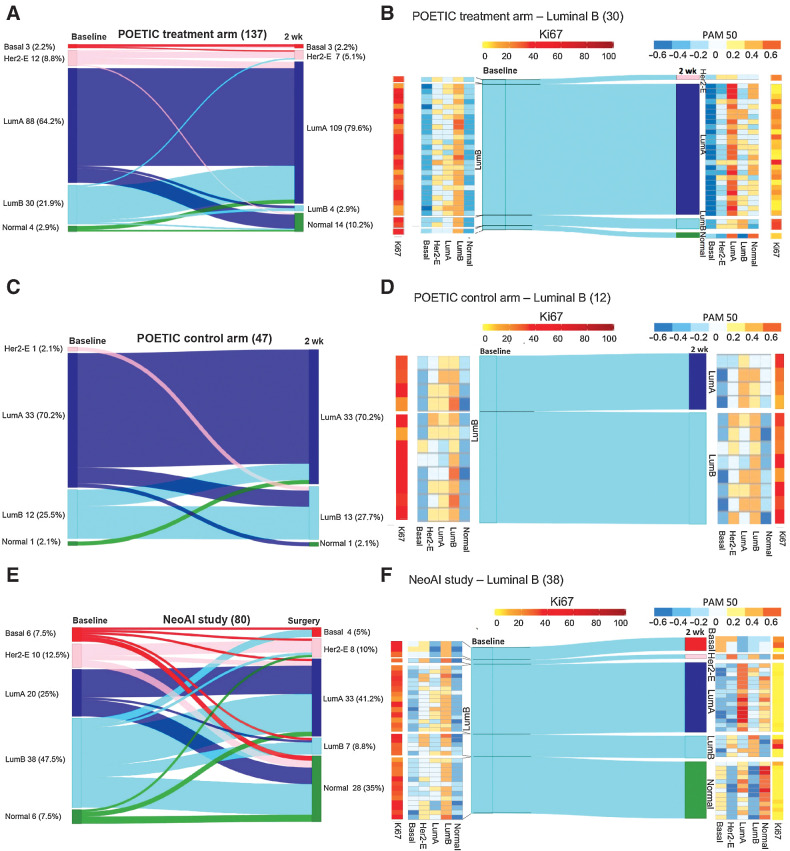
Global gene expression profiles from the PeriOperative Endocrine Therapy for Individualised Care (POETIC) trial (137 received 2 weeks of AIs and 47 received no treatment) and targeted gene expression from 80 patients with breast cancer treated with NET for more than 1 month (NeoAI) were assessed. Intrinsic subtyping, module scores covering different cancer pathways and immune-related genes were calculated for pretreated and posttreated tumors.
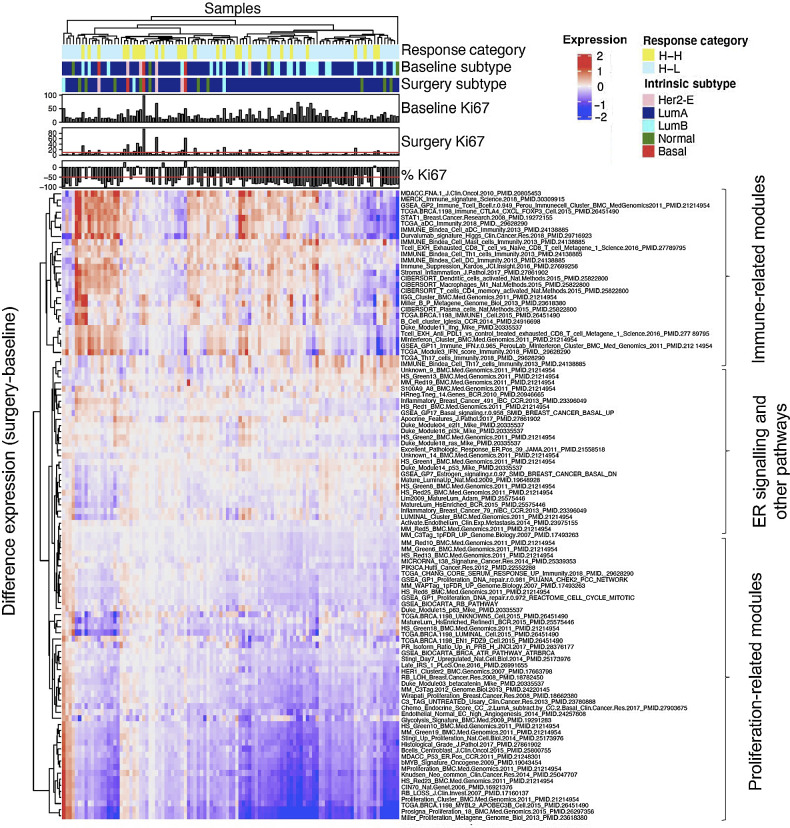
The differences in intrinsic subtypes after NET were comparable between the two cohorts, with most Luminal B (90.0% in the POETIC trial and 76.3% in NeoAI) and 50.0% of HER2 enriched at baseline reclassified as Luminal A or normal-like after NET. Downregulation of proliferative-related pathways was observed after 2 weeks of AIs. However, more changes in genes from cancer-signaling pathways such as MAPK and PI3K/AKT/mTOR and immune response/immune-checkpoint components that were associated with AI-resistant tumors and differential outcome were observed in the NeoAI study.
Tumor transcriptional profiles undergo bigger changes in response to longer NET. Changes in HER2-enriched and Luminal B subtypes are similar between the two cohorts, thus AI-sensitive intrinsic subtype tumors associated with good survival might be identified after 2 weeks of AI. The changes of immune-checkpoint component expression in early AI resistance and its impact on survival outcome warrants careful investigation in clinical trials.
芳香化酶抑制剂(AI)治疗是绝经后雌激素受体阳性乳腺癌患者的标准治疗方法。新辅助内分泌治疗(NET)持续时间对分子特征的影响尚不清楚。我们评估并比较了短期(2 周)与长期新辅助 AI 治疗下基因表达谱的变化。
评估了来自围手术期个体化内分泌治疗(POETIC)试验(137 例接受 2 周 AI 治疗,47 例未接受治疗)的全基因表达谱和 80 例接受 NET 治疗超过 1 个月(NeoAI)的乳腺癌患者的靶向基因表达谱。计算了预处理和后处理肿瘤的固有亚型、涵盖不同癌症途径和免疫相关基因的模块评分。
NET 后固有亚型的差异在两个队列中相似,大多数 Luminal B(POETIC 试验中为 90.0%,NeoAI 中为 76.3%)和 50.0%的 HER2 富集在基线时重新分类为 Luminal A 或正常样,NET 后。在用 AI 治疗 2 周后观察到与增殖相关的途径下调。然而,在 NeoAI 研究中观察到更多来自癌症信号通路(如 MAPK 和 PI3K/AKT/mTOR)和免疫反应/免疫检查点成分的基因变化,这些变化与 AI 耐药肿瘤和不同的结果相关。
肿瘤转录谱对更长时间的 NET 反应发生更大的变化。两个队列中 HER2 富集和 Luminal B 亚型的变化相似,因此在用 AI 治疗 2 周后可能识别出与 AI 敏感性固有亚型肿瘤相关的良好生存。早期 AI 耐药中免疫检查点成分表达的变化及其对生存结果的影响值得在临床试验中仔细研究。