
躯体性与认知性抑郁症状作为疑似缺血女性冠心病预测指标的研究:女性缺血综合征评估
Somatic Versus Cognitive Depressive Symptoms as Predictors of Coronary Artery Disease among Women with Suspected Ischemia: The Women's Ischemia Syndrome Evaluation.
作者信息
Emami Ashley S, Bairey Merz C Noel, Eastwood Jo-Ann, Pepine Carl J, Handberg Eileen M, Bittner Vera, Mehta Puja K, Krantz David S, Vaccarino Viola, Eteiba Wafia, Cornell Carol E, Rutledge Thomas
机构信息
Psychology Service, VA San Diego Healthcare System, San Diego, California.
Barbra Streisand Women's Heart Center, Cedars-Sinai Smidt Heart Institute, Los Angeles, California.
出版信息
Heart Mind (Mumbai). 2021 Oct-Dec;5(4):112-118. doi: 10.4103/hm.hm_34_21. Epub 2021 Nov 30.
BACKGROUND
Depression is an established predictor of coronary artery disease (CAD) progression and mortality. "Somatic" symptoms of depression such as fatigue and sleep impairment overlap with symptoms of CAD and independently predict CAD events. Differentiating between "somatic" and "cognitive" depressive symptoms in at-risk patients may improve our understanding of the relationship between depression and CAD.
METHODS
The study utilized data from the Women's Ischemia Syndrome Evaluation. Participants ( = 641; mean age = 58.0 [11.4] years) were enrolled to evaluate chest pain or suspected myocardial ischemia. They completed a battery of symptom and psychological questionnaires (including the Beck Depression Inventory [BDI]) at baseline, along with quantitative coronary angiography and other CAD diagnostic procedures. The BDI provided scores for total depression and for cognitive and somatic depressive symptom subscales.
RESULTS
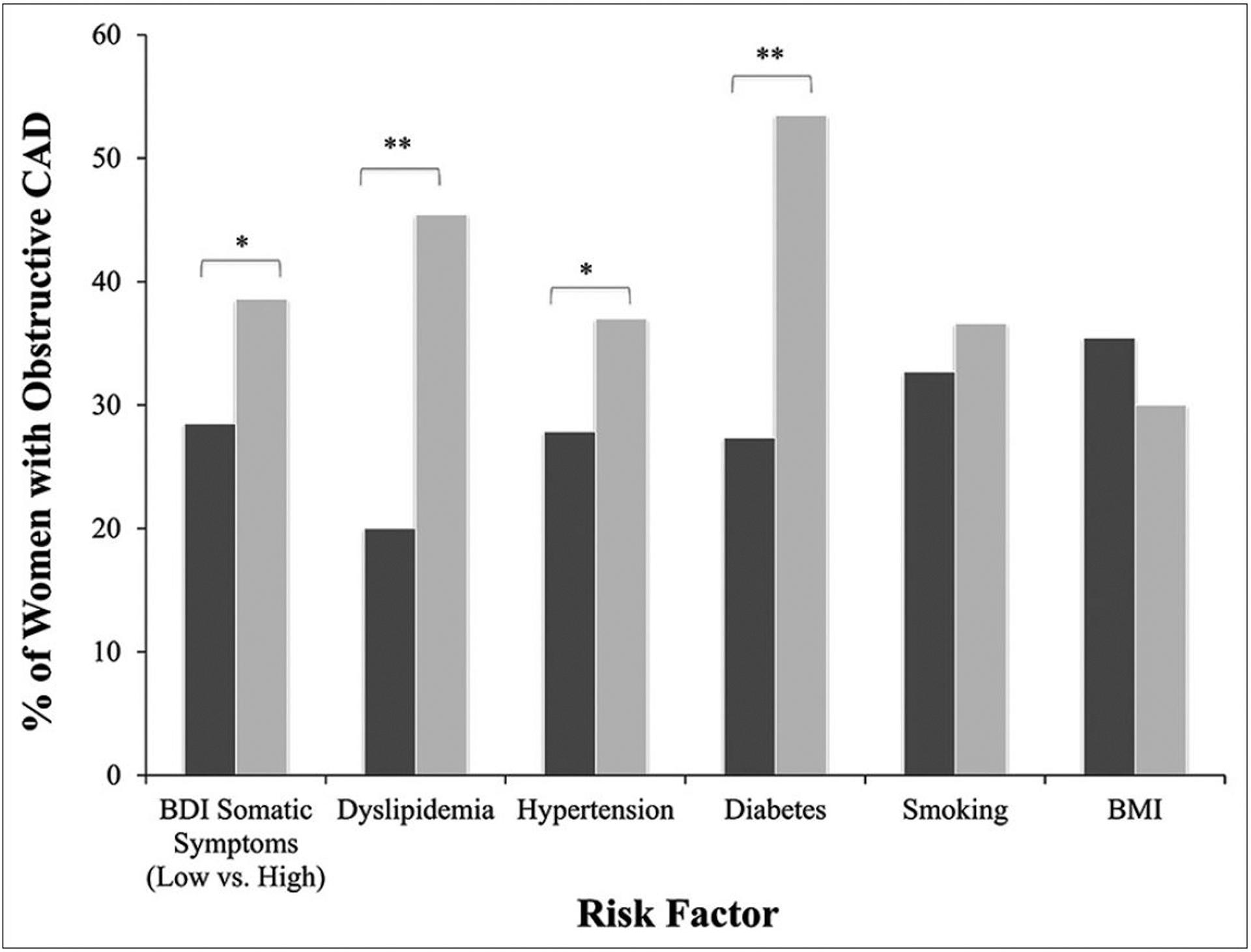
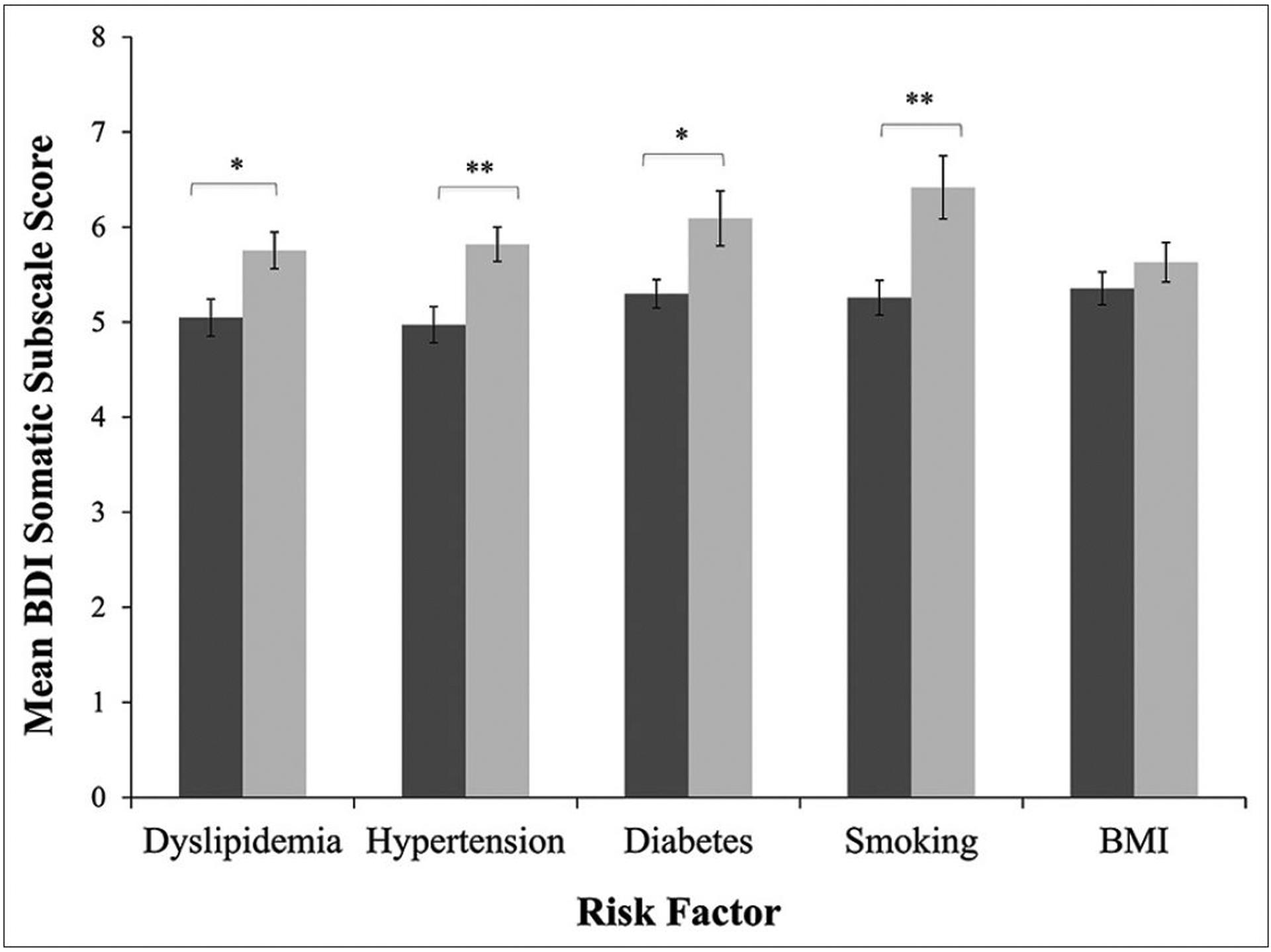
Two hundred and fourteen (33.4%) women met criteria for obstructive CAD. Logistic regression models were used to examine relationships between depression symptoms and obstructive CAD. Neither BDI total scores (odds ratio [OR] =1.02, 95% confidence interval [CI], 0.99-1.05, = 0.053) nor BDI cognitive scores (OR = 1.02, 95% CI, 1.00-1.04, = 0.15) predicted CAD status. BDI somatic symptom scores, however, significantly predicted CAD status and remained statistically significant after controlling for age, race, and education (OR = 1.06, 95% CI, 1.01-1.12, = 0.02).
CONCLUSION
Among women with suspected myocardial ischemia, somatic but not cognitive depressive symptoms predicted an increased risk of obstructive CAD determined by coronary angiography. Consistent with prior reports, these results suggest a focus on somatic rather than cognitive depressive symptoms could offer additional diagnostic information.
背景
抑郁症是冠状动脉疾病(CAD)进展和死亡率的既定预测指标。抑郁症的“躯体”症状,如疲劳和睡眠障碍,与CAD症状重叠,并独立预测CAD事件。区分高危患者的“躯体”和“认知”抑郁症状可能会增进我们对抑郁症与CAD之间关系的理解。
方法
本研究利用了女性缺血综合征评估的数据。参与者(n = 641;平均年龄 = 58.0 [11.4]岁)入选以评估胸痛或疑似心肌缺血。他们在基线时完成了一系列症状和心理问卷(包括贝克抑郁量表[BDI]),以及定量冠状动脉造影和其他CAD诊断程序。BDI提供了总抑郁得分以及认知和躯体抑郁症状子量表的得分。
结果
214名(33.4%)女性符合阻塞性CAD的标准。使用逻辑回归模型来检验抑郁症状与阻塞性CAD之间的关系。BDI总分(优势比[OR] = 1.02,95%置信区间[CI],0.99 - 1.05,P = 0.053)和BDI认知得分(OR = 1.02,95% CI,1.00 - 1.04,P = 0.15)均未预测CAD状态。然而,BDI躯体症状得分显著预测了CAD状态,并且在控制年龄、种族和教育程度后仍具有统计学意义(OR = 1.06,95% CI,1.01 - 1.12,P = 0.02)。
结论
在疑似心肌缺血的女性中,躯体而非认知抑郁症状预测了冠状动脉造影确定的阻塞性CAD风险增加。与先前的报告一致,这些结果表明关注躯体而非认知抑郁症状可能会提供额外的诊断信息。

 Zotero 插件