Department of Radiology, Second Affiliated Hospital, School of Medicine, Zhejiang University, Hangzhou, China.
Department of Neurology, Epilepsy Center, Second Affiliated Hospital, School of Medicine, Zhejiang University, Hangzhou, China.
Hum Brain Mapp. 2022 Apr 15;43(6):1917-1929. doi: 10.1002/hbm.25763. Epub 2021 Dec 30.
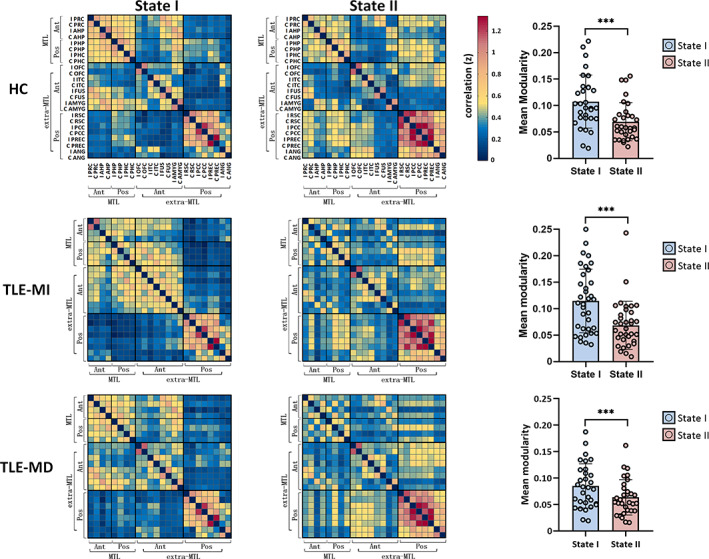
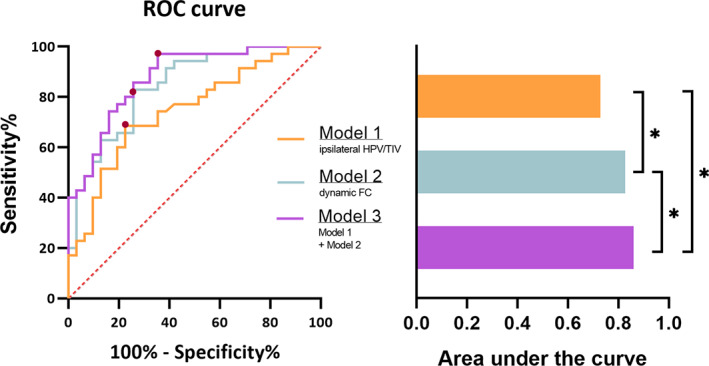
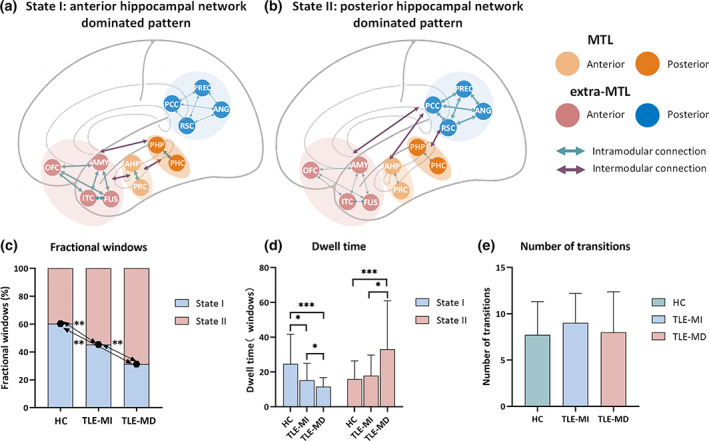
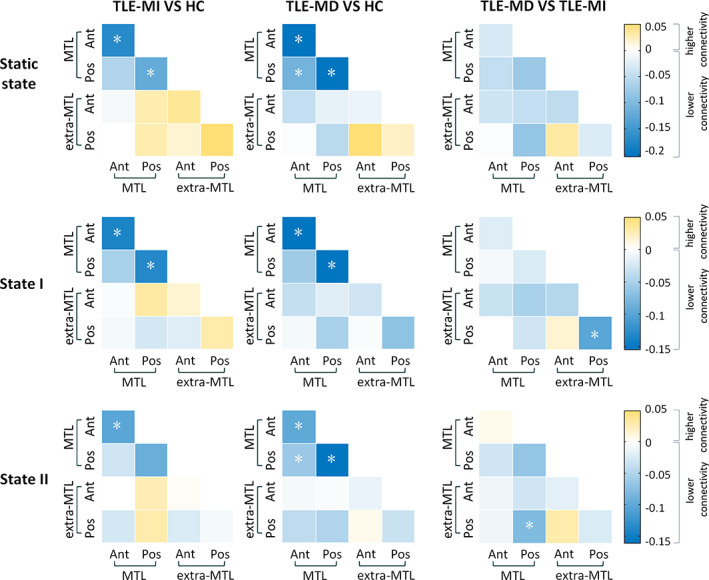
Temporal lobe epilepsy (TLE) is a network disorder with a high incidence of memory impairment. Memory processing ability highly depends on the dynamic coordination between distinct modules within the hippocampal network. Here, we investigate the relationship between memory phenotypes and modular alterations of dynamic functional connectivity (FC) in the hippocampal network in TLE patients. Then, 31 healthy controls and 66 TLE patients with hippocampal sclerosis were recruited. The patients were classified into memory-intact (MI, 35 cases) group and memory-deficit (MD, 31 cases) group, each based on individual's Wechsler Memory Scale-Revised score. The sliding-windows approach and graph theory analysis were used to analyze the hippocampal network based on resting state functional magnetic resonance imaging. Temporal properties and modular metrics were calculated. Two discrete and switchable states were revealed: a high modularized state (State I) and a low modularized state (State II), which corresponded to either anterior or posterior hippocampal network dominated pattern. TLE was prone to drive less State I but more State II, and the tendency was more obvious in TLE-MD. Additionally, TLE-MD showed more widespread alterations of modular properties compared with TLE-MI across two states. Furthermore, the dynamic modularity features had unique superiority in discriminating TLE-MD from TLE-MI. These findings demonstrated that state transitions and modular function of dissociable hippocampal networks were altered in TLE and more importantly, they could reflect different memory phenotypes. The trend revealed potential values of dynamic FC in elucidating the mechanism underlying memory impairments in TLE.
颞叶癫痫(TLE)是一种具有高发病率的记忆障碍的网络障碍。记忆处理能力高度依赖于海马网络中不同模块之间的动态协调。在这里,我们研究了 TLE 患者海马网络中记忆表型与动态功能连接(FC)模块改变之间的关系。然后,招募了 31 名健康对照者和 66 名海马硬化的 TLE 患者。根据个体的韦氏记忆量表修订版评分,将患者分为记忆完好(MI,35 例)组和记忆缺损(MD,31 例)组。使用滑动窗口方法和图论分析基于静息状态功能磁共振成像来分析海马网络。计算了时间特性和模块度量。揭示了两种离散且可切换的状态:高模块化状态(State I)和低模块化状态(State II),分别对应于前或后海马网络主导模式。TLE 更倾向于驱动较少的 State I 但更多的 State II,并且这种趋势在 TLE-MD 中更为明显。此外,与 TLE-MI 相比,TLE-MD 在两个状态下表现出更广泛的模块特性改变。此外,动态模块特征在区分 TLE-MD 和 TLE-MI 方面具有独特的优势。这些发现表明,TLE 中分离的海马网络的状态转换和模块功能发生了改变,更重要的是,它们可以反映不同的记忆表型。该趋势揭示了动态 FC 在阐明 TLE 中记忆障碍机制方面的潜在价值。