Department of Orthopaedic Surgery, Kristiansund Hospital, Kristiansund, Norway.
Department of Neuromedicine and Movement Science, Faculty of Medicine and Health Science, Norwegian University of Science and Technology, Trondheim, Norway.
Bone Joint J. 2022 Jan;104-B(1):19-26. doi: 10.1302/0301-620X.104B1.BJJ-2021-0325.R2.
Highly polished stems with force-closed design have shown satisfactory clinical results despite being related to relatively high early migration. It has been suggested that the minimal thickness of cement mantles surrounding the femoral stem should be 2 mm to 4 mm to avoid aseptic loosening. The line-to-line cementing technique of the femoral stem, designed to achieve stem press-fit, challenges this opinion. We compared the migration of a highly polished stem with force-closed design by standard and line-to-line cementing to investigate whether differences in early migration of the stems occur in a clinical study.
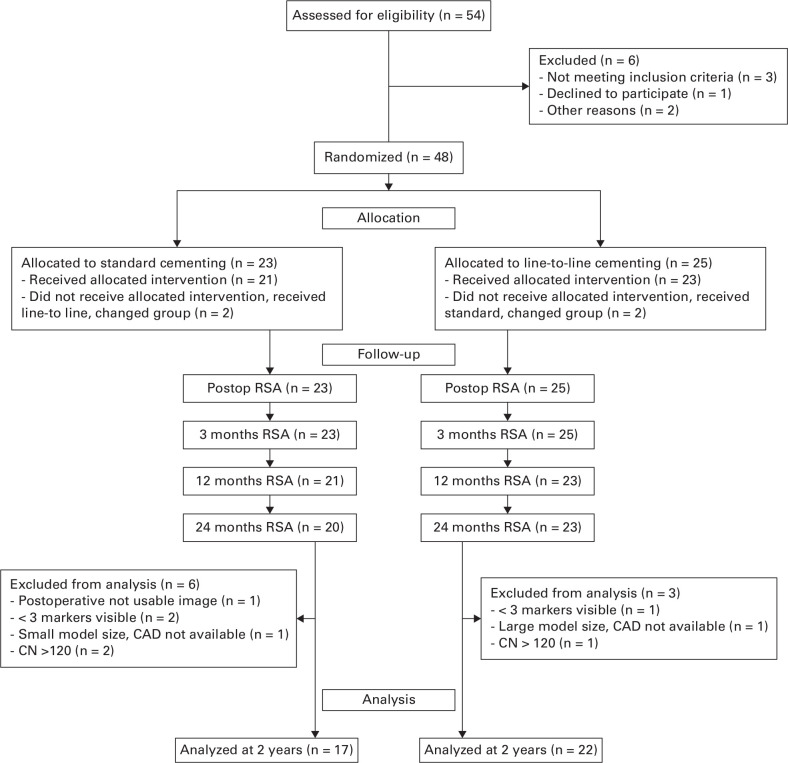
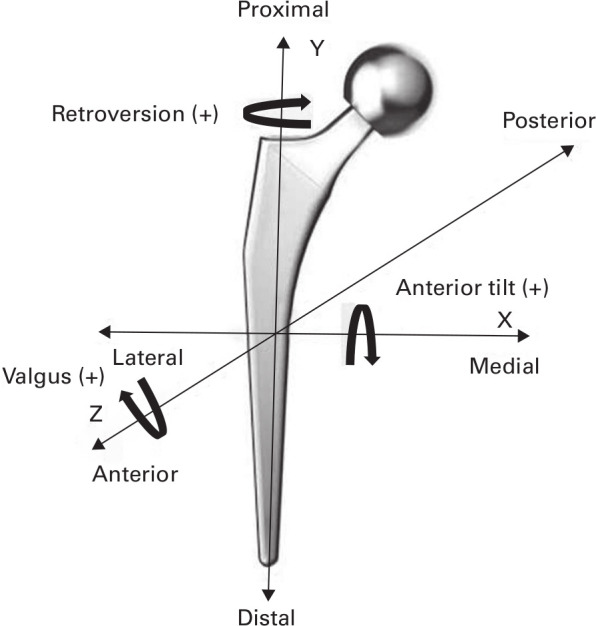
In this single-blind, randomized controlled, clinical radiostereometric analysis (RSA) study, the migration pattern of the cemented Corail hip stem was compared between line-to-line and standard cementing in 48 arthroplasties. The primary outcome measure was femoral stem migration in terms of rotation and translation around and along with the X-, Y-, and Z- axes measured using model-based RSA at three, 12, and 24 months. A linear mixed-effects model was used for statistical analysis.
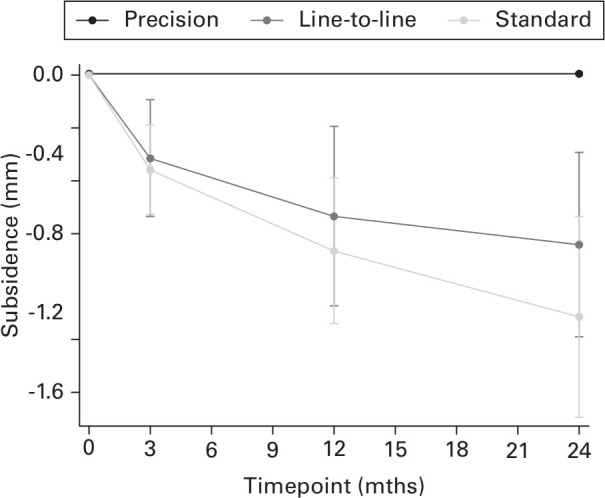
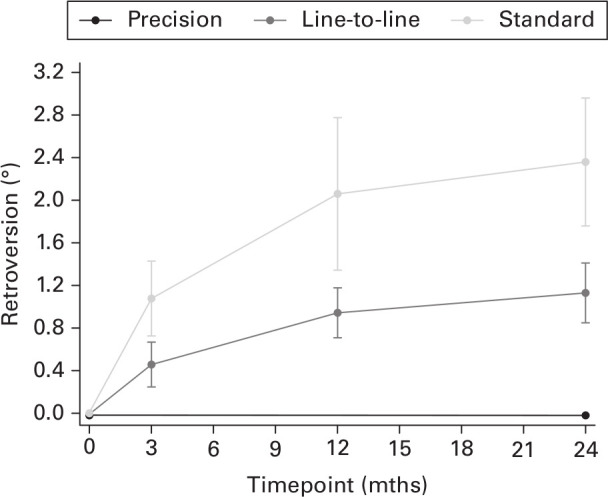
Results from mixed model analyses revealed a lower mean retroversion for line-to-line (0.72° (95% confidence interval (CI) 0.38° to 1.07°; p < 0.001), but no significant differences in subsidence between the techniques (-0.15 mm (95% CI -0.53 to 0.227; p = 0.429) at 24 months. Radiolucent lines measuring < 2 mm wide were found in three and five arthroplasties cemented by the standard and line-to-line method, respectively.
The cemented Corail stem with a force-closed design seems to settle earlier and better with the line-to-line cementing method, although for subsidence the difference was not significant. However, the lower rate of migration into retroversion may reduce the wear and cement deformation, contributing to good long-term fixation and implant survival. Cite this article: 2022;104-B(1):19-26.
具有力封闭设计的高度抛光柄已显示出令人满意的临床结果,尽管与相对较高的早期迁移有关。有人认为,股骨柄周围水泥覆盖层的最小厚度应为 2 毫米至 4 毫米,以避免无菌性松动。旨在实现股骨柄压配合的股骨柄线对线水泥技术挑战了这一观点。我们比较了力封闭设计的高度抛光柄的迁移,通过标准和线对线水泥固定,以调查在临床研究中是否会发生柄早期迁移的差异。
在这项单盲、随机对照、临床放射立体测量分析(RSA)研究中,通过线对线和标准水泥固定,比较了 48 例髋关节置换术 Corail 水泥柄的迁移模式。主要观察指标是使用基于模型的 RSA 在 3、12 和 24 个月时测量的 X、Y 和 Z 轴上的旋转和沿旋转和沿旋转的股骨柄迁移。使用线性混合效应模型进行统计分析。
混合模型分析结果显示,线对线组的平均后倾角度较低(0.72°(95%置信区间(CI)0.38°至 1.07°;p<0.001),但两种技术之间的沉降无显著差异(-0.15mm(95%CI-0.53 至 0.227;p=0.429)在 24 个月时。用标准和线对线方法分别在 3 个和 5 个关节置换术中发现宽度<2mm 的透亮线。
具有力封闭设计的 Corail 水泥柄似乎通过线对线水泥固定方法更早、更好地沉降,尽管沉降没有显著差异。然而,较低的向后旋转迁移率可能会减少磨损和水泥变形,有助于良好的长期固定和植入物存活。