
硝基苯类皮肤敏化剂 DNFB 和 DNCB 对 TRPA1 离子通道的选择性激活。
Selective activation of TRPA1 ion channels by nitrobenzene skin sensitizers DNFB and DNCB.
机构信息
Department of Pharmacology, School of Pharmacy, Qingdao University, Qingdao, China.
Department of Pharmacology, School of Pharmacy, Qingdao University, Qingdao, China; Institute of Innovative Drugs, Qingdao University, Qingdao, China.
出版信息
J Biol Chem. 2022 Feb;298(2):101555. doi: 10.1016/j.jbc.2021.101555. Epub 2021 Dec 30.
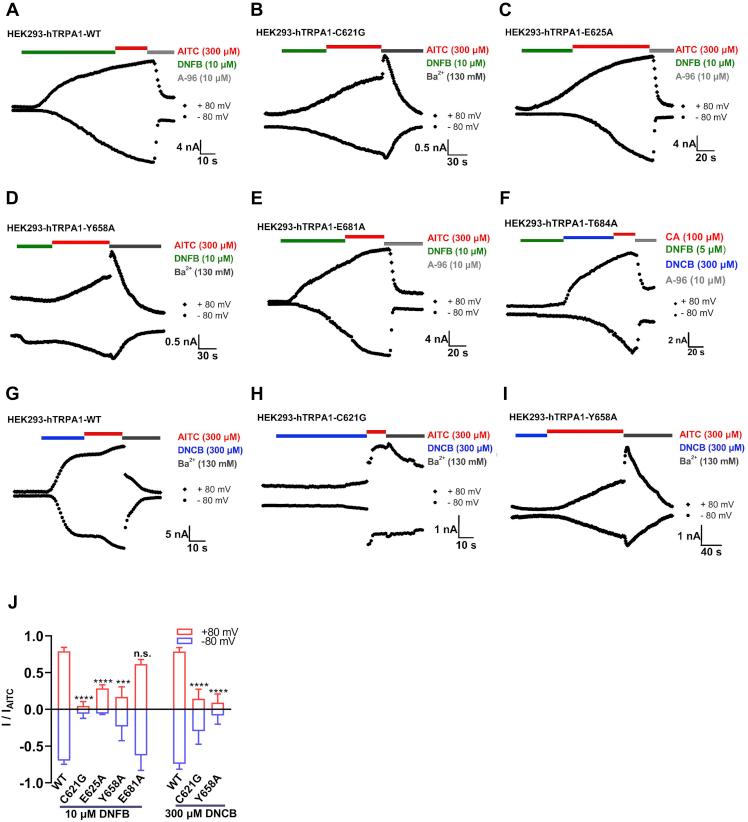
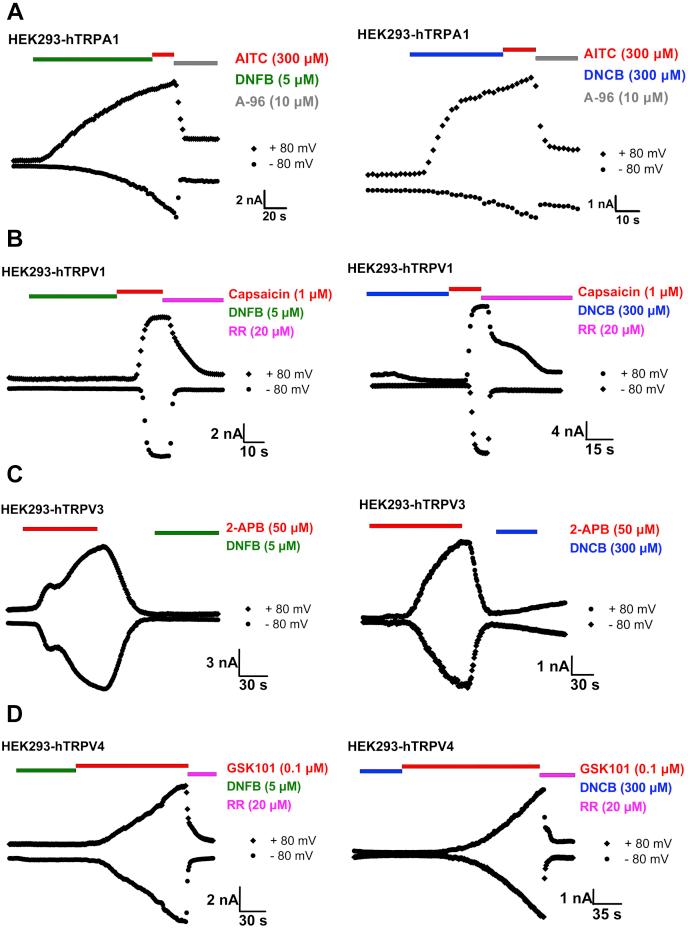
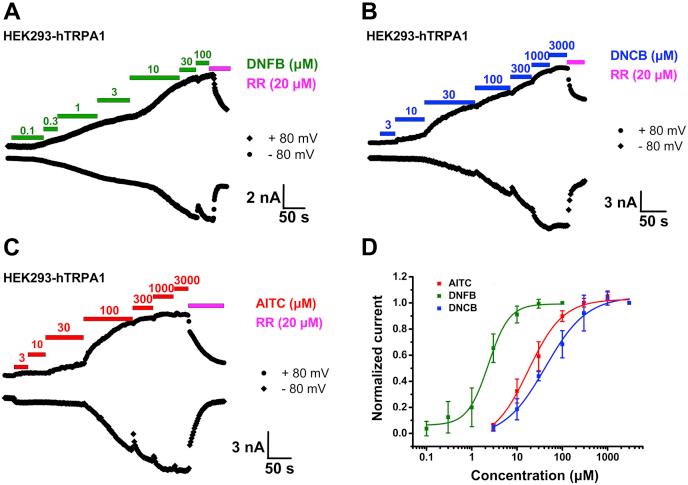
2, 4-dinitrofluorobenzene (DNFB) and 2, 4-dinitrochlorobenzene (DNCB) are well known as skin sensitizers that can cause dermatitis. DNFB has shown to more potently sensitize skin; however, how DNFB and DNCB cause skin inflammation at a molecular level and why this difference in their sensitization ability is observed remain unknown. In this study, we aimed to identify the molecular targets and mechanisms on which DNFB and DNCB act. We used a fluorescent calcium imaging plate reader in an initial screening assay before patch-clamp recordings for validation. Molecular docking in combination with site-directed mutagenesis was then carried out to investigate DNFB and DNCB binding sites in the TRPA1 ion channel that may be selectively activated by these tow sensitizers. We found that DNFB and DNCB selectively activated TRPA1 channel with EC values of 2.3 ± 0.7 μM and 42.4 ± 20.9 μM, respectively. Single-channel recordings revealed that DNFB and DNCB increase the probability of channel opening and act on three residues (C621, E625, and Y658) critical for TRPA1 activation. Our findings may not only help explain the molecular mechanism underlying the dermatitis and pruritus caused by chemicals such as DNFB and DNCB, but also provide a molecular tool 7.5-fold more potent than the current TRPA1 activator allyl isothiocyanate (AITC) used for investigating TRPA1 channel pharmacology and pathology.
2,4-二硝基氟苯(DNFB)和 2,4-二硝基氯苯(DNCB)是众所周知的皮肤敏化剂,可引起皮炎。DNFB 已被证明更有效地敏化皮肤;然而,DNFB 和 DNCB 在分子水平上如何引起皮肤炎症,以及为什么观察到它们致敏能力的这种差异仍然未知。在这项研究中,我们旨在确定 DNFB 和 DNCB 作用的分子靶标和机制。我们在进行膜片钳记录验证之前,使用荧光钙成像板读数器进行了初步筛选测定。然后进行分子对接结合定点突变,以研究 TRPA1 离子通道中可能被这两种敏化剂选择性激活的 DNFB 和 DNCB 结合位点。我们发现 DNFB 和 DNCB 分别以 2.3±0.7 μM 和 42.4±20.9 μM 的 EC 值选择性激活 TRPA1 通道。单通道记录显示,DNFB 和 DNCB 增加了通道开放的概率,并作用于三个关键残基(C621、E625 和 Y658),这些残基对 TRPA1 的激活至关重要。我们的发现不仅有助于解释 DNFB 和 DNCB 等化学物质引起皮炎和瘙痒的分子机制,而且为研究 TRPA1 通道药理学和病理学提供了比目前的 TRPA1 激活剂丙烯基异硫氰酸酯(AITC)强 7.5 倍的分子工具。



 Zotero 插件