Department of Health and Human Physiology, University of Iowa, Iowa City, IA, United States; Department of Kinesiology, Pennsylvania State University, University Park, PA, United States.
Department of Kinesiology, Pennsylvania State University, University Park, PA, United States; Center for Healthy Aging, Pennsylvania State University, University Park, PA, United States.
Pregnancy Hypertens. 2022 Mar;27:81-86. doi: 10.1016/j.preghy.2021.12.010. Epub 2021 Dec 28.
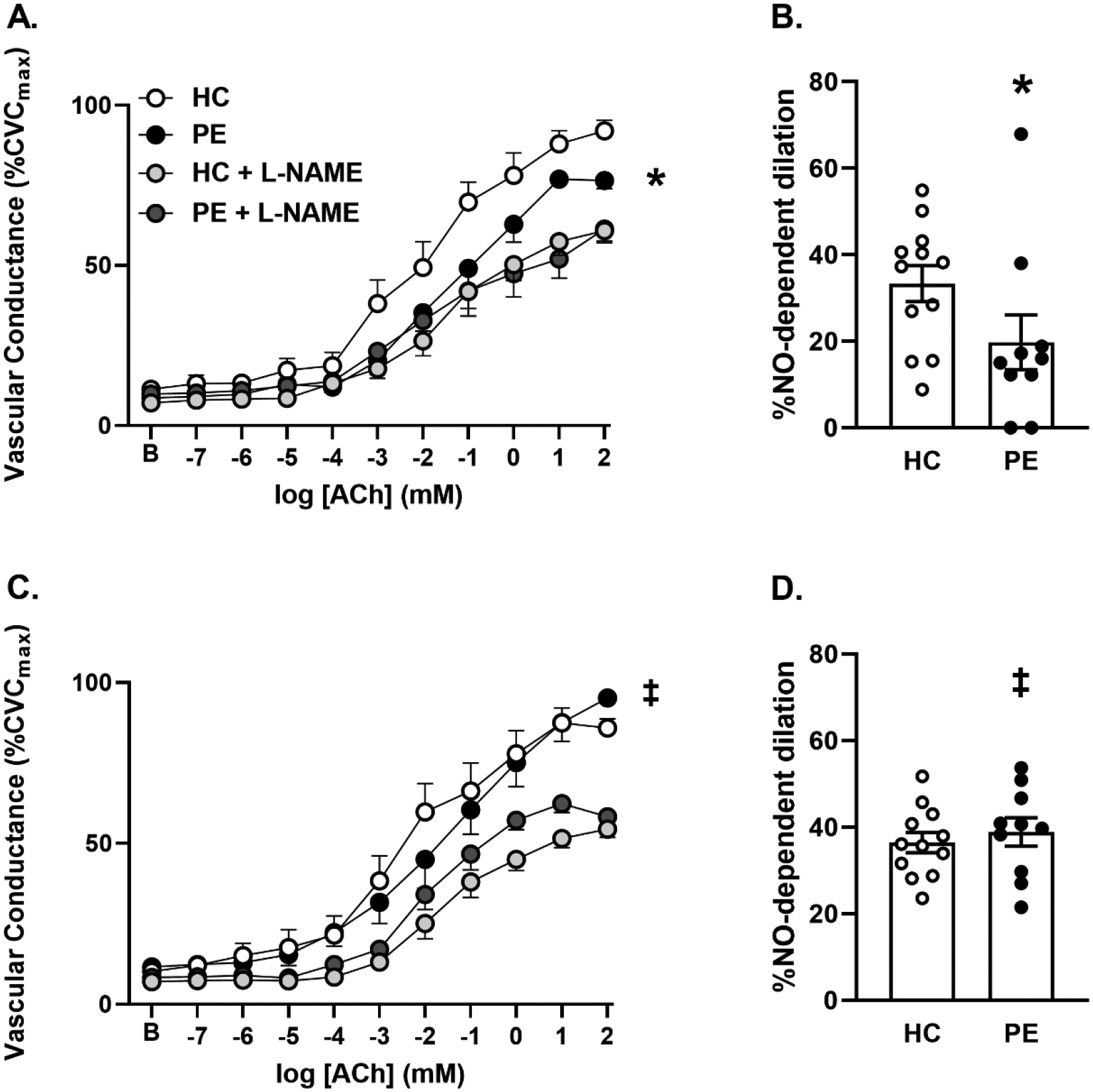
Women who have had preeclampsia demonstrate microvascular endothelial-dysfunction, mediated in part by reduced nitric oxide (NO)-dependent dilation. Preeclamptic pregnancies are associated with elevated inflammation, and inhibition of inflammation attenuates endothelial damage in animal models of preeclampsia. However, it is unclear if inhibition of vascular inflammation improves endothelial function in women after a preeclamptic pregnancy. Using the cutaneous microcirculation as a model, we hypothesized that acute systemic inhibition of vascular inflammation (oral salsalate; 1500 mg/twice daily, 4 days) would improve endothelium- and NO-dependent vasodilation in women with a history of preeclampsia (PE) but not in women with a history of uncomplicated pregnancy (HC). Twelve HC (30 ± 1yrs, 10 ± 2 months postpartum) and 10 PE (30 ± 2yrs, 8 ± 2 months postpartum) participated in a double-blind placebo-controlled study. Following each treatment, 2 intradermal microdialysis fibers were placed in the skin of the ventral forearm for graded infusion of acetylcholine (Ach, 10-10mM) or Ach + 15 mM L-NAME (NO synthase antagonist). Red blood cell flux was measured over each site by laser-Doppler flowmetry (LDF). Cutaneous vascular conductance was calculated (CVC = LDF/mean arterial pressure) and normalized to maximum (%CVC; 28 mM SNP + local heat 43 °C). ACh-induced (77 ± 3 vs. 92 ± 3%CVC; p = 0.01) and NO-dependent (20 ± 6 vs. 33 ± 4%; p = 0.02) vasodilation were attenuated in PE compared to HC. Salsalate augmented ACh-induced (95 ± 2%CVC; p = 0.002) and NO-dependent (39 ± 3%; p = 0.009) dilation in PE compared to placebo but had no effect in HC (all p > 0.05). Salsalate treatment augmented endothelium-dependent vasodilation via NO-mediated pathways in women who have had preeclampsia, suggesting that inflammatory signaling mediates persistent endothelial dysfunction following preeclampsia.
患有先兆子痫的女性表现出微血管内皮功能障碍,部分由一氧化氮(NO)依赖性扩张减少介导。先兆子痫妊娠与炎症升高有关,并且在先兆子痫的动物模型中抑制炎症可减轻内皮损伤。然而,尚不清楚抑制血管炎症是否会改善先兆子痫后女性的内皮功能。使用皮肤微循环作为模型,我们假设急性全身性抑制血管炎症(口服柳氮磺胺吡啶;1500mg/每日两次,持续 4 天)会改善有先兆子痫病史的女性(PE)的内皮和 NO 依赖性血管扩张,但不会改善有单纯妊娠病史的女性(HC)。12 名 HC(30±1 岁,产后 10±2 个月)和 10 名 PE(30±2 岁,产后 8±2 个月)参加了一项双盲安慰剂对照研究。在每次治疗后,将 2 个皮内微透析纤维放置在前臂腹侧皮肤中,以分级输注乙酰胆碱(Ach,10-10mM)或 Ach+15mM L-NAME(一氧化氮合酶拮抗剂)。通过激光多普勒流量仪(LDF)测量每个部位的红细胞通量。计算皮肤血管传导率(CVC=LDF/平均动脉压)并归一化为最大值(%CVC;28mM SNP+局部加热 43°C)。与 HC 相比,PE 中 Ach 诱导的(77±3 对 92±3%的 CVC;p=0.01)和 NO 依赖性(20±6 对 33±4%;p=0.02)血管扩张减弱。与安慰剂相比,柳氮磺胺吡啶增强了 PE 中 Ach 诱导的(95±2%CVC;p=0.002)和 NO 依赖性(39±3%;p=0.009)扩张,但对 HC 没有影响(均 p>0.05)。柳氮磺胺吡啶通过 NO 介导的途径增强了患有先兆子痫的女性的内皮依赖性血管扩张,表明炎症信号介导了先兆子痫后的持续内皮功能障碍。