Lee Min-Jeong, Lee Eunyoung, Park Bumhee, Park Inwhee
Department of Nephrology, Ajou University School of Medicine, Suwon, Republic of Korea.
Department of Biomedical Informatics, Ajou University School of Medicine, Suwon, Republic of Korea.
Kidney Res Clin Pract. 2022 Mar;41(2):231-241. doi: 10.23876/j.krcp.21.047. Epub 2021 Dec 6.
The limited literature on mental illness in end-stage kidney disease (ESKD) patients suggests that this disease is common and burdensome but underrecognized in clinical practice. This study aimed to analyze the prevalence of mental illness in ESKD patients.
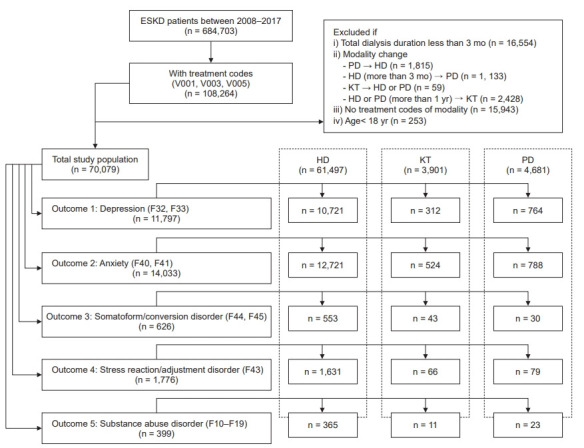
We assessed the prevalence and patterns of mental illnesses in a nationwide cohort of patients diagnosed with ESKD between January 1, 2008, and December 31, 2017. The risk of mental illness was evaluated using a multivariable Cox proportional hazards model.
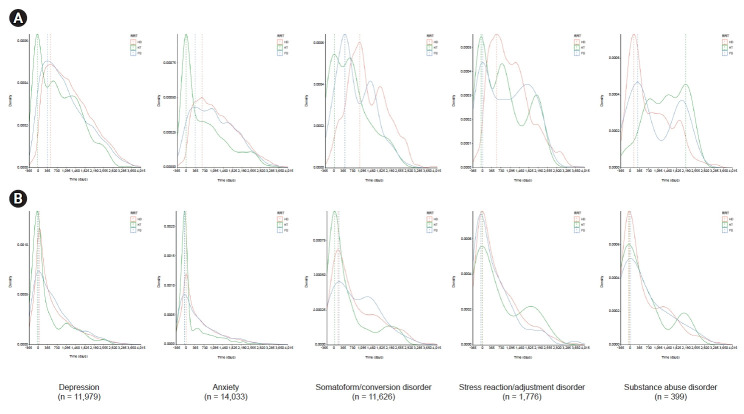
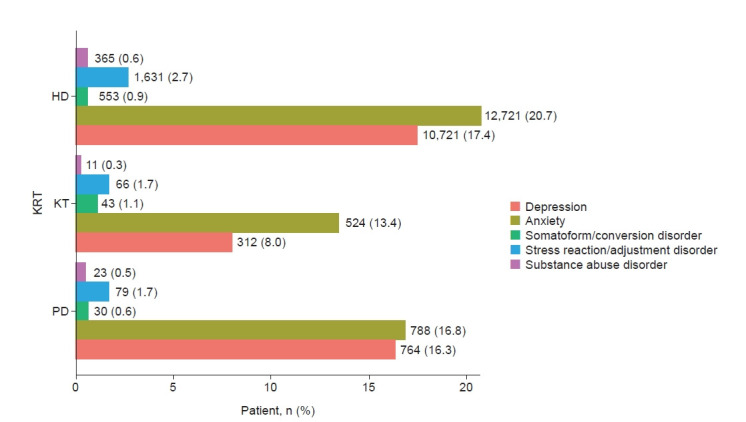
A total of 70,079 patients met all study inclusion criteria. A total of 28.3% of patients had mental illness, and the specific distribution was as follows: depression, 16.8%; anxiety, 20.0%; somatoform/conversion disorder, 0.9%; stress reaction/adjustment disorder, 2.5%; and substance abuse disorder, 0.6%. The frequency of mental illness was highest in patients on hemodialysis (HD), followed by patients on peritoneal dialysis (PD) and kidney transplant (KT) patients. The peak rate of mental illness in HD and PD patients was reached 1 to 2 years after renal replacement therapy initiation, but the peak rate of most mental illnesses in KT patients occurred before surgery. The prevalence of depression was 2.19 times higher in HD patients and 1.97 times higher in PD patients than in KT patients.
ESKD patients are at high risk of mental illness, and the prevalence of mental illness is highest in HD patients. Since the onset of mental illness occurs around the initiation of renal replacement therapy, clinicians need to pay attention to mental illness when treating ESKD patients.
关于终末期肾病(ESKD)患者精神疾病的文献有限,提示该疾病常见且负担沉重,但在临床实践中未得到充分认识。本研究旨在分析ESKD患者精神疾病的患病率。
我们评估了2008年1月1日至2017年12月31日期间全国范围内诊断为ESKD的患者队列中精神疾病的患病率和模式。使用多变量Cox比例风险模型评估精神疾病风险。
共有70079名患者符合所有研究纳入标准。共有28.3%的患者患有精神疾病,具体分布如下:抑郁症,16.8%;焦虑症,20.0%;躯体形式/转换障碍,0.9%;应激反应/适应障碍,2.5%;物质滥用障碍,0.6%。精神疾病的发生率在血液透析(HD)患者中最高,其次是腹膜透析(PD)患者和肾移植(KT)患者。HD和PD患者精神疾病的发生率在开始肾脏替代治疗后1至2年达到峰值,但KT患者大多数精神疾病的峰值发生率出现在手术前。HD患者抑郁症的患病率比KT患者高2.19倍,PD患者高1.97倍。
ESKD患者精神疾病风险高,HD患者精神疾病患病率最高。由于精神疾病的发病发生在肾脏替代治疗开始前后,临床医生在治疗ESKD患者时需要关注精神疾病。