Ornello Raffaele, Baraldi Carlo, Guerzoni Simona, Lambru Giorgio, Fuccaro Matteo, Raffaelli Bianca, Gendolla Astrid, Barbanti Piero, Aurilia Cinzia, Cevoli Sabina, Favoni Valentina, Vernieri Fabrizio, Altamura Claudia, Russo Antonio, Silvestro Marcello, Dalla Valle Elisabetta, Mancioli Andrea, Ranieri Angelo, Alfieri Gennaro, Latysheva Nina, Filatova Elena, Talbot Jamie, Cheng Shuli, Holle Dagny, Scheffler Armin, Nežádal Tomáš, Čtrnáctá Dana, Šípková Jitka, Matoušová Zuzana, Sette Lucia, Casalena Alfonsina, Maddestra Maurizio, Viola Stefano, Affaitati Giannapia, Giamberardino Maria Adele, Pistoia Francesca, Reuter Uwe, Sacco Simona
Neuroscience Section, Department of Applied Clinical Sciences and Biotechnology, University of L'Aquila, L'Aquila, Italy.
Department of Biomedical, Metabolic and Neural Sciences, School in Neurosciences, University of Modena and Reggio Emilia, Modena, Italy.
Front Neurol. 2021 Dec 16;12:774341. doi: 10.3389/fneur.2021.774341. eCollection 2021.
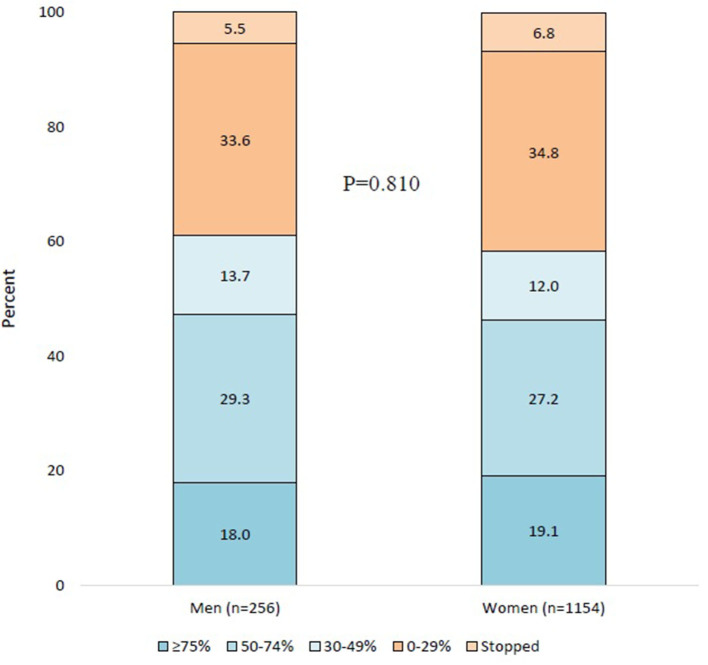
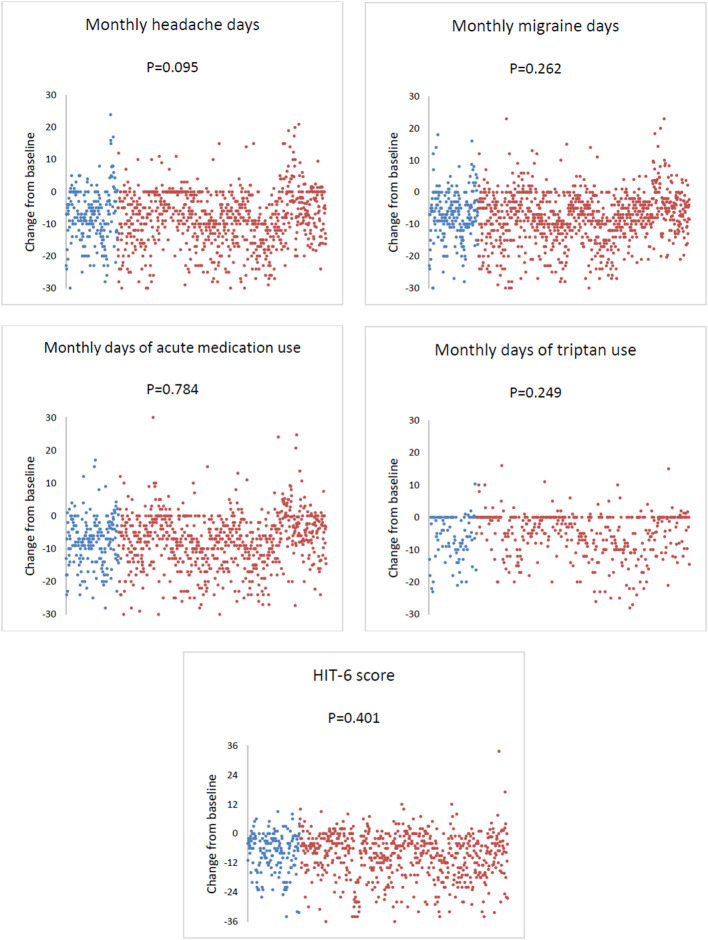
We reported gender-specific data on the efficacy and safety of erenumab, a monoclonal antibody antagonizing the calcitonin gene-related peptide (CGRP) receptor. Our pooled patient-level analysis of real-world data included patients treated with erenumab and followed up for 12 weeks. We considered the following outcomes at weeks 9-12 of treatment compared with baseline: 0-29%, 30-49%, 50-75%, and ≥75% responder rates, according to the decrease in monthly headache days (MHDs), rate of treatment stopping, change in MHDs, monthly migraine days (MMDs), monthly days of acute medication and triptan use, and Headache Impact Test-6 (HIT-6) score from baseline to weeks 9-12. Outcomes were compared between men and women by the chi-squared test or -test, as appropriate. An analysis of covariance (ANCOVA) was performed to identify factors influencing the efficacy outcomes. We included 1,410 patients from 16 centers, of which 256 (18.2%) were men. Men were older than women and had a lower number of MHDs at baseline. At weeks 9-12, compared with baseline, 46 (18.0%) men had a ≥75% response, 75 (29.3%) had a 50-74% response, 35 (13.7%) had a 30-49% response, and 86 (33.6%) had a 0-29% response, while 14 (5.5%) stopped the treatment. The corresponding numbers for women were 220 (19.1%), 314 (27.2%), 139 (12.0%), 402 (34.8%), and 79 (6.8%). No gender difference was found in any of the outcomes. The ANCOVA showed that gender did not influence the efficacy of outcomes. We found that erenumab is equally safe and effective in men compared with women after 12 weeks.
我们报告了关于erenumab(一种拮抗降钙素基因相关肽(CGRP)受体的单克隆抗体)疗效和安全性的性别特异性数据。我们对真实世界数据进行的汇总患者水平分析纳入了接受erenumab治疗并随访12周的患者。与基线相比,我们在治疗第9 - 12周考虑了以下结局:根据每月头痛天数(MHDs)的减少情况分为0 - 29%、30 - 49%、50 - 75%和≥75%的缓解率,治疗停药率,MHDs的变化,每月偏头痛天数(MMDs),每月急性药物和曲坦类药物使用天数,以及从基线到第9 - 12周的头痛影响测试-6(HIT-6)评分。根据情况,采用卡方检验或t检验比较男性和女性的结局。进行协方差分析(ANCOVA)以确定影响疗效结局的因素。我们纳入了来自16个中心的1410例患者,其中256例(18.2%)为男性。男性比女性年龄大,且基线时MHDs数量较少。在第9 - 12周时,与基线相比,46例(18.0%)男性有≥75%的缓解,75例(29.3%)有50 - 74%的缓解,35例(13.7%)有30 - 49%的缓解,86例(33.6%)有0 - 29%的缓解,而14例(5.5%)停止治疗。女性的相应数字分别为220例(19.1%)、314例(27.2%)、139例(12.0%)、402例(34.8%)和79例(6.8%)。在任何结局中均未发现性别差异。ANCOVA显示性别不影响结局的疗效。我们发现,12周后,与女性相比,erenumab在男性中同样安全有效。