Department of Diagnostic Sciences, Ghent University, Ghent, Belgium.
Medisch Sociaal Opvangcentrum (MSOC) Gent, Ghent, Belgium.
Front Immunol. 2021 Dec 16;12:775098. doi: 10.3389/fimmu.2021.775098. eCollection 2021.
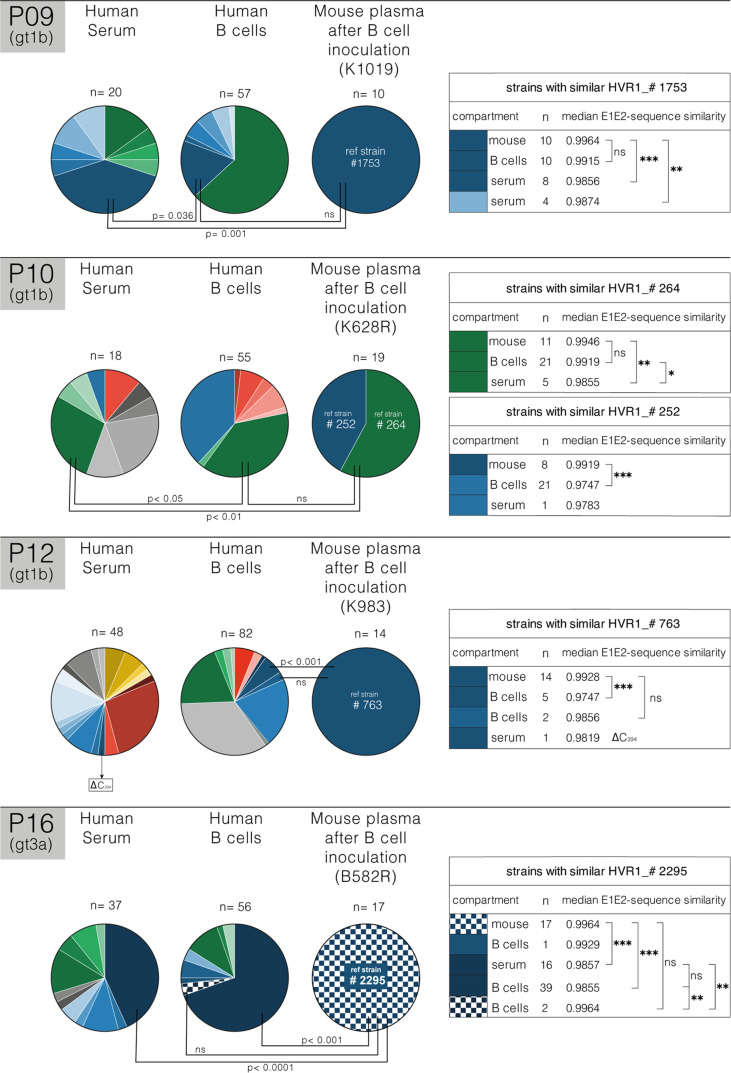
Hepatitis C virus (HCV) is highly variable and transmits through infected blood to establish a chronic liver infection in the majority of patients. Our knowledge on the infectivity of clinical HCV strains is hampered by the lack of cell culture systems that support efficient viral replication. We and others have reported that HCV can associate with and infect immune cells and may thereby evade host immune surveillance and elimination. To evaluate whether B cells play a role in HCV transmission, we assessed the ability of B cells and sera from recent (<2 years) or chronic (≥ 2 years) HCV patients to infect humanized liver chimeric mice. HCV was transmitted by B cells from chronic infected patients whereas the sera were non-infectious. In contrast, B cells from recently infected patients failed to transmit HCV to the mice, whereas all serum samples were infectious. We observed an association between circulating anti-glycoprotein E1E2 antibodies and B cell HCV transmission. Taken together, our studies provide evidence for HCV transmission by B cells, findings that have clinical implications for prophylactic and therapeutic antibody-based vaccine design.
丙型肝炎病毒 (HCV) 高度变异,通过受感染的血液传播,在大多数患者中导致慢性肝脏感染。由于缺乏支持有效病毒复制的细胞培养系统,我们对临床 HCV 毒株的传染性知之甚少。我们和其他人已经报告说,HCV 可以与免疫细胞结合并感染它们,从而逃避宿主的免疫监视和清除。为了评估 B 细胞在 HCV 传播中的作用,我们评估了来自近期(<2 年)或慢性(≥2 年)HCV 患者的 B 细胞和血清感染人源化肝嵌合小鼠的能力。慢性感染患者的 B 细胞可传播 HCV,而血清则无传染性。相比之下,来自近期感染患者的 B 细胞未能将 HCV 传播给小鼠,而所有血清样本均具有传染性。我们观察到循环抗糖蛋白 E1E2 抗体与 B 细胞 HCV 传播之间存在关联。总之,我们的研究为 B 细胞传播 HCV 提供了证据,这些发现对预防性和治疗性基于抗体的疫苗设计具有临床意义。