Miotto Yohanna Evelyn, da Costa Cibele Tesser, Offringa Remko, Kleine-Vehn Jürgen, Maraschin Felipe Dos Santos
Programa de Pós-Graduação em Genética e Biologia Molecular, Universidade Federal do Rio Grande do Sul, Porto Alegre, Brazil.
Departamento de Botânica, Universidade Federal do Rio Grande do Sul, Porto Alegre, Brazil.
Front Plant Sci. 2021 Dec 15;12:778382. doi: 10.3389/fpls.2021.778382. eCollection 2021.
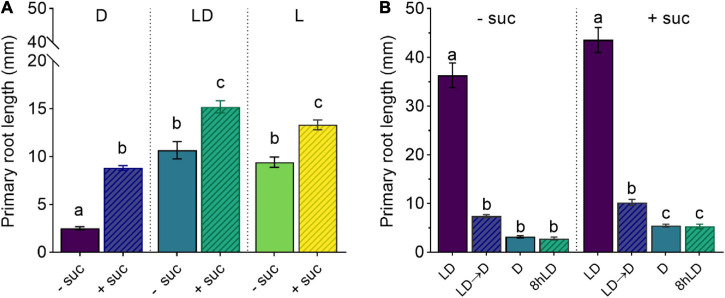
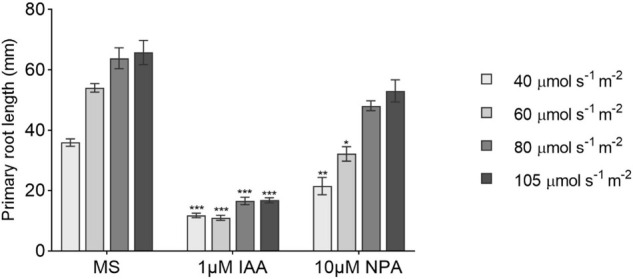
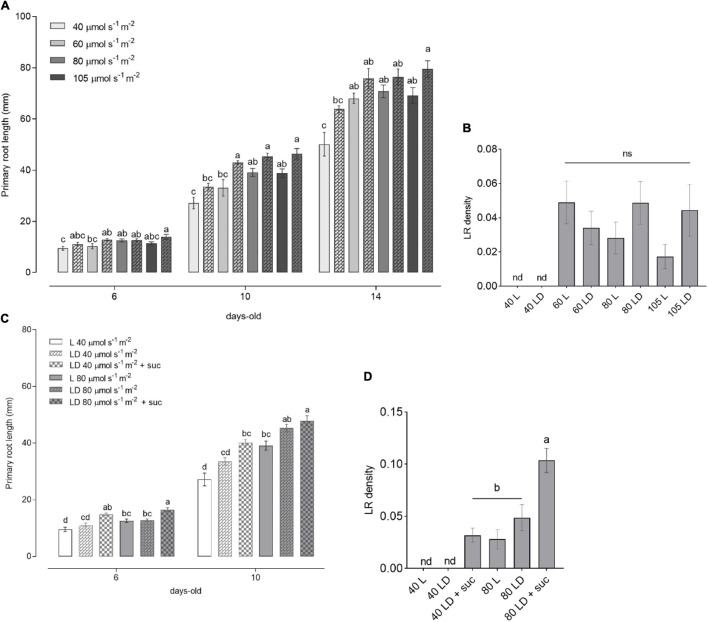
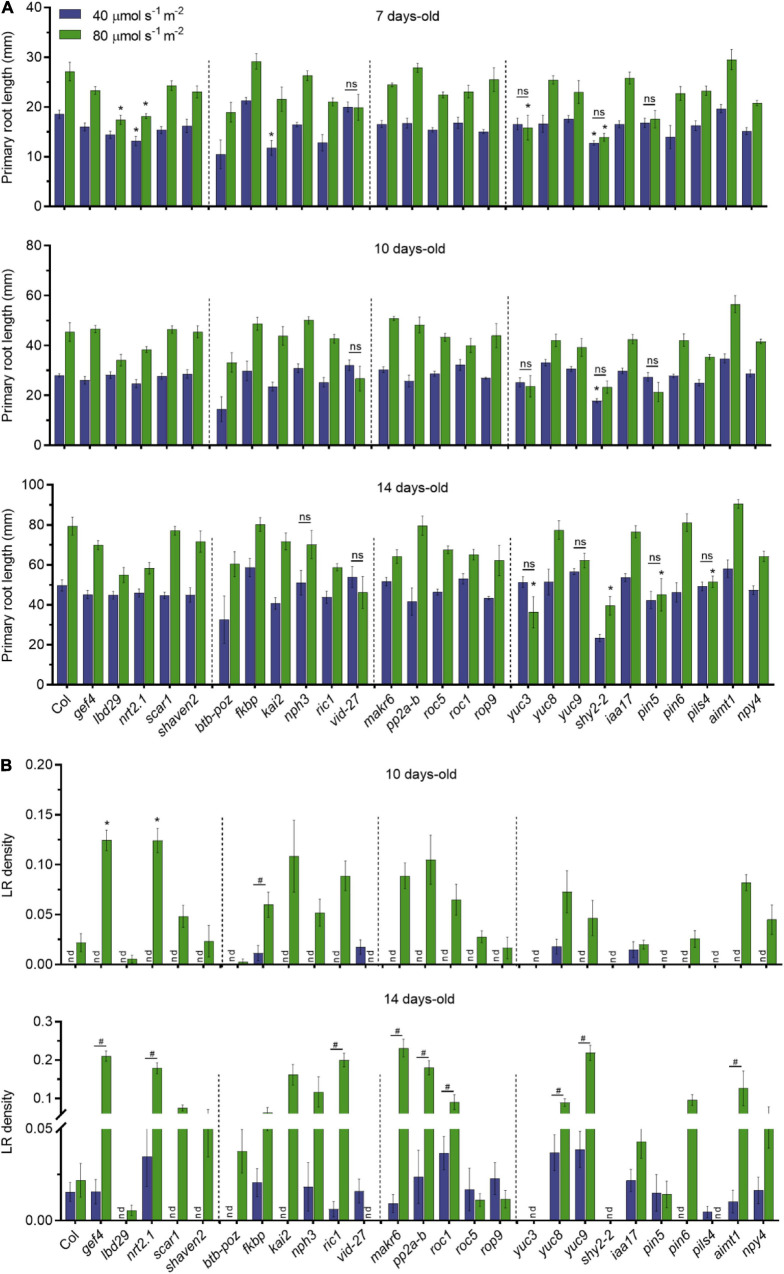
Plant development is highly affected by light quality, direction, and intensity. Under natural growth conditions, shoots are directly exposed to light whereas roots develop underground shielded from direct illumination. The photomorphogenic development strongly represses shoot elongation whereas promotes root growth. Over the years, several studies helped the elucidation of signaling elements that coordinate light perception and underlying developmental outputs. Light exposure of the shoots has diverse effects on main root growth and lateral root (LR) formation. In this study, we evaluated the phenotypic root responses of wild-type Arabidopsis plants, as well as several mutants, grown in a D-Root system. We observed that sucrose and light act synergistically to promote root growth and that sucrose alone cannot overcome the light requirement for root growth. We also have shown that roots respond to the light intensity applied to the shoot by changes in primary and LR development. Loss-of-function mutants for several root light-response genes display varying phenotypes according to the light intensity to which shoots are exposed. Low light intensity strongly impaired LR development for most genotypes. Only and mutants showed higher LR density at 40 μmol m s than at 80 μmol m s whereas and presented no LR development in any light condition, reinforcing the importance of auxin signaling in light-dependent root development. Our results support the use of D-Root systems to avoid the effects of direct root illumination that might lead to artifacts and unnatural phenotypic outputs.
植物发育受到光质、光向和光强的高度影响。在自然生长条件下,地上部分直接暴露于光照,而根系在地下生长,免受直接光照。光形态建成发育强烈抑制地上部分伸长,而促进根系生长。多年来,多项研究有助于阐明协调光感知和潜在发育输出的信号元件。地上部分接受光照对主根生长和侧根形成有多种影响。在本研究中,我们评估了在D-Root系统中生长的野生型拟南芥植株以及几个突变体的根系表型反应。我们观察到蔗糖和光协同作用促进根系生长,且单独的蔗糖无法克服根系生长对光的需求。我们还表明,根系通过主根和侧根发育的变化对施加于地上部分的光强作出反应。几个根系光响应基因的功能缺失突变体根据地上部分所接受的光强表现出不同的表型。低光强严重损害了大多数基因型的侧根发育。只有 和 突变体在40 μmol m s 时的侧根密度高于80 μmol m s 时,而 和 在任何光照条件下都没有侧根发育,这强化了生长素信号在光依赖型根系发育中的重要性。我们的结果支持使用D-Root系统来避免可能导致假象和非自然表型输出的直接根系光照的影响。