Köster Pamela C, Lapuente Juan, Pizarro Andrea, Prieto-Pérez Laura, Pérez-Tanoira Ramón, Dashti Alejandro, Bailo Begoña, Muadica Aly S, González-Barrio David, Calero-Bernal Rafael, Ponce-Gordo Francisco, Carmena David
Parasitology Reference and Research Laboratory, Spanish National Centre for Microbiology, 28220 Majadahonda, Madrid, Spain.
Animal Ecology and Tropical Biology, Biozentrum, Universität Würzburg, Tierökologie und Tropenbiologie (Zoologie III), Würzburg, Germany.
Int J Parasitol Parasites Wildl. 2021 Dec 13;17:26-34. doi: 10.1016/j.ijppaw.2021.12.004. eCollection 2022 Apr.
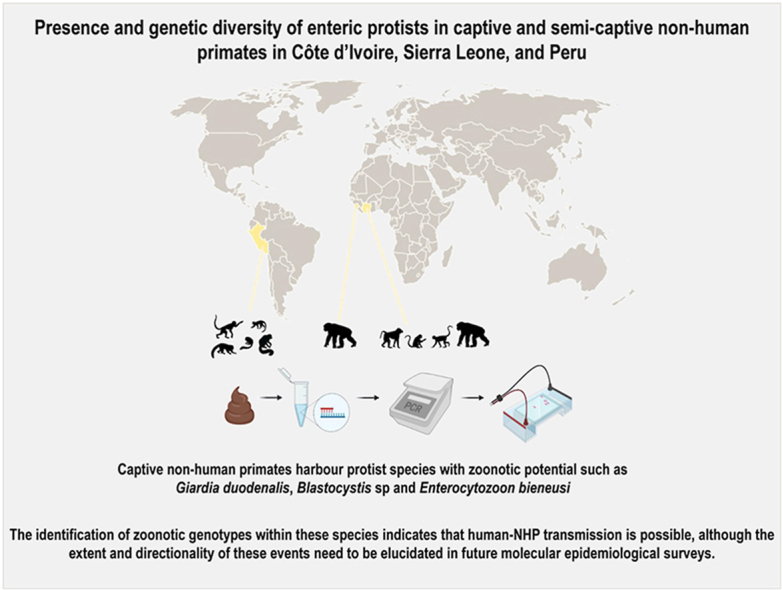
Little information is currently available on the occurrence and genetic diversity of pathogenic and commensal protist species in captive and semi-captive non-human primates (NHP) resident in zoological gardens or sanctuaries in low- and medium-income countries. In this molecular-based study, we prospectively collected individual faecal samples from apparently healthy NHP at the Abidjan Zoological Garden (AZG) in Côte d'Ivoire, the Tacugama Sanctuary (TS) in Sierra Leone, and the Quistococha Zoological Garden (QZG) in Peru between November 2018 and February 2020. We evaluated for the presence of pathogenic ( spp., , , sp., , ) and commensal (, ) protist species using PCR methods and Sanger sequencing. was the most prevalent species found (25.9%, 30/116), followed by sp. (22.4%, 26/116), and (18.1%, 21/116). We detected (4.2%, 1/24) and (12.5%, 3/24) only on NHP from AZG. spp., , and were undetected at the three sampling sites investigated here. Sequence analyses revealed the presence of zoonotic sub-assemblages BIII ( = 1) in AZG and BIV ( = 1) in TS within . We identified subtype ST3 (100%, 6/6) in AZG, ST1 (80.0%, 12/15), ST2 (6.7%, 1/15), and ST3 (13.3%, 2/15) in TS, and ST2 (80.0%, 4/5) and ST3 (20.0%, 1/5) in QZG. The only isolate detected here was identified as zoonotic genotype CAF4. Our PCR-based data indicate that potentially pathogenic protist species including , sp., , and are present at variable rates in the three NHP populations investigated here. The identification of zoonotic genotypes within these species indicates that human-NHP transmission is possible, although the extent and directionality of these events need to be elucidated in future molecular surveys.
目前,关于中低收入国家动物园或保护区内圈养及半圈养非人灵长类动物(NHP)中致病及共生原生生物物种的发生情况和遗传多样性的信息较少。在这项基于分子的研究中,我们于2018年11月至2020年2月期间,前瞻性地从科特迪瓦阿比让动物园(AZG)、塞拉利昂塔库加马保护区(TS)和秘鲁基斯托科查动物园(QZG)表面健康的NHP个体中收集粪便样本。我们使用PCR方法和桑格测序评估致病原生生物物种( spp.、 、 、 sp.、 、 )和共生原生生物物种( 、 )的存在情况。 是最常见的物种(25.9%,30/116),其次是 sp.(22.4%,26/116)和 (18.1%,21/116)。我们仅在来自AZG的NHP中检测到 (4.2%,1/24)和 (12.5%,3/24)。在这里调查的三个采样点未检测到 spp.、 、 和 。序列分析显示,在AZG的 中存在人畜共患亚群BIII( = 1),在TS的 中存在BIV( = 1)。我们在AZG中鉴定出 亚型ST3(100%,6/6),在TS中鉴定出ST1(80.0%,12/15)、ST2(6.7%,1/15)和ST3(13.3%,2/15),在QZG中鉴定出ST2(80.0%,4/5)和ST3(20.0%,1/5)。这里检测到的唯一 分离株被鉴定为人畜共患基因型CAF4。我们基于PCR的数据表明,包括 、 sp.、 、 和 在内的潜在致病原生生物物种在此处调查的三个NHP种群中以不同比例存在。这些物种中人畜共患基因型的鉴定表明人 - NHP传播是可能的,尽管这些事件的程度和方向性需要在未来的分子调查中阐明。