Köster Pamela C, Dashti Alejandro, Bailo Begoña, Muadica Aly S, Maloney Jenny G, Santín Mónica, Chicharro Carmen, Migueláñez Silvia, Nieto Francisco J, Cano-Terriza David, García-Bocanegra Ignacio, Guerra Rafael, Ponce-Gordo Francisco, Calero-Bernal Rafael, González-Barrio David, Carmena David
Parasitology Reference and Research Laboratory, Spanish National Centre for Microbiology, 28220 Madrid, Spain.
Departamento de Ciências e Tecnologia, Universidade Licungo, Quelimane 106, Zambézia, Mozambique.
Animals (Basel). 2021 Mar 5;11(3):700. doi: 10.3390/ani11030700.
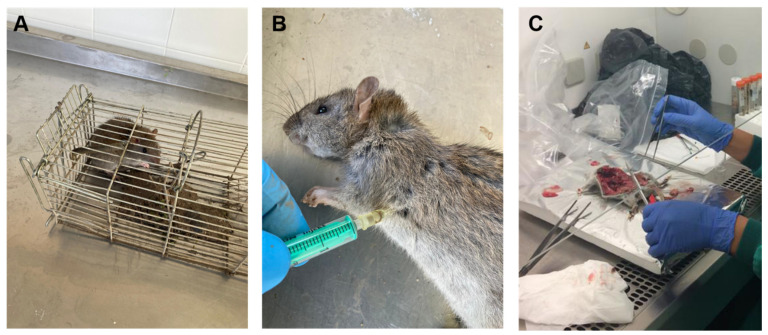
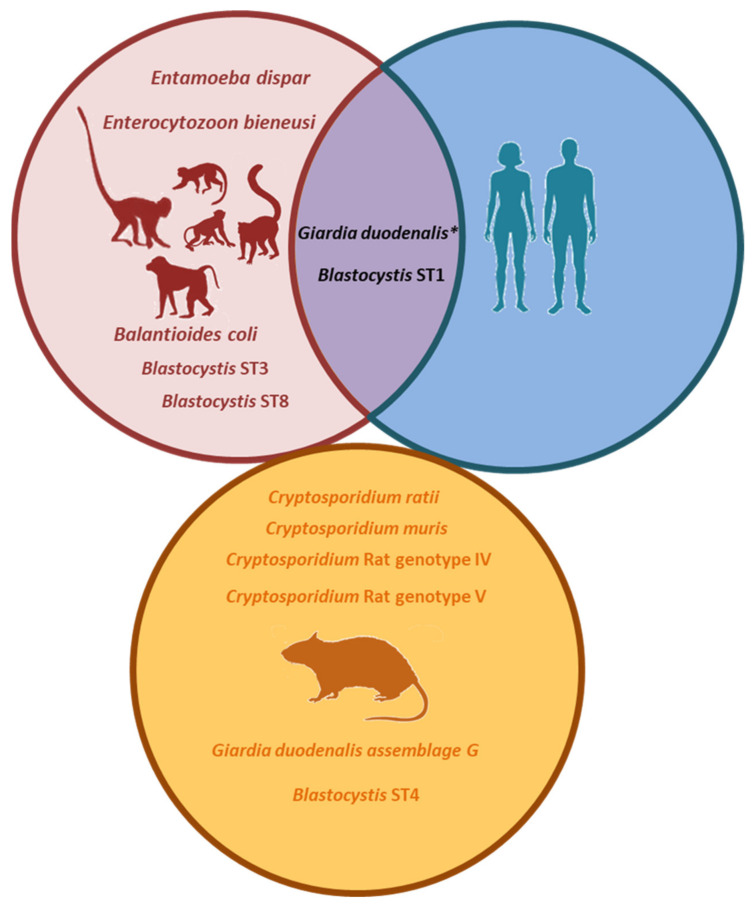
Little information is currently available on the epidemiology of parasitic and commensal protist species in captive non-human primates (NHP) and their zoonotic potential. This study investigates the occurrence, molecular diversity, and potential transmission dynamics of parasitic and commensal protist species in a zoological garden in southern Spain. The prevalence and genotypes of the main enteric protist species were investigated in faecal samples from NHP ( = 51), zookeepers ( = 19) and free-living rats ( = 64) by molecular (PCR and sequencing) methods between 2018 and 2019. The presence of spp. was also investigated in tissues from sympatric rats using PCR. sp. (45.1%), (27.5%), (21.6%), (3.9%), and (2.0%) (but not spp.) were detected in NHP. (10.5%) and sp. (10.5%) were identified in zookeepers, while spp. (45.3%), (14.1%), and sp. (6.25%) (but not spp.) were detected in rats. ST1, ST3, and ST8 and sub-assemblage AII were identified in NHP, and ST1 in zookeepers. isolates failed to be genotyped in human samples. In rats, four (, , and rat genotypes IV and V), one (assemblage G), and three (ST4) genetic variants were detected. Our results indicate high exposure of NHP to zoonotic protist species. Zoonotic transmission of ST1 was highly suspected between captive NHP and zookeepers.
目前关于圈养非人灵长类动物(NHP)体内寄生和共生原生生物物种的流行病学及其人畜共患病潜力的信息很少。本研究调查了西班牙南部一个动物园中寄生和共生原生生物物种的发生情况、分子多样性及潜在传播动态。2018年至2019年间,采用分子(PCR和测序)方法对NHP(n = 51)、动物园饲养员(n = 19)和自由生活大鼠(n = 64)粪便样本中主要肠道原生生物物种的流行率和基因型进行了调查。还使用PCR检测了同域大鼠组织中贾第虫属物种的存在情况。在NHP中检测到了蓝氏贾第鞭毛虫(45.1%)、微小内蜒阿米巴(27.5%)、哈氏内阿米巴(21.6%)、结肠内阿米巴(3.9%)和布氏嗜碘阿米巴(2.0%)(但未检测到贾第虫属物种)。在动物园饲养员中鉴定出了微小内蜒阿米巴(10.5%)和贾第虫属物种(10.5%),而在大鼠中检测到了贾第虫属物种(45.3%)、结肠内阿米巴(14.1%)和贾第虫属物种(6.25%)(但未检测到蓝氏贾第鞭毛虫)。在NHP中鉴定出了蓝氏贾第鞭毛虫ST1、ST3和ST8以及AII亚群,在动物园饲养员中鉴定出了蓝氏贾第鞭毛虫ST1。在人类样本中未能对贾第虫分离株进行基因分型。在大鼠中,检测到了四种贾第虫(蓝氏贾第鞭毛虫、微小内蜒阿米巴以及大鼠基因型IV和V)、一种内阿米巴(G群)和三种结肠内阿米巴(ST4)基因变体。我们的结果表明NHP对人畜共患原生生物物种的暴露程度很高。强烈怀疑圈养NHP和动物园饲养员之间存在蓝氏贾第鞭毛虫ST1的人畜共患传播。