Shiroud Heidari Behzad, Lopez Emma Muinos, Chen Peilin, Ruan Rui, Vahabli Ebrahim, Davachi Seyed Mohammad, Granero-Moltó Froilán, De-Juan-Pardo Elena M, Zheng Minghao, Doyle Barry
Harry Perkins Institute of Medical Research, QEII Medical Centre, Nedlands and the UWA Centre for Medical Research, The University of Western Australia, Perth, Australia.
School of Engineering, The University of Western Australia, Perth, Australia.
Mater Today Bio. 2023 Aug 24;22:100778. doi: 10.1016/j.mtbio.2023.100778. eCollection 2023 Oct.
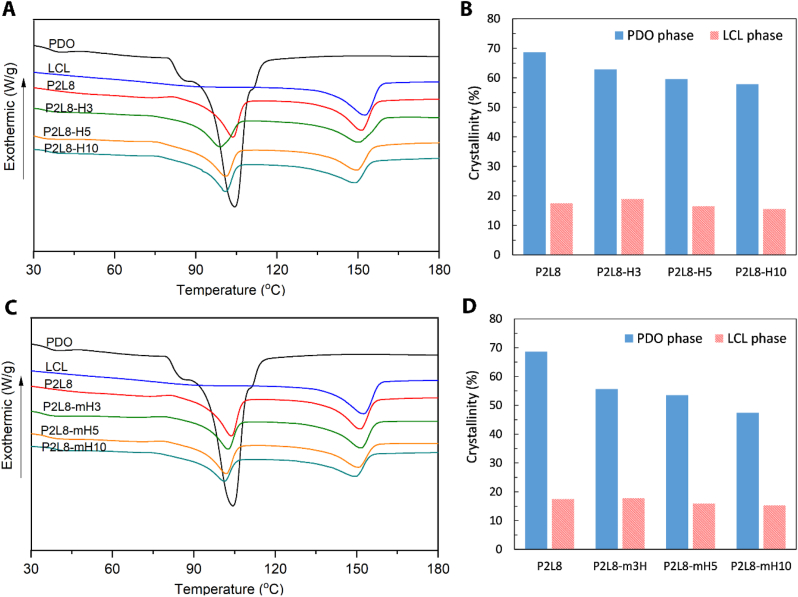
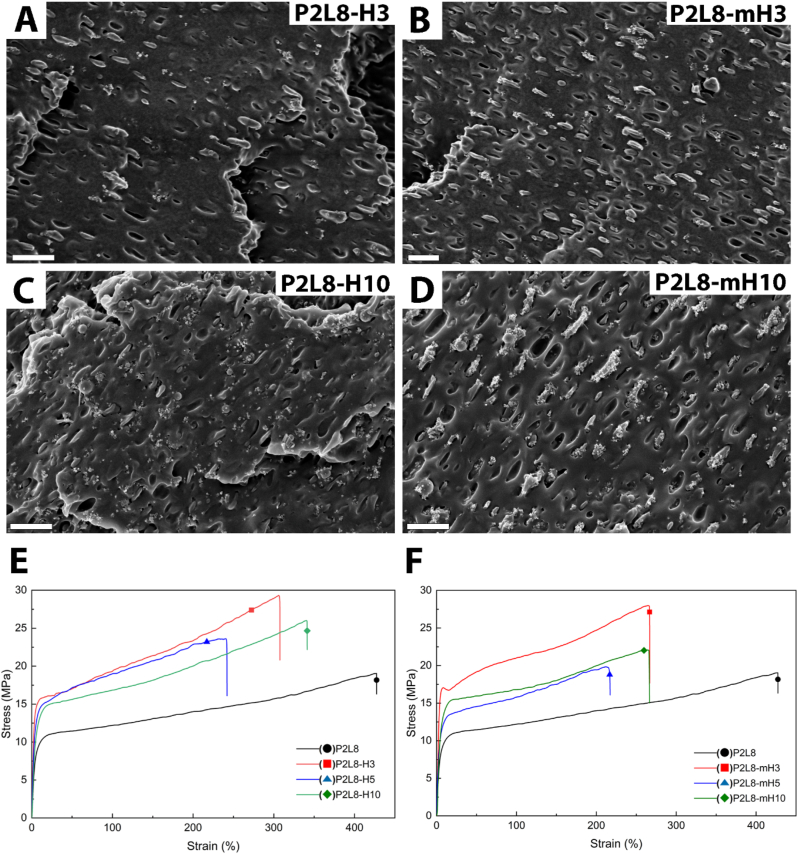
The interface tissue between bone and soft tissues, such as tendon and ligament (TL), is highly prone to injury. Although different biomaterials have been developed for TL regeneration, few address the challenges of the TL-bone interface. Here, we aim to develop novel hybrid nanocomposites based on poly(-dioxanone) (PDO), poly(lactide--caprolactone) (LCL), and hydroxyapatite (HA) nanoparticles suitable for TL-bone interface repair. Nanocomposites, containing 3-10% of both unmodified and chemically modified hydroxyapatite (mHA) with a silane coupling agent. We then explored biocompatibility through and studies using a subcutaneous mouse model. Through different characterisation tests, we found that mHA increases tensile properties, creates rougher surfaces, and reduces crystallinity and hydrophilicity. Morphological observations indicate that mHA nanoparticles are attracted by PDO rather than LCL phase, resulting in a higher degradation rate for mHA group. We found that adding the 5% of nanoparticles gives a balance between the properties. experiments show that osteoblasts' activities are more affected by increasing the nanoparticle content compared with fibroblasts. Animal studies indicate that both HA and mHA nanoparticles (10%) can reduce the expression of pro-inflammatory cytokines after six weeks of implantation. In summary, this work highlights the potential of PDO/LCL/HA nanocomposites as an excellent biomaterial for TL-bone interface tissue engineering applications.
骨骼与软组织(如肌腱和韧带(TL))之间的界面组织极易受伤。尽管已经开发出不同的生物材料用于TL再生,但很少有材料能应对TL-骨界面的挑战。在此,我们旨在开发基于聚(-二氧六环酮)(PDO)、聚(丙交酯-己内酯)(LCL)和羟基磷灰石(HA)纳米颗粒的新型杂化纳米复合材料,适用于TL-骨界面修复。纳米复合材料包含3-10%未改性和用硅烷偶联剂化学改性的羟基磷灰石(mHA)。然后,我们通过皮下小鼠模型的实验和研究探索了生物相容性。通过不同的表征测试,我们发现mHA提高了拉伸性能,使表面更粗糙,并降低了结晶度和亲水性。形态学观察表明,mHA纳米颗粒被PDO而非LCL相吸引,导致mHA组的降解速率更高。我们发现添加5%的纳米颗粒能在性能之间取得平衡。实验表明,与成纤维细胞相比,增加纳米颗粒含量对成骨细胞活性的影响更大。动物研究表明,HA和mHA纳米颗粒(10%)在植入六周后均能降低促炎细胞因子的表达。总之,这项工作突出了PDO/LCL/HA纳米复合材料作为一种用于TL-骨界面组织工程应用的优秀生物材料的潜力。