Lu Tiantian, Liang Bin, Jia Yanping, Cai Jiangyun, Wang Danhong, Liu Min, He Bo, Wang Qing
Department of Neonatology, Haikou Maternal and Child Health Hospital, Haikou, China.
Department of Pediatric Medicine, Affiliated Haikou Hospital of Xiangya Medical School Central South University, Haikou, China.
Transl Pediatr. 2021 Nov;10(11):3075-3081. doi: 10.21037/tp-21-494.
We aimed to investigate the relationship between the level of serum 25 hydroxyvitamin D [25-(OH)D] at birth and the complications of bronchopulmonary dysplasia (BPD), as well as the long-term lung function of preterm infants.
A total of 286 premature infants who were admitted to the neonatal ward of Haikou Maternal and Child Health Hospital from January 2018 to December 2020 and met the inclusion criteria were selected as the research objects. The level of serum 25(OH)D at birth was detected. The children were divided into a BPD group (79 cases) and a non-BPD group (207 cases). The case information and basic data of the children were recorded. The children were followed up 6 months after correcting the gestational age of 40 weeks, and their long-term lung function development was reported. Logistic regression analysis was used to evaluate the high-risk factors of BPD in preterm infants.
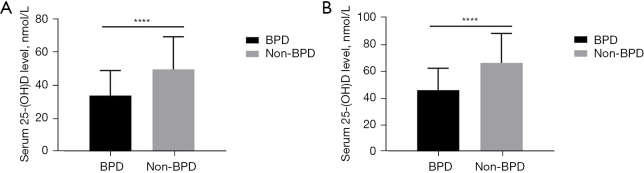
The 1- and 5-minute Apgar scores of preterm infants in the BPD group were significantly lower than those in the non-BPD group. Also, the combined neonatal pneumonia, neonatal asphyxia, hospital stay, and total oxygen therapy time in the BPD group were substantially higher than those in the non-BPD group. The mean value of serum 25-(OH)D at birth in the BPD group (33.7±15.1 nmol/L) was significantly lower than that in the non-BPD group (49.5±19.6 nmol/L). Compared with the non-BPD group, the respiratory rate (RR) in the BPD group increased significantly, while the tidal volume (VT), inspiratory to expiratory ratio (TI/TE), ratio of time to peak tidal expiratory flow to total expiratory time (TPEF/TE), and 25% tidal expiratory flow rate (TEF25%) decreased markedly (P<0.05). Total oxygen therapy time, neonatal pneumonia, neonatal asphyxia, and serum 25-(OH)D level at birth were identified as independent risk factors for BPD in preterm infants.
The level of serum 25-(OH)D in preterm infants at birth is closely related to the occurrence of BPD and long-term lung function damage, and is affected by multiple high-risk factors. This study provides a theoretical basis for the individualized treatment of preterm infants and the early prevention of BPD.
我们旨在研究出生时血清25羟维生素D [25-(OH)D]水平与支气管肺发育不良(BPD)并发症以及早产儿长期肺功能之间的关系。
选取2018年1月至2020年12月入住海口市妇幼保健院新生儿病房且符合纳入标准的286例早产儿作为研究对象。检测出生时血清25(OH)D水平。将患儿分为BPD组(79例)和非BPD组(207例)。记录患儿的病例信息和基本资料。在矫正胎龄40周后对患儿进行6个月的随访,并报告其长期肺功能发育情况。采用Logistic回归分析评估早产儿发生BPD的高危因素。
BPD组早产儿1分钟和5分钟Apgar评分显著低于非BPD组。此外,BPD组合并新生儿肺炎、新生儿窒息、住院时间和总氧疗时间均显著高于非BPD组。BPD组出生时血清25-(OH)D的平均值(33.7±15.1 nmol/L)显著低于非BPD组(49.5±19.6 nmol/L)。与非BPD组相比,BPD组呼吸频率(RR)显著增加,而潮气量(VT)、吸气与呼气比(TI/TE)、呼气潮气量峰值时间与总呼气时间之比(TPEF/TE)和25%呼气潮气流速(TEF25%)显著降低(P<0.05)。总氧疗时间、新生儿肺炎、新生儿窒息和出生时血清25-(OH)D水平被确定为早产儿发生BPD的独立危险因素。
早产儿出生时血清25-(OH)D水平与BPD发生及长期肺功能损害密切相关,且受多种高危因素影响。本研究为早产儿个体化治疗及BPD早期预防提供了理论依据。