Department of Sociology, California State University-Dominguez Hills, Carson, CA, United States.
Department of Sociology, University of Utah, Salt Lake City, UT, United States.
Soc Sci Med. 2017 Sep;189:44-52. doi: 10.1016/j.socscimed.2017.07.019. Epub 2017 Jul 25.
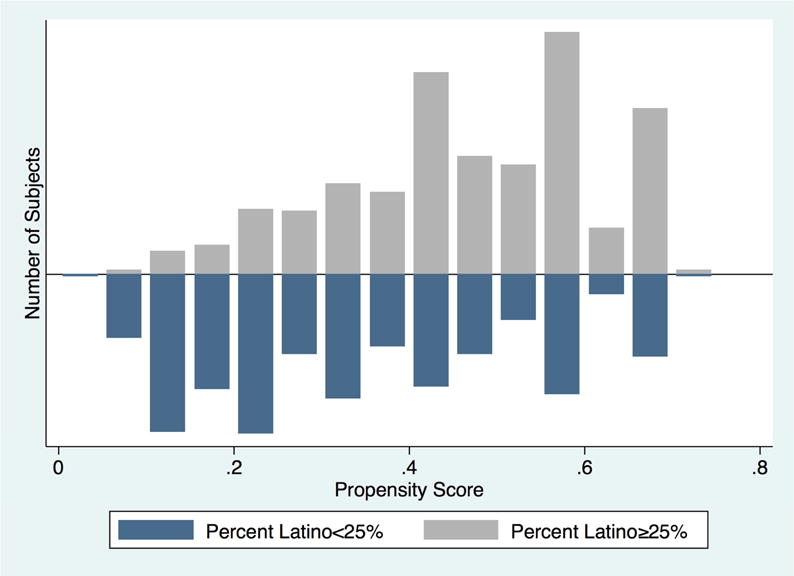
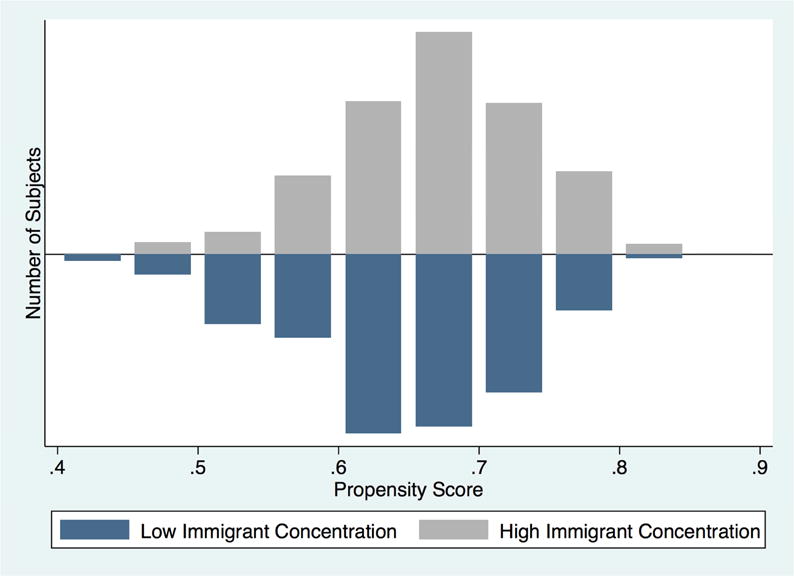
Whether minority concentration in a neighborhood exposes residents to, or protects them from, health risks has generated burgeoning scholarly interests; yet endogeneity as a result of neighborhood selection largely remains unclear in the literature. This study addresses such endogeneity and simultaneously investigates the roles of co-ethnic density and immigrant enclaves in influencing high blood pressure and high cholesterol level among Latinos, the largest minority group in the United States. Pooled cross-sectional data that included both native and foreign-born Latinos of Puerto Rican, Mexican, and other origins (N = 1563) from the 2006 and 2008 Southeastern Pennsylvania Household Health Survey were linked to census-tract profiles from the 2005-2009 American Community Survey. Results from both multilevel regression and propensity score matching analysis confirmed the deleterious effect of residential co-ethnic density on Latino adults' health risks over and above individual risk factors. We also found selection bias associated with the observed protective effect of immigrant concentration, which is likely a result of residential preference.
无论少数民族在社区中的集中是否会使居民面临或避免健康风险,这一问题已经引起了学术界的浓厚兴趣;然而,由于邻里选择导致的内生性在文献中仍不清楚。本研究解决了这种内生性问题,同时调查了同族人密度和移民飞地在影响美国最大的少数族裔拉丁裔人群的高血压和高胆固醇水平方面的作用。这项研究使用了来自 2006 年和 2008 年宾夕法尼亚州东南部家庭健康调查的、包括波多黎各、墨西哥和其他原籍地的本地出生和外国出生的拉丁裔人(N=1563)的汇总横截面数据,并与 2005-2009 年美国社区调查的普查区概况进行了关联。多层次回归和倾向得分匹配分析的结果证实了居住同族人密度对拉丁裔成年人健康风险的有害影响,这种影响超过了个体风险因素。我们还发现了与观察到的移民集中的保护作用相关的选择偏差,这可能是居住偏好的结果。