Bendall Oliver, James Joel, Pawlak Katarzyna M, Ishaq Sauid, Tau J Andy, Suzuki Noriko, Bollipo Steven, Siau Keith
Department of Gastroenterology, Royal Cornwall Hospitals NHS Trust, Truro, UK.
Endoscopy Unit, Department of Gastroenterology, Ministry of Interior and Administration, Szczecin, Poland.
Clin Exp Gastroenterol. 2021 Dec 24;14:477-492. doi: 10.2147/CEG.S282699. eCollection 2021.
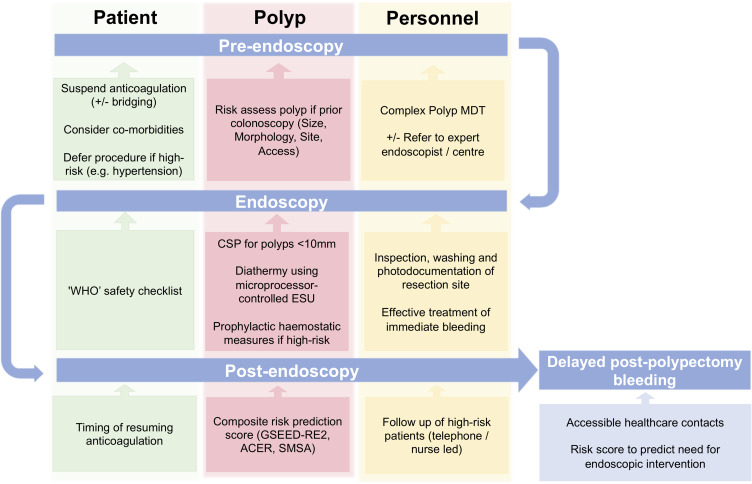
Delayed post-polypectomy bleeding (DPPB) is a potentially severe complication of therapeutic colonoscopy which can result in hospital readmission and re-intervention. Over the last decade, rates of DPPB reported in the literature have fallen from over 2% to 0.3-1.2%, largely due to improvements in resection technique, a shift towards cold snare polypectomy, better training, adherence to guidelines on periprocedural antithrombotic management, and the use of antithrombotics with more favourable bleeding profiles. However, as the complexity of polypectomy undertaken worldwide increases, so does the importance of identifying patients at increased risk of DPPB. Risk factors can be categorised according to patient, polyp and personnel related factors, and their integration together to provide an individualised risk score is an evolving field. Strategies to reduce DPPB include safe practices relevant to all patients undergoing colonoscopy, as well as specific considerations for patients identified to be high risk. This narrative review sets out an evidence-based summary of factors that contribute to the risk of DPPB before discussing pragmatic interventions to mitigate their risk and improve patient safety.
息肉切除术后延迟出血(DPPB)是治疗性结肠镜检查的一种潜在严重并发症,可导致患者再次入院和再次接受干预。在过去十年中,文献报道的DPPB发生率已从超过2%降至0.3%-1.2%,这主要归功于切除技术的改进、向冷圈套息肉切除术的转变、更好的培训、对围手术期抗血栓管理指南的遵循,以及使用具有更有利出血特征的抗血栓药物。然而,随着全球范围内息肉切除术复杂性的增加,识别DPPB风险增加患者的重要性也日益凸显。风险因素可根据患者、息肉和人员相关因素进行分类,将这些因素整合以提供个体化风险评分仍是一个不断发展的领域。降低DPPB的策略包括适用于所有接受结肠镜检查患者的安全措施,以及针对被确定为高风险患者的特殊考虑。本叙述性综述在讨论减轻DPPB风险和提高患者安全性的务实干预措施之前,先对导致DPPB风险的因素进行基于证据的总结。