Burgio Valentina, Iavarone Massimo, Di Costanzo Giovanni Giuseppe, Marra Fabio, Lonardi Sara, Tamburini Emiliano, Piscaglia Fabio, Masi Gianluca, Celsa Ciro, Foschi Francesco Giuseppe, Silletta Marianna, Amoruso Daniela Caterina, Rimini Margherita, Bruccoleri Mariangela, Tortora Raffaella, Campani Claudia, Soldà Caterina, Viola Massimo Giuseppe, Forgione Antonella, Conti Fabio, Salani Francesca, Catanese Silvia, Giacchetto Carmelo Marco, Fulgenzi Claudia, Coppola Carmine, Lampertico Pietro, Pellino Antonio, Rancatore Gabriele, Cabibbo Giuseppe, Ratti Francesca, Pedica Federica, Della Corte Angelo, Colombo Massimo, De Cobelli Francesco, Aldrighetti Luca, Cascinu Stefano, Casadei-Gardini Andrea
Department of Medical Oncology, Vita-Salute San Raffaele University, IRCCS San Raffaele Scientific Institute, Milan, 20132, Italy.
Foundation IRCCS Ca' Granda Ospedale Maggiore Policlinico, Division of Gastroenterology and Hepatology, Milan, Italy.
Cancer Manag Res. 2021 Dec 24;13:9379-9389. doi: 10.2147/CMAR.S330195. eCollection 2021.
Lenvatinib has been approved in Italy since October 2019 as a first-line therapy for advanced hepatocellular carcinoma (HCC) and to date data on effectiveness and safety of lenvatinib are not available in our region. To fill this gap, we performed a multicentric analysis of the real-world treatment outcomes with the propensity score matching in a cohort of Italian patients with unresectable HCC who were treated with either sorafenib or lenvatinib.
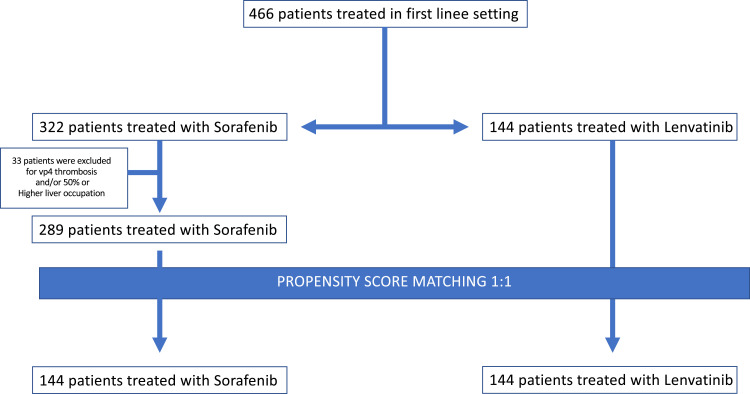
To evaluate the effectiveness of sorafenib and lenvatinib as primary treatment of advanced HCC in clinical practice we performed a multicentric analysis of the treatment outcomes of 288 such patients recruited in 11 centers in Italy. A propensity score was used to mitigate confounding due to referral biases in the assessment of mortality and progression-free survival.
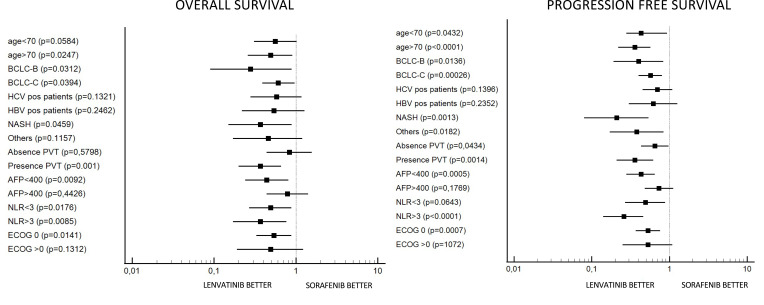
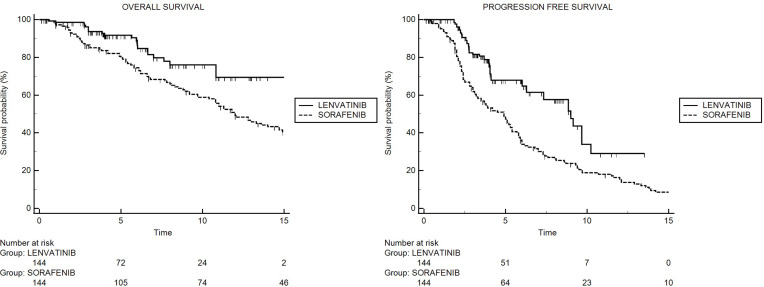
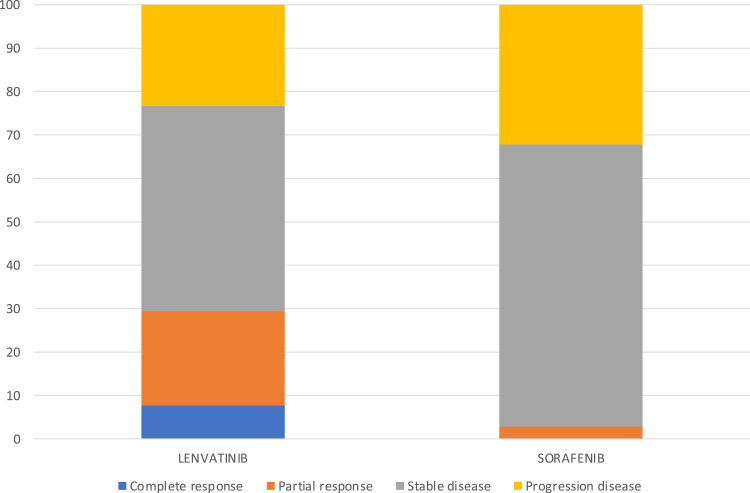
Over a follow-up period of 11 months the Cox regression model showed 48% reduction of death risk for patients treated with lenvatinib (95% CI: 0.34-0.81; p = 0.0034), compared with those treated with sorafenib. The median PFS was 9.0 and 4.9 months for lenvatinib and sorafenib arm, respectively. Patients treated with lenvatinib showed a higher percentage of response rate (29.4% vs 2.8%; p < 0.00001) compared with patients treated with sorafenib. Sorafenib was shown to be correlated with more HFSR, diarrhea and fatigue, while lenvatinib with more hypertension and fatigue.
Our study highlighted for the first time the efficacy and safety of lenvatinib in an Italian cohort of patients.
自2019年10月起,乐伐替尼在意大利被批准作为晚期肝细胞癌(HCC)的一线治疗药物,迄今为止,我们所在地区尚无乐伐替尼有效性和安全性的数据。为填补这一空白,我们对一组接受索拉非尼或乐伐替尼治疗的意大利不可切除HCC患者进行了倾向得分匹配的真实世界治疗结局多中心分析。
为了评估索拉非尼和乐伐替尼作为晚期HCC一线治疗的有效性,我们对意大利11个中心招募的288例此类患者的治疗结局进行了多中心分析。采用倾向得分来减轻评估死亡率和无进展生存期时因转诊偏倚导致的混杂。
在11个月的随访期内,Cox回归模型显示,与接受索拉非尼治疗的患者相比,接受乐伐替尼治疗的患者死亡风险降低了48%(95%CI:0.34 - 0.81;p = 0.0034)。乐伐替尼组和索拉非尼组的中位无进展生存期分别为9.0个月和4.9个月。与接受索拉非尼治疗的患者相比,接受乐伐替尼治疗的患者缓解率更高(29.4%对2.8%;p < 0.00001)。结果显示,索拉非尼与更多的手足皮肤反应、腹泻和疲劳相关,而乐伐替尼与更多的高血压和疲劳相关。
我们的研究首次突出了乐伐替尼在意大利患者队列中的疗效和安全性。