Department of Orthopedics, The Second Xiangya Hospital, Central South University, China.
Department of Orthopedics, The Third Xiangya Hospital, Central South University, China.
Mediators Inflamm. 2021 Dec 27;2021:2979124. doi: 10.1155/2021/2979124. eCollection 2021.
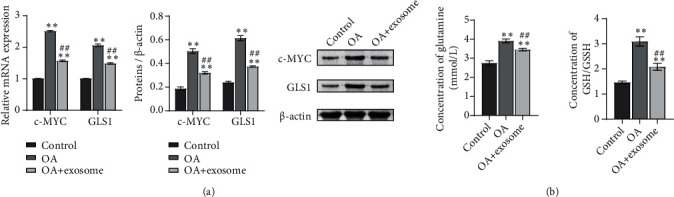
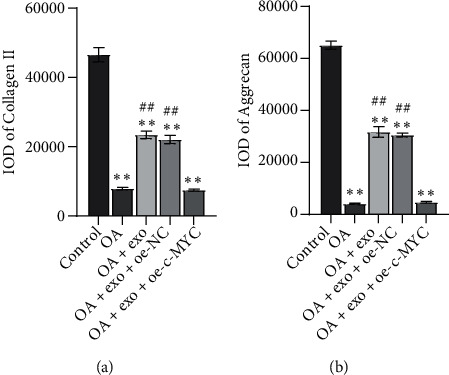
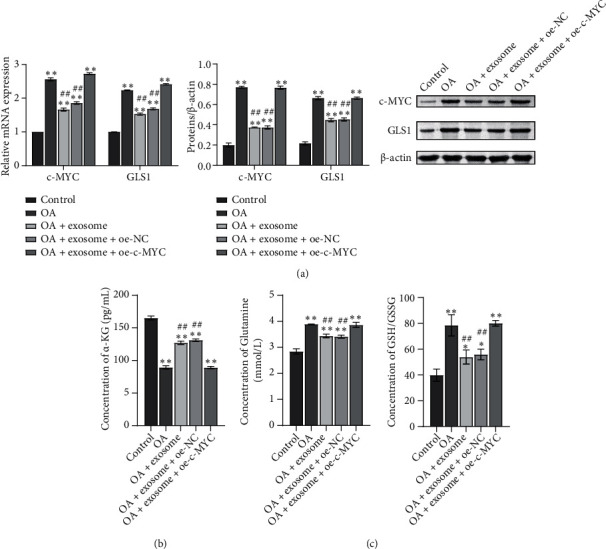
Osteoarthritis (OA) had a high incidence in people over 65 years old, and there is currently no drug that could completely cure it. This study is aimed at studying the role of exosomes in regulating glutamine metabolism in the treatment of OA. First, we identified the exosomes extracted from the mouse OA model's bone marrow mesenchymal stem cells (MSC). , compared with the control group, the cell apoptosis in the OA group increased, while the cell proliferation of the OA group was suppressed. After exosomal treatment, cell apoptosis and cell proliferation were reversed. Inflammatory factors (TNF, IL-6), glutamine metabolic activity-related proteins (c-MYC, GLS1), glutamine, and GSH/GSSG were increased in the OA group. The overexpression of c-MYC reduced the therapeutic effect of exosomes. At the same time, we found that chondrocyte functional factors (collagen II, Aggrecan) were improved under the treatment of exosomes. However, oe-c-MYC reversed the therapeutic effect of exosomes. , we found that the running capacity of the mice in the OA group was reduced, and the cartilage tissue was severely damaged. In addition, TNF, IL-6, and chondrocyte apoptosis increased, while the metabolism of collagen II, Aggrecan, and glutamate decreased in the OA group. After exosomal treatment, the mice's exercise capacity, tissue damage, inflammation, and chondrocyte function were improved, and glutamate metabolism was increased. This study showed that exosomes regulated the level of chondrocyte glutamine metabolism by regulating c-MYC, thereby alleviating OA.
骨关节炎(OA)在 65 岁以上人群中的发病率较高,目前尚无药物可以完全治愈该病。本研究旨在研究外泌体在调节 OA 治疗中谷氨酰胺代谢中的作用。首先,我们从 OA 模型小鼠的骨髓间充质干细胞(MSC)中鉴定出外泌体。与对照组相比,OA 组细胞凋亡增加,而 OA 组细胞增殖受到抑制。经外泌体处理后,细胞凋亡和细胞增殖得到逆转。OA 组中炎症因子(TNF、IL-6)、谷氨酰胺代谢活性相关蛋白(c-MYC、GLS1)、谷氨酰胺和 GSH/GSSG 增加。c-MYC 的过表达降低了外泌体的治疗效果。同时,我们发现外泌体治疗可改善软骨细胞功能因子(胶原 II、聚集蛋白聚糖)。然而,oe-c-MYC 逆转了外泌体的治疗效果。此外,我们发现 OA 组小鼠的奔跑能力降低,软骨组织严重受损。此外,OA 组 TNF、IL-6 和软骨细胞凋亡增加,而胶原 II、聚集蛋白聚糖和谷氨酸代谢减少。经外泌体处理后,小鼠的运动能力、组织损伤、炎症和软骨细胞功能得到改善,谷氨酸代谢增加。本研究表明,外泌体通过调节 c-MYC 来调节软骨细胞谷氨酰胺代谢水平,从而缓解 OA。