Julius Center for Health Sciences and Primary Care, University Medical Center Utrecht, Utrecht University, Utrecht, The Netherlands.
Acta Paediatr. 2022 Apr;111(4):716-732. doi: 10.1111/apa.16248. Epub 2022 Feb 7.
A follow-up conversation with bereaved parents is a relatively well-established intervention in paediatric clinical practice. Yet, the content and value of these conversations remain unclear. This review aims to provide insight into the content of follow-up conversations between bereaved parents and regular healthcare professionals (HCPs) in paediatrics and how parents and HCPs experience these conversations.
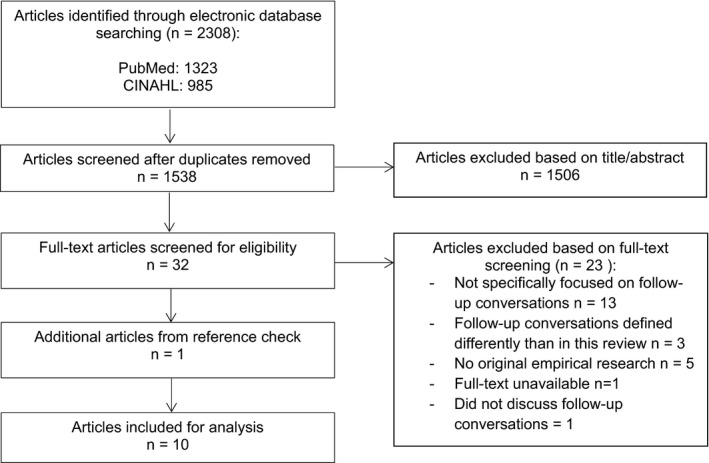
Systematic literature review using the methods PALETTE and PRISMA. The search was conducted in PubMed and CINAHL on 3 February 2021. The results were extracted and integrated using thematic analysis.
Ten articles were included. This review revealed that follow-up conversations are built around three key elements: (1) gaining information, (2) receiving emotional support and (3) facilitating parents to provide feedback. In addition, this review showed that the vast majority of parents and HCPs experienced follow-up conversations as meaningful and beneficial for several reasons.
An understanding of what parents and HCPs value in follow-up conversations aids HCPs in conducting follow-up conversations and improves care for bereaved parents by enhancing the HCPs' understanding of parental needs.
与丧亲父母进行后续对话是儿科临床实践中一种相对成熟的干预措施。然而,这些对话的内容和价值仍不清楚。本综述旨在深入了解儿科中丧亲父母与常规医疗保健专业人员(HCP)之间的后续对话的内容,以及父母和 HCP 对这些对话的体验。
使用 PALETTE 和 PRISMA 方法进行系统文献综述。于 2021 年 2 月 3 日在 PubMed 和 CINAHL 中进行了检索。使用主题分析对结果进行提取和整合。
共纳入 10 篇文章。本综述表明,后续对话围绕三个关键要素构建:(1)获取信息,(2)获得情感支持,(3)促进父母提供反馈。此外,本综述还表明,绝大多数父母和 HCP 认为后续对话具有重要意义和益处,原因有几个。
了解父母和 HCP 在后续对话中重视的内容,有助于 HCP 进行后续对话,并通过增强 HCP 对父母需求的理解,改善对丧亲父母的护理。