Chin Juhee, Park Jaeseol, Yang Soh-Jeong, Yeom Jiyoung, Ahn Yisuh, Baek Min Jae, Ryu Hui Jin, Lee Byung Hwa, Han Noh Eul, Ryu Kyung Hi, Kang Yeonwook
Department of Neurology, Samsung Medical Center, Seoul, Korea.
Department of Neurology, Hallym University Sacred Heart Hospital, Anyang, Korea.
Dement Neurocogn Disord. 2018 Mar;17(1):11-22. doi: 10.12779/dnd.2018.17.1.11. Epub 2018 Mar 31.
Evaluating instrumental activities of daily living (IADL) is an important part of procedure to diagnose dementia. The Korean-Instrumental Activities of Daily Living (K-IADL) has been used extensively in Korea. However, its cut-off score has not been reformulated since 2002. The purpose of this study was to yield a new optimal cut-off score for the K-IADL and confirm the validity of this new cut-off score with various dementia groups.
We retrospectively collected a total of 2,347 patients' K-IADL data from 6 general hospitals in Korea. These patients had mild cognitive impairment (MCI) or dementia with various etiologies for cognitive impairment. We also recruited a normal control group (=254) from the community. Korean-Mini Mental State Examination, Short version of the Geriatric Depression Scale, Clinical Dementia Rating, and Global Deterioration Scale were administered to all participants. Caregivers completed K-IADL and Barthel Index.
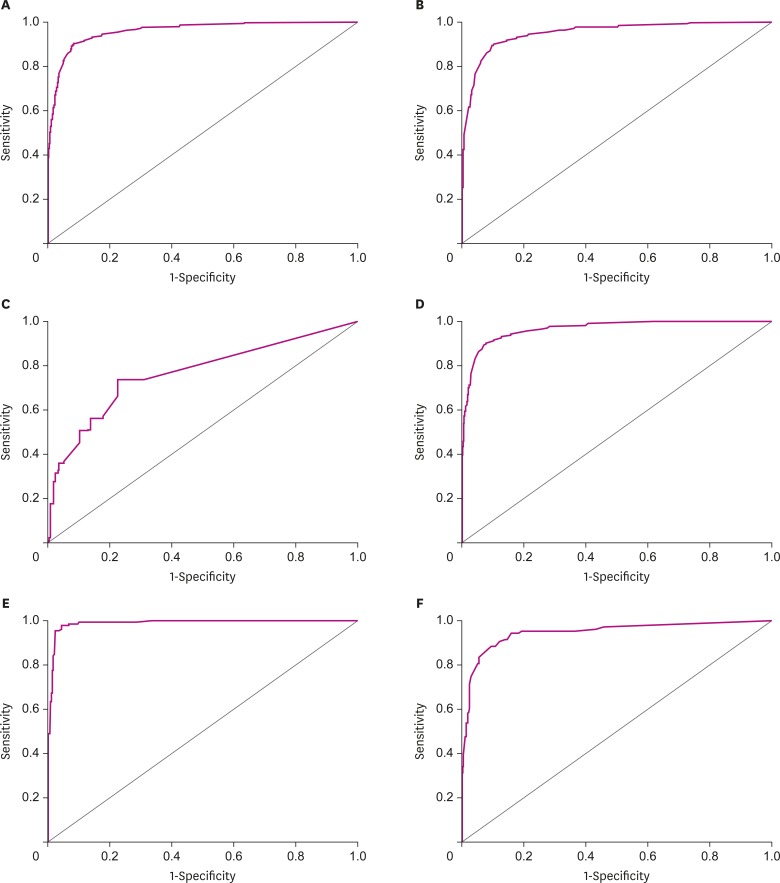
K-IADL scores were significantly different among dementia subgroups, but not significantly different among MCI subgroups. Based on internal consistency, correlations with other scales, and factor analysis, K-IADL showed excellent reliability and validity. The new optimal cut-off score to diagnose dementia was 0.40, which gave a sensitivity of 0.901 and a specificity of 0.916. Positive predictive value for dementia using the new cut-off score was 94.2% for Alzheimer's disease, 100% for vascular dementia, and 84% for Parkinson's disease.
Our results illustrate that the new K-IADL cut-off score of 0.40 is reliable and valid for screening impairments of daily functioning resulting from various etiologies.
评估日常生活工具性活动(IADL)是痴呆诊断程序的重要组成部分。韩国日常生活工具性活动量表(K-IADL)在韩国已被广泛使用。然而,自2002年以来其临界值尚未重新制定。本研究的目的是得出K-IADL的新的最佳临界值,并在不同痴呆组中验证该新临界值的有效性。
我们回顾性收集了韩国6家综合医院共2347例患者的K-IADL数据。这些患者患有轻度认知障碍(MCI)或因各种认知障碍病因导致的痴呆。我们还从社区招募了一个正常对照组(n = 254)。对所有参与者进行了韩国简易精神状态检查表、老年抑郁量表简版、临床痴呆评定量表和总体衰退量表评估。照顾者完成K-IADL和巴氏指数评估。
K-IADL得分在痴呆亚组间有显著差异,但在MCI亚组间无显著差异。基于内部一致性、与其他量表的相关性以及因子分析,K-IADL显示出优异的信度和效度。诊断痴呆的新的最佳临界值为0.40,其灵敏度为0.901,特异度为0.916。使用新临界值对痴呆的阳性预测值,阿尔茨海默病为94.2%,血管性痴呆为100%,帕金森病为84%。
我们的结果表明,新的K-IADL临界值0.40对于筛查由各种病因导致的日常功能损害是可靠且有效的。