Health Equity and Rights Team, CARE USA, Atlanta, GA, USA.
Hubert Department of Global Health, Rollins School of Public Health, Emory University, Atlanta, GA, USA.
Matern Child Health J. 2022 Jun;26(6):1350-1357. doi: 10.1007/s10995-021-03338-6. Epub 2022 Jan 8.
Movements to stem abortion accessibility and provision are underway across the southern United States. Preserving access to safe abortion requires a steady maternal health workforce. Targeted laws and limiting environments have contributed to a regional dearth of abortion providers. This study evaluates the consequences of restrictive environments for the abortion workforce to inform strategies to reduce the provider shortage in the South.
We recruited twelve physicians using purposive sampling and interviewed them on their motivations and experiences practicing in the South. We employed grounded theory analysis to translate their perspectives into recommendations for provider recruitment and retention.
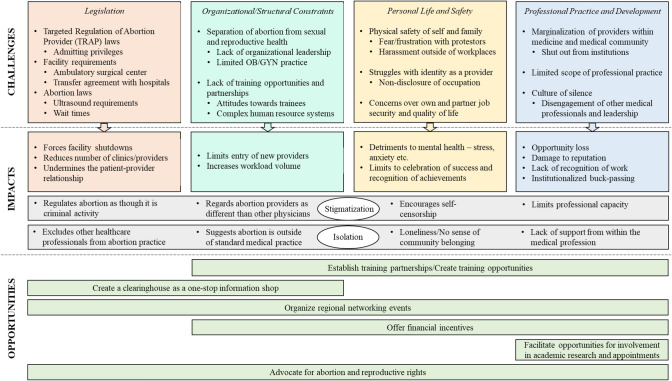
Abortion providers identified challenges relating to restrictive legislation, institutional separation of abortion from other medical services, training unavailability, safety concerns, identity struggles, and marginalization within their profession. This contributed to providers widely experiencing stigma and isolation within their work and life environments. Their motivations for practicing in the South despite these challenges included wanting to be impactful in areas of high need, combating health access disparites, and having personal ties to the region. Providers' suggested increasing regional networking and training opportunities, creating an information clearinghouse, and offering additional compensation to better support their work. We conceptualized these findings into a framework detailing the challenges, impacts and opportunities for abortion provision in the southern United States.
Our recommendations for provider recruitment and retention include cooperation between professional organizations, training programs, and healthcare institutions to create opportunities for training and networking and encourage abortion-supportive organizational and policy environments.
美国南部各地正在采取行动,限制堕胎的可及性和提供。维护安全堕胎的机会需要一支稳定的孕产妇保健劳动力。有针对性的法律和限制环境导致该地区堕胎服务提供者短缺。本研究评估了限制性环境对堕胎劳动力的影响,以为减少南部堕胎提供者短缺的策略提供信息。
我们通过目的性抽样招募了 12 名医生,并对他们在南部执业的动机和经验进行了访谈。我们采用扎根理论分析,将他们的观点转化为招聘和留住提供者的建议。
堕胎提供者确定了与限制性立法、堕胎与其他医疗服务机构分离、培训机会缺乏、安全问题、身份斗争以及职业边缘化相关的挑战。这导致提供者在工作和生活环境中普遍感到耻辱和孤立。尽管面临这些挑战,他们仍选择在南部执业的动机包括希望在高需求地区产生影响、对抗卫生服务获取差距以及与该地区有个人联系。提供者建议增加区域网络和培训机会,创建信息中心,并提供额外的补偿,以更好地支持他们的工作。我们将这些发现概念化为一个框架,详细说明了美国南部堕胎提供的挑战、影响和机会。
我们对招聘和留住提供者的建议包括专业组织、培训计划和医疗机构之间的合作,以创造培训和网络机会,并鼓励支持堕胎的组织和政策环境。