Chair of Endocrinology and Medical Sexology (ENDOSEX), Department of Systems Medicine, University of Rome Tor Vergata, via Montpellier 1, 00133, Rome, Italy.
Flare-Health, Amstelveen, The Netherlands.
J Endocrinol Invest. 2022 Apr;45(4):691-703. doi: 10.1007/s40618-021-01719-w. Epub 2022 Jan 8.
The association between gout, the most common crystal arthropathy, and sexual dysfunctions has often been investigated by studies in the last decades. Despite the presence of shared risk factors and comorbidities and the possible effects on sexual health of long-term gout complications, awareness of this association is severely lacking and the pathogenetic mechanisms have only partially been identified. In the present review, we aimed to investigate the current evidence regarding the potential mechanisms linking sexual dysfunctions and gout.
A comprehensive literature search within PubMed was performed to provide a summary of currently available evidence regarding the association between gout and sexual dysfunctions.
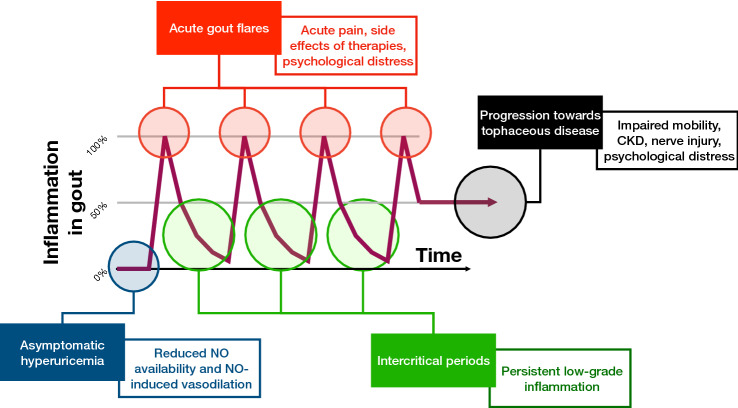
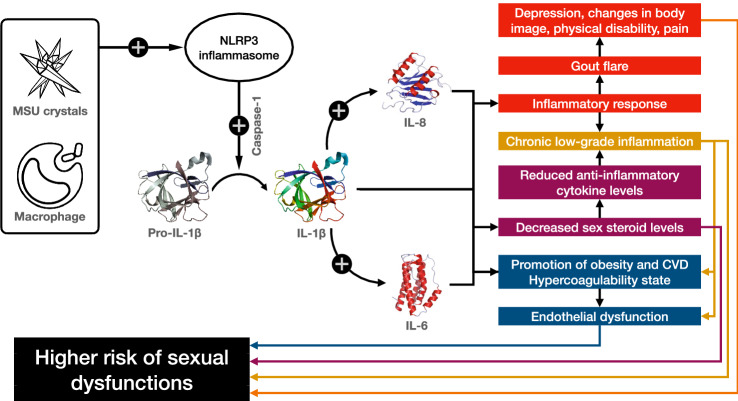
Gout and sexual dysfunctions share several risk factors, including diabesity, chronic kidney disease, hypertension, metabolic syndrome, and peripheral vascular disease. Gout flares triggered by intense inflammatory responses feature severe pain and disability, resulting in worse sexual function, and some, but not all, treatments can also impair sexual health. Long-term gout complications can result in persistent pain and disability due to joint deformity, fractures, or nerve compression, with negative bearing on sexual function. The presence of low-grade inflammation impairs both sex steroids synthesis and endothelial function, further advancing sexual dysfunctions. The psychological burden of gout is another issue negatively affecting sexual health.
According to currently available evidence, several biological and psychological mechanisms link sexual dysfunctions and gout. Addressing risk factors and providing adequate treatment could potentially have beneficial effects on both conditions. Appropriate clinical evaluation and multidisciplinary approach are recommended to improve patient care.
痛风是最常见的晶体关节病,在过去几十年的研究中,人们经常研究痛风与性功能障碍之间的关系。尽管存在共同的危险因素和共病,以及长期痛风并发症可能对性功能健康产生的影响,但人们对这种关联的认识严重不足,其发病机制也仅部分得到确定。在本综述中,我们旨在研究目前关于性功能障碍与痛风之间潜在联系的机制的证据。
我们在 PubMed 中进行了全面的文献检索,以总结目前关于痛风与性功能障碍之间关联的现有证据。
痛风和性功能障碍存在一些共同的危险因素,包括糖脂代谢紊乱、慢性肾脏病、高血压、代谢综合征和外周血管疾病。由强烈炎症反应引发的痛风发作会出现严重疼痛和残疾,从而导致性功能下降,一些(但并非全部)治疗方法也会损害性功能健康。长期痛风并发症会因关节畸形、骨折或神经受压而导致持续疼痛和残疾,对性功能产生负面影响。低度炎症的存在会损害性激素合成和内皮功能,进一步导致性功能障碍。痛风带来的心理负担也是影响性功能健康的另一个问题。
根据目前的证据,几种生物学和心理学机制将性功能障碍和痛风联系在一起。解决危险因素并提供适当的治疗可能对这两种疾病都有有益的影响。建议进行适当的临床评估和多学科方法,以改善患者的护理。