Sydney Pharmacy School, Faculty of Medicine and Health, The University of Sydney, Camperdown, New South Wales, Australia.
Department of Clinical Pharmacology, Royal North Shore Hospital, St. Leonards, New South Wales, Australia.
Health Expect. 2022 Jun;25(3):936-946. doi: 10.1111/hex.13429. Epub 2022 Jan 8.
Guidelines encourage engagement in self-care activities for osteoarthritis (OA), but there are gaps in consumers' knowledge about suitable choices for self-care. Community pharmacists are in an ideal position to contribute to OA management through screening and supporting evidence-based pain management choices. Prior research established an association between health literacy and advice-seeking and appropriateness of analgesics choices (both lower in participants with limited health literacy) amongst people living with OA. This article explores the implications of these data for pharmacists in OA management.
A national online survey was conducted amongst 628 adults aged 45-74 years, currently residing in Australia, with self-reported symptoms of OA. All data were collected using a customized online questionnaire, which was completed only once. 'Self-reported symptoms of OA' was based on six validated screening questions to identify people with OA without a formal clinical diagnosis.
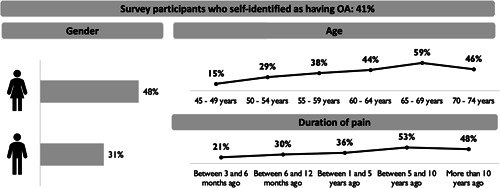
Respondents matched the typical profile of people diagnosed with OA; more than half were female (56%), knees (59%) and hips (31%) were the primary affected joints and 74% were either overweight or obese. Self-identification of OA was limited (41%). Overall, 38% self-managed their pain, and limited health literacy was associated with less advice-seeking. Efficacy and ease of use were the main reasons cited for prompting use across all classes of nonprescription analgesic, with less than 20% reporting recommendation from a pharmacist. Participants were managing their pain with an average of 1.74 (95% confidence interval: 1.60-1.88) analgesics, but 73% reported inadequate pain relief and 54% had disrupted sleep.
Our findings highlight three key themes: lack of self-identification of OA, suboptimal pain relief and limited use of the community pharmacist as a source of management advice. Equipping community pharmacists with tools to identify OA could bridge this gap. More research is needed to determine if it will improve consumers' ability to appropriately manage OA pain.
Consumers living with OA contributed to the study outcomes, reviewed the survey questionnaire for face validity and advised on plain language terminology.
指南鼓励骨关节炎(OA)患者进行自我保健活动,但消费者对自我保健的适宜选择知之甚少。社区药剂师通过筛查和支持基于证据的疼痛管理选择,处于管理 OA 的理想位置。先前的研究表明,在患有 OA 的人群中,健康素养与寻求建议以及镇痛药选择的适当性之间存在关联(健康素养有限的参与者两者都较低)。本文探讨了这些数据对 OA 管理中药剂师的意义。
在澳大利亚,对 628 名年龄在 45-74 岁之间、有 OA 症状的成年人进行了一项全国性的在线调查。所有数据均使用定制的在线问卷收集,仅完成一次。“自我报告的 OA 症状”是基于六个经过验证的筛查问题来识别没有正式临床诊断的 OA 患者。
受访者符合 OA 诊断患者的典型特征;超过一半是女性(56%),受影响的主要关节是膝盖(59%)和臀部(31%),74%超重或肥胖。OA 的自我识别有限(41%)。总体而言,38%的人自行管理疼痛,健康素养有限与寻求建议较少有关。有效性和易用性是促使所有非处方镇痛药使用的主要原因,不到 20%的人报告是从药剂师那里得到的建议。参与者平均使用 1.74 种(95%置信区间:1.60-1.88)镇痛药来管理疼痛,但 73%的人报告疼痛缓解不足,54%的人睡眠受到干扰。
我们的研究结果突出了三个关键主题:OA 的自我识别不足、疼痛缓解效果不佳以及社区药剂师作为管理建议来源的使用有限。为社区药剂师配备识别 OA 的工具可以弥补这一差距。需要进一步研究以确定这是否会提高消费者适当管理 OA 疼痛的能力。
患有 OA 的消费者为研究结果做出了贡献,审查了调查问卷的表面效度,并就通俗易懂的术语提供了建议。