Department of Nutrition, Exercise and Sports, Faculty of Science, University of Copenhagen, Rolighedsvej 26, 1958, Frederiksberg, Denmark.
Department of Food Science, University of Copenhagen, Frederiksberg, Denmark.
Eur J Nutr. 2022 Jun;61(4):2079-2089. doi: 10.1007/s00394-021-02796-6. Epub 2022 Jan 9.
Replacing saturated fatty acids (SFA) with polyunsaturated fatty acids (PUFA) is associated with a reduced risk of cardiovascular disease. Yet, the changes in the serum metabolome after this replacement is not well known. Therefore, the present study aims to identify the metabolites differentiating diets where six energy percentage SFA is replaced with PUFA and to elucidate the association of dietary metabolites with cardiometabolic risk markers.
In an 8-week, double-blind, randomized, controlled trial, 99 moderately hyper-cholesterolemic adults (25-70 years) were assigned to a control diet (C-diet) or an experimental diet (Ex-diet). Both groups received commercially available food items with different fatty acid compositions. In the Ex-diet group, products were given where SFA was replaced mostly with n-6 PUFA. Fasting serum samples were analysed by untargeted ultra-performance liquid chromatography high-resolution mass spectrometry (UPLC-HRMS). Pre-processed data were analysed by double cross-validated Partial Least-Squares Discriminant Analysis (PLS-DA) to detect features differentiating the two diet groups.
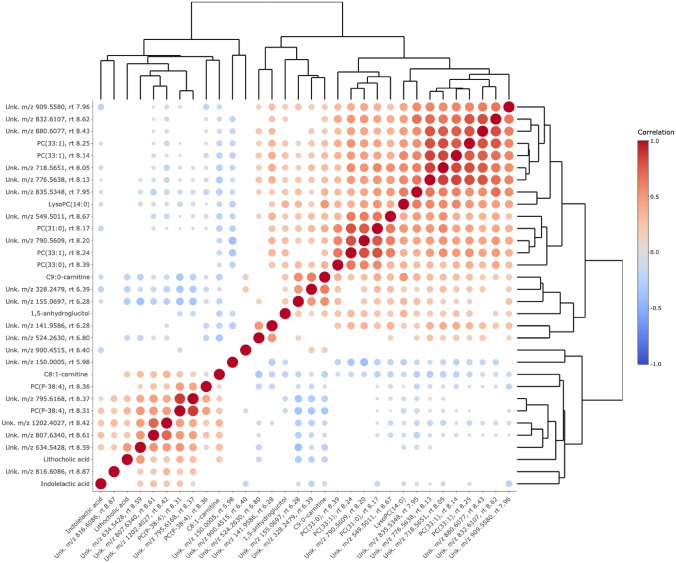
PLS-DA differentiated the metabolic profiles of the Ex-diet and the C-diet groups with an area under the curve of 0.83. The Ex-diet group showed higher levels of unsaturated phosphatidylcholine plasmalogens, an unsaturated acylcarnitine, and a secondary bile acid. The C-diet group was characterized by odd-numbered phospholipids and a saturated acylcarnitine. The Principal Component analysis scores of the serum metabolic profiles characterizing the diets were significantly associated with low-density lipoprotein cholesterol, total cholesterol, and triglyceride levels but not with glycaemia.
The serum metabolic profiles confirmed the compliance of the participants based on their diet-specific metabolome after replacing SFA with mostly n-6 PUFA. The participants' metabolic profiles in response to the change in diet were associated with cardiovascular disease risk markers. This study was registered at clinicaltrials.gov as NCT01679496 on September 6th 2012.
用多不饱和脂肪酸(PUFA)替代饱和脂肪酸(SFA)可降低心血管疾病的风险。然而,这种替代后血清代谢组的变化尚不清楚。因此,本研究旨在确定用 PUFA 替代 6 个能量百分比 SFA 的饮食中区分代谢物的方法,并阐明饮食代谢物与心血管代谢风险标志物的关联。
在一项为期 8 周的双盲、随机、对照试验中,99 名中度高胆固醇血症成年人(25-70 岁)被分配到对照组(C 饮食)或实验组(Ex 饮食)。两组均接受具有不同脂肪酸组成的商业可获得食品。在 Ex 饮食组中,用 n-6 PUFA 替代 SFA。对禁食血清样本进行非靶向超高效液相色谱高分辨率质谱(UPLC-HRMS)分析。通过双交叉验证偏最小二乘判别分析(PLS-DA)对预处理数据进行分析,以检测区分两组饮食的特征。
PLS-DA 区分了 Ex 饮食组和 C 饮食组的代谢谱,曲线下面积为 0.83。Ex 饮食组显示出较高水平的不饱和磷脂酰胆碱溶血磷脂、不饱和酰基肉碱和次级胆酸。C 饮食组的特征是奇数磷脂和饱和酰基肉碱。表征饮食的血清代谢谱的主成分分析评分与低密度脂蛋白胆固醇、总胆固醇和甘油三酯水平显著相关,但与血糖无关。
血清代谢谱证实了参与者在用 n-6 PUFA 替代 SFA 后基于其特定饮食的代谢组的依从性。参与者对饮食变化的代谢谱与心血管疾病风险标志物有关。本研究于 2012 年 9 月 6 日在 clinicaltrials.gov 上以 NCT01679496 注册。