Department of Human Behaviour, Ecology and Culture, Max Planck Institute for Evolutionary Anthropology, 04103 Leipzig, Germany.
Department of Methodology, London School of Economics and Political Science, London WC2A 2AE, UK.
Philos Trans R Soc Lond B Biol Sci. 2022 Feb 28;377(1845):20200440. doi: 10.1098/rstb.2020.0440. Epub 2022 Jan 10.
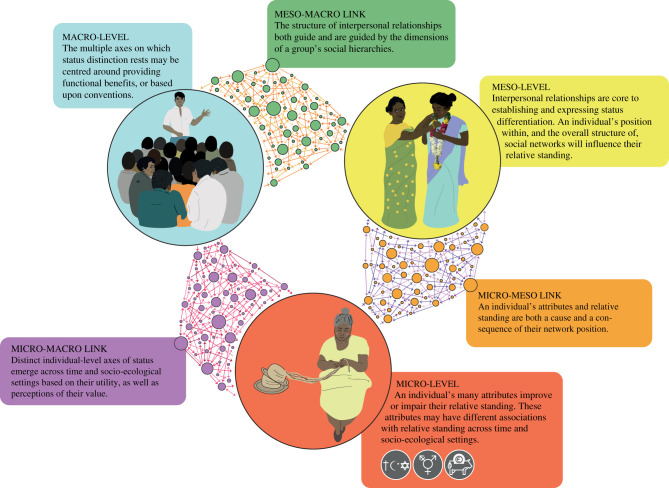
Across species, social hierarchies are often governed by dominance relations. In humans, where there are multiple culturally valued axes of distinction, social hierarchies can take a variety of forms and need not rest on dominance relations. Consequently, humans navigate multiple domains of status, i.e. relative standing. Importantly, while these hierarchies may be constructed from dyadic interactions, they are often more fundamentally guided by subjective peer evaluations and group perceptions. Researchers have typically focused on the distinct elements that shape individuals' relative standing, with some emphasizing individual-level attributes and others outlining emergent macro-level structural outcomes. Here, we synthesize work across the social sciences to suggest that the dynamic interplay between individual-level and meso-level properties of the social networks in which individuals are embedded are crucial for understanding the diverse processes of status differentiation across groups. More specifically, we observe that humans not only navigate multiple social hierarchies at any given time but also simultaneously operate within multiple, overlapping social networks. There are important dynamic feedbacks between social hierarchies and the characteristics of social networks, as the types of social relationships, their structural properties, and the relative position of individuals within them both influence and are influenced by status differentiation. This article is part of the theme issue 'The centennial of the pecking order: current state and future prospects for the study of dominance hierarchies'.
在不同物种中,社会等级制度通常受支配关系的支配。在人类中,由于存在多种具有文化价值的区别轴,社会等级制度可以采取多种形式,不一定依赖于支配关系。因此,人类在多个地位领域中进行导航,即相对地位。重要的是,虽然这些等级制度可能是由二元互动构建的,但它们通常更受主观同伴评价和群体感知的指导。研究人员通常专注于塑造个体相对地位的不同因素,有些强调个体层面的属性,有些则概述了新兴的宏观层面结构结果。在这里,我们综合了社会科学的研究工作,提出个体所处的社会网络的个体层面和中间层面属性之间的动态相互作用对于理解群体之间多样化的地位分化过程至关重要。更具体地说,我们观察到人类不仅在任何给定的时间都在多个社会等级制度中进行导航,而且还同时在多个重叠的社会网络中运作。社会等级制度和社会网络的特征之间存在着重要的动态反馈,因为社会关系的类型、它们的结构属性以及个体在其中的相对位置都既影响又受到地位分化的影响。本文是主题为“啄序的百年:支配等级制度研究的现状和未来前景”的一部分。