Armaly Miles T, Buckley David T, Enders Adam M
Department of Political Science, University of Mississippi, Oxford, MS USA.
Department of Political Science, University of Louisville, Louisville, USA.
Polit Behav. 2022;44(2):937-960. doi: 10.1007/s11109-021-09758-y. Epub 2022 Jan 4.
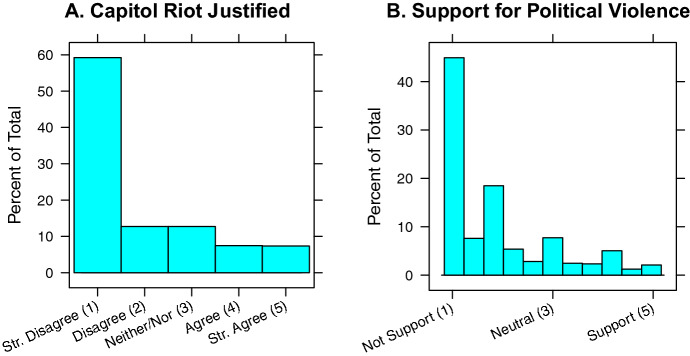
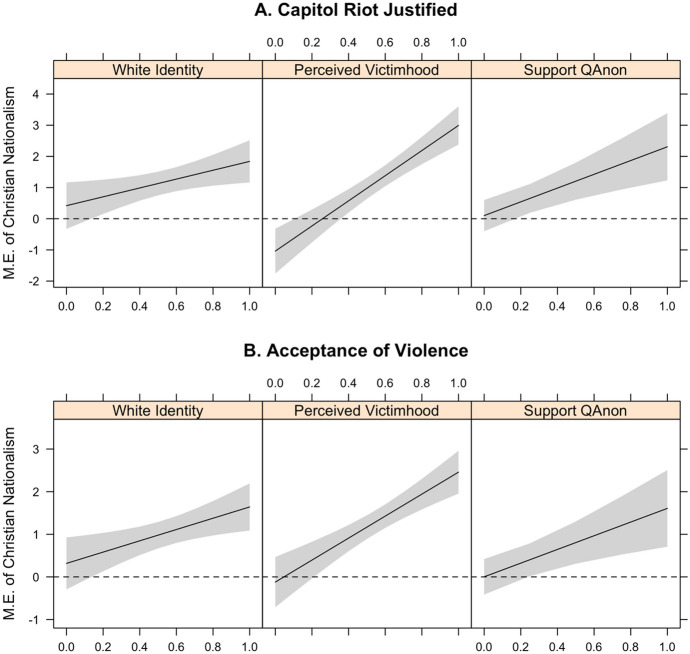
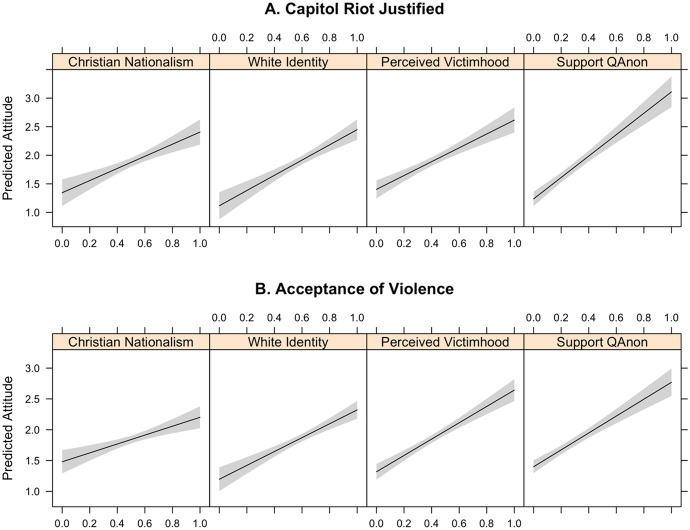
What explains popular support for political violence in the contemporary United States, particularly the anti-institutional mob that attacked the U.S. Capitol in January 2021? Recent scholarship gives reason to suspect that a constellation of beliefs known as "Christian nationalism" may be associated with support for such violence. We build on this work, arguing that religious ideologies like Christian nationalism should be associated with support for violence, conditional on several individual characteristics that can be inflamed by elite cues. We turn to three such factors long-studied by scholars of political violence: perceived victimhood, reinforcing racial and religious identities, and support for conspiratorial information sources. Each can be exacerbated by elite cues, thus translating individual beliefs in Christian nationalism into support for political violence. We test this approach with original survey data collected in the wake of the Capitol attacks. We find that all the identified factors are positively related to each other and support for the Capitol riot; moreover, the relationship between Christian nationalism and support for political violence is sharply conditioned by white identity, perceived victimhood, and support for the QAnon movement. These results suggest that religion's role in contemporary right-wing violence is embedded with non-religious factors that deserve further scholarly attention in making sense of support for political violence.
The online version contains supplementary material available at 10.1007/s11109-021-09758-y.
如何解释当代美国民众对政治暴力的支持,尤其是2021年1月袭击美国国会大厦的反建制暴徒的行为?近期的学术研究有理由怀疑,一系列被称为“基督教民族主义”的信仰可能与对这种暴力的支持有关。我们在此基础上展开研究,认为像基督教民族主义这样的宗教意识形态应该与对暴力的支持有关,这取决于一些可能被精英暗示激化的个人特征。我们转向政治暴力学者长期研究的三个此类因素:感知到的受害者身份、强化种族和宗教身份,以及对阴谋论信息源的支持。每一个因素都可能被精英暗示加剧,从而将个人对基督教民族主义的信仰转化为对政治暴力的支持。我们用在国会大厦袭击事件后收集的原始调查数据来检验这种方法。我们发现,所有确定的因素彼此之间以及与对国会大厦骚乱的支持都呈正相关;此外,基督教民族主义与对政治暴力的支持之间的关系在很大程度上取决于白人身份、感知到的受害者身份以及对“匿名者Q”运动的支持。这些结果表明,宗教在当代右翼暴力中的作用与非宗教因素交织在一起,在理解对政治暴力的支持方面,这些非宗教因素值得学术界进一步关注。
网络版包含可在10.1007/s11109-021-09758-y获取的补充材料。