Syrek Christine J, de Bloom Jessica, Lehr Dirk
Department of Business Psychology, Bonn Rhein-Sieg University of Applied Sciences, Rheinbach, Germany.
Department of Psychology, Tampere University, Tampere, Finland.
Front Psychol. 2021 Dec 23;12:784844. doi: 10.3389/fpsyg.2021.784844. eCollection 2021.
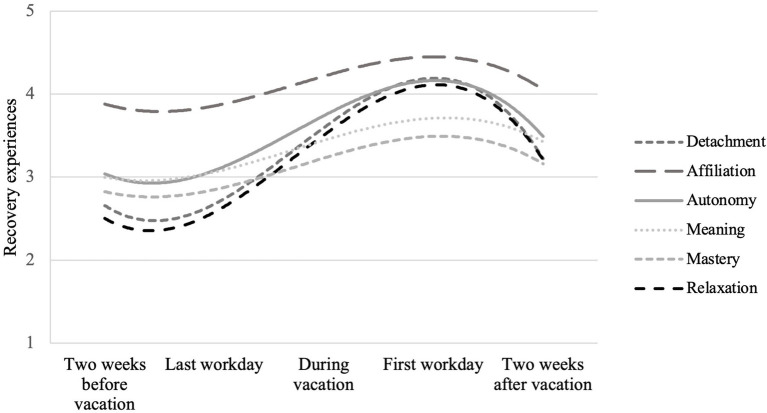
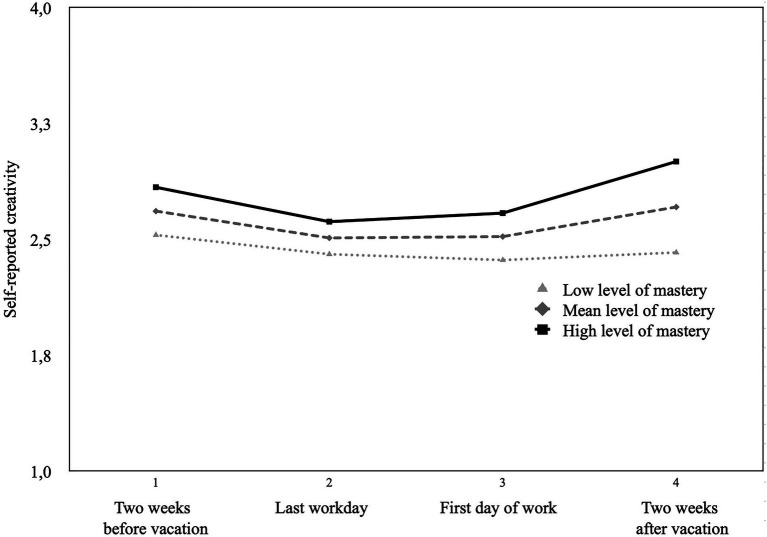
The aim of this study was to investigate employees' self-reported creativity before and after vacation and to examine the impact of recovery experiences (detachment, relaxation, mastery, meaning, autonomy, affiliation) on changes in creativity. The DRAMMA model of Newman et al. provides the theoretical background of our approach. Longitudinal data was assessed with four repeated measurements. The study encompassed data from 274 white-collar workers. Analyses showed that employees subjectively perceive their creativity to benefit not immediately after their vacation but 2 weeks later. Detachment was significantly related to lower creativity within persons, while mastery experiences explained differences in creativity between persons. This study provides a detailed picture of changes in creativity around vacations.
本研究旨在调查员工在休假前后自我报告的创造力,并检验恢复体验(超脱、放松、掌握、意义、自主、归属)对创造力变化的影响。纽曼等人的DRAMMA模型为我们的研究方法提供了理论背景。通过四次重复测量评估纵向数据。该研究涵盖了274名白领的数据。分析表明,员工主观上认为他们的创造力并非在休假后立即受益,而是在两周后受益。超脱与个体内部较低的创造力显著相关,而掌握体验则解释了个体之间创造力的差异。本研究详细描绘了休假前后创造力的变化情况。