Department of Radiology, University of California, San Diego, CA, United States.
GE Healthcare, San Diego, CA, United States.
Front Endocrinol (Lausanne). 2021 Dec 24;12:777080. doi: 10.3389/fendo.2021.777080. eCollection 2021.
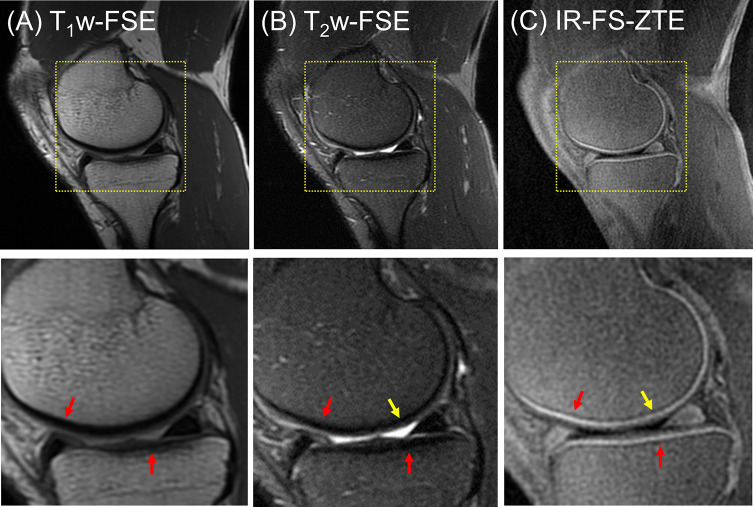
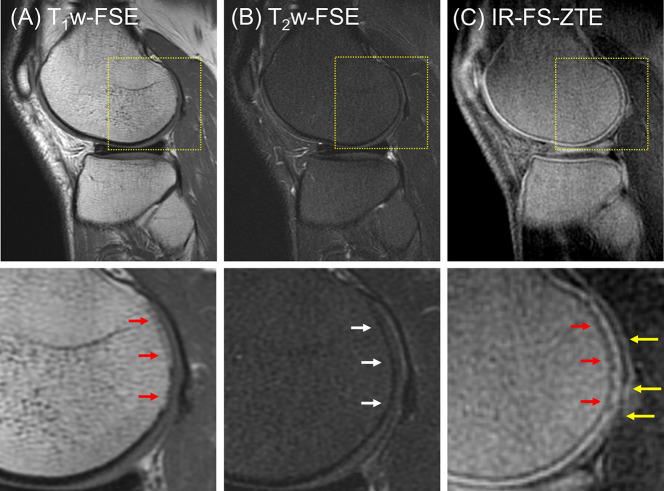
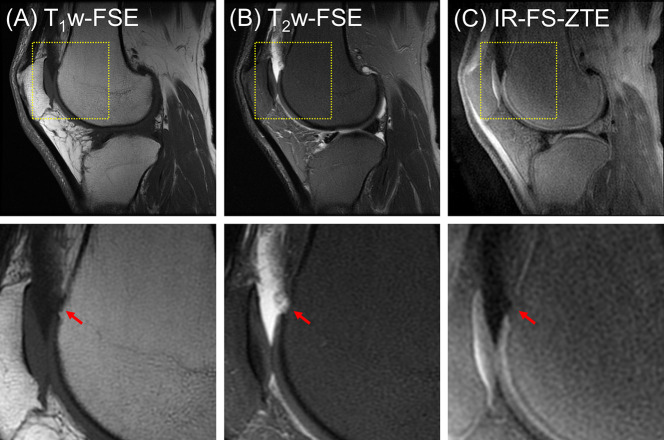
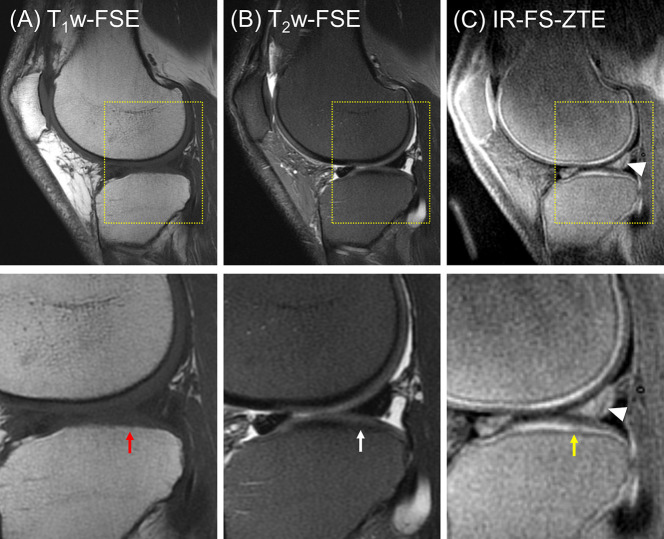
The osteochondral junction (OCJ) region-commonly defined to include the deep radial uncalcified cartilage, tidemark, calcified cartilage, and subchondral bone plate-functions to absorb mechanical stress and is commonly associated with the pathogenesis of osteoarthritis. However, magnetic resonance imaging of the OCJ region is difficult due to the tissues' short transverse relaxation times (i.e., short T or T*), which result in little or no signal with conventional MRI. The goal of this study is to develop a 3D adiabatic inversion recovery prepared fat saturated zero echo time (IR-FS-ZTE) sequence for high-contrast imaging of the OCJ.
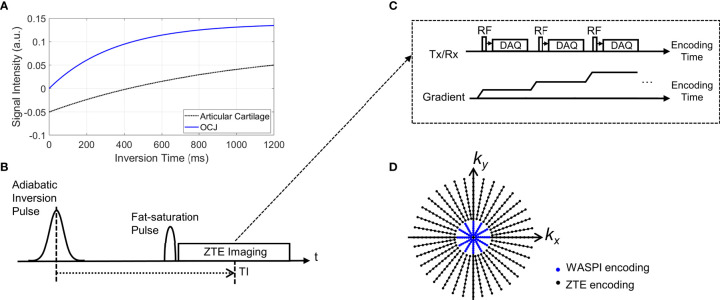
An IR-FS-ZTE MR sequence was developed to image the OCJ on a clinical 3T MRI scanner. The IR-FS-ZTE sequence employed an adiabatic inversion pulse followed by a fat saturation pulse that suppressed signals from the articular cartilage and fat. At an inversion time (TI) that was matched to the nulling point of the articular cartilage, continuous ZTE imaging was performed with a smoothly rotating readout gradient, which enabled time-efficient encoding of the OCJ region's short T signal with a minimal echo time (TE) of 12 μs. An ex vivo experiment with six cadaveric knee joints, and an experiment with six healthy volunteers and three patients with OA were performed to evaluate the feasibility of the proposed approach for high contrast imaging of the OCJ. Contrast-to-noise ratios (CNRs) between the OCJ and its neighboring femoral and tibial cartilage were measured.
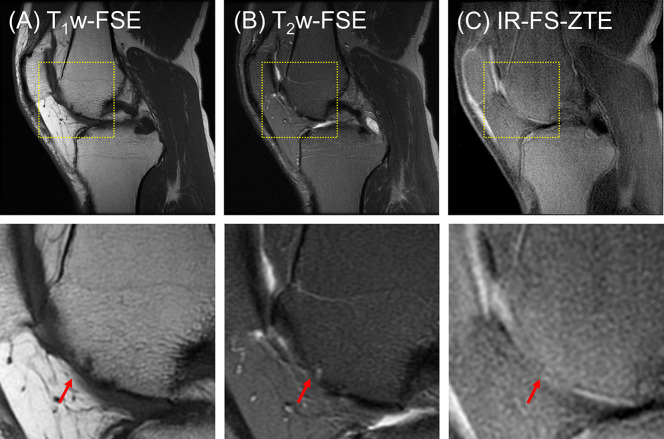
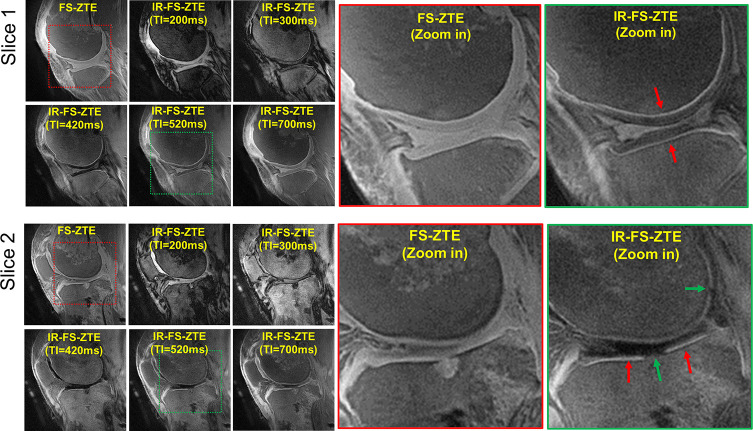
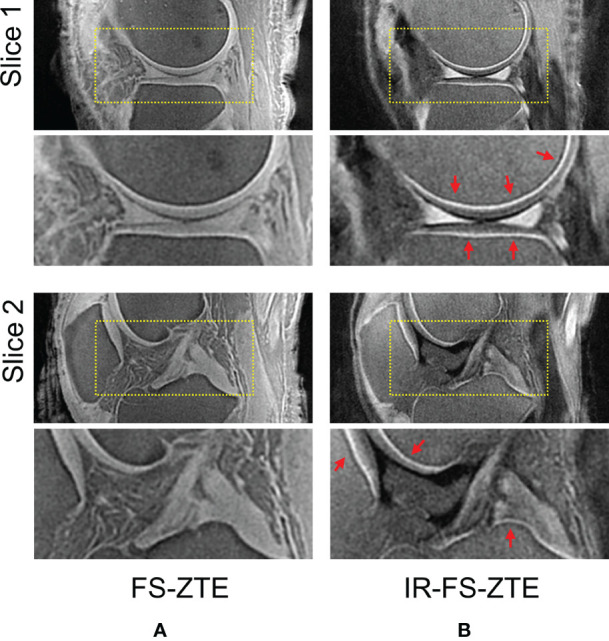
In the experiment, IR-FS-ZTE produced improved imaging of the OCJ region over the clinical sequences, and significantly improved the contrast compared to FS-ZTE without IR preparation (p = 0.0022 for tibial cartilage and p = 0.0019 for femoral cartilage with t-test). We also demonstrated the feasibility of high contrast imaging of the OCJ region using the proposed IR-FS-ZTE sequence, thereby providing more direct information on lesions in the OCJ. Clinical MRI did not detect signal from OCJ due to the long TE (>20 ms).
IR-FS-ZTE allows direct imaging of the OCJ region of the human knee and may help in elucidating the role of the OCJ in cartilage degeneration.
骨软骨连接(OCJ)区域通常被定义为包括深层桡侧未钙化软骨、边界带、钙化软骨和软骨下骨板,其功能是吸收机械应力,通常与骨关节炎的发病机制有关。然而,由于 OCJ 区域的组织横向弛豫时间较短(即短 T 或 T*),常规 MRI 几乎没有或没有信号,因此对 OCJ 区域的磁共振成像(MRI)较为困难。本研究的目的是开发一种 3D 绝热反转恢复脂肪饱和零回波时间(IR-FS-ZTE)序列,以实现 OCJ 的高对比度成像。
开发了一种 IR-FS-ZTE MR 序列,以在临床 3T MRI 扫描仪上对 OCJ 进行成像。IR-FS-ZTE 序列采用绝热反转脉冲,随后采用脂肪饱和脉冲,抑制关节软骨和脂肪的信号。在与关节软骨的零值点匹配的反转时间(TI)下,连续进行 ZTE 成像,采用平滑旋转的读出梯度,以 12μs 的最小回波时间(TE)对 OCJ 区域的短 T 信号进行高效编码。进行了一项包含 6 个尸体膝关节的离体实验和一项包含 6 个健康志愿者和 3 个 OA 患者的实验,以评估该方法用于 OCJ 高对比度成像的可行性。测量了 OCJ 与其相邻的股骨和胫骨软骨之间的对比噪声比(CNR)。
在实验中,与临床序列相比,IR-FS-ZTE 对 OCJ 区域的成像效果得到了改善,并且与无 IR 准备的 FS-ZTE 相比,对比度显著提高(胫骨软骨 p=0.0022,股骨软骨 p=0.0019,t 检验)。我们还证明了使用所提出的 IR-FS-ZTE 序列对 OCJ 区域进行高对比度成像的可行性,从而提供了 OCJ 病变的更直接信息。由于较长的 TE(>20ms),临床 MRI 无法检测到 OCJ 的信号。
IR-FS-ZTE 允许直接对人膝关节的 OCJ 区域进行成像,可能有助于阐明 OCJ 在软骨退变中的作用。