Institute of Human Genetics, Polish Academy of Sciences, Poznań, Poland.
Discipline of Medical Genetics and Centre for Information-Based Medicine, The University of Newcastle and Hunter Medical Research Institute, Newcastle, NSW, Australia.
Front Immunol. 2021 Dec 22;12:790803. doi: 10.3389/fimmu.2021.790803. eCollection 2021.
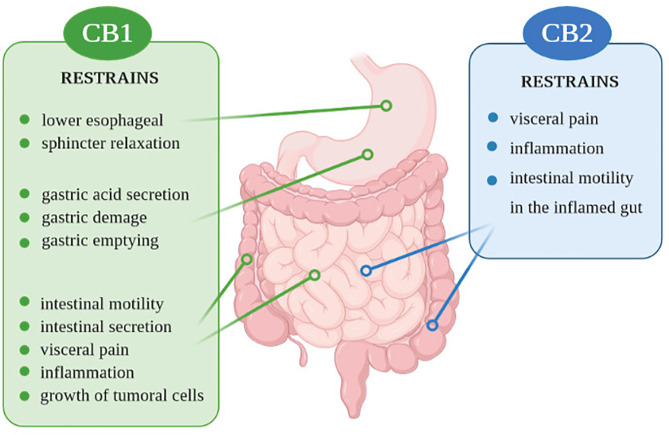
Inflammatory bowel disease (IBD) is a general term used to describe a group of chronic inflammatory conditions of the gastrointestinal tract of unknown etiology, including two primary forms: Crohn's disease (CD) and ulcerative colitis (UC). The endocannabinoid system (ECS) plays an important role in modulating many physiological processes including intestinal homeostasis, modulation of gastrointestinal motility, visceral sensation, or immunomodulation of inflammation in IBD. It consists of cannabinoid receptors (CB1 and CB2), transporters for cellular uptake of endocannabinoid ligands, endogenous bioactive lipids (Anandamide and 2-arachidonoylglycerol), and the enzymes responsible for their synthesis and degradation (fatty acid amide hydrolase and monoacylglycerol lipase), the manipulation of which through agonists and antagonists of the system, shows a potential therapeutic role for ECS in inflammatory bowel disease. This review summarizes the role of ECS components on intestinal inflammation, suggesting the advantages of cannabinoid-based therapies in inflammatory bowel disease.
炎症性肠病(IBD)是一组用于描述胃肠道慢性炎症性疾病的总称,病因不明,包括两种主要形式:克罗恩病(CD)和溃疡性结肠炎(UC)。内源性大麻素系统(ECS)在调节许多生理过程中起着重要作用,包括肠道稳态、胃肠道动力调节、内脏感觉或炎症的免疫调节在 IBD 中。它由大麻素受体(CB1 和 CB2)、内源性生物活性脂质(大麻素和 2-花生四烯酸甘油)的细胞摄取转运体以及负责其合成和降解的酶(脂肪酸酰胺水解酶和单酰基甘油脂肪酶)组成,通过该系统的激动剂和拮抗剂对其进行操纵,显示 ECS 在炎症性肠病中的潜在治疗作用。这篇综述总结了 ECS 成分在肠道炎症中的作用,表明基于大麻素的治疗在炎症性肠病中的优势。