Di Pietro R, Basile M, Antolini L, Alberti S
Department of Medicine and Aging Sciences, Section of Biomorphology, G. d'Annunzio University of Chieti-Pescara, Chieti, Italy.
Center for Biostatistics, Department of Clinical Medicine, Prevention and Biotechnology, University of Milano-Bicocca, Monza, Italy.
Front Genet. 2021 Dec 23;12:663371. doi: 10.3389/fgene.2021.663371. eCollection 2021.
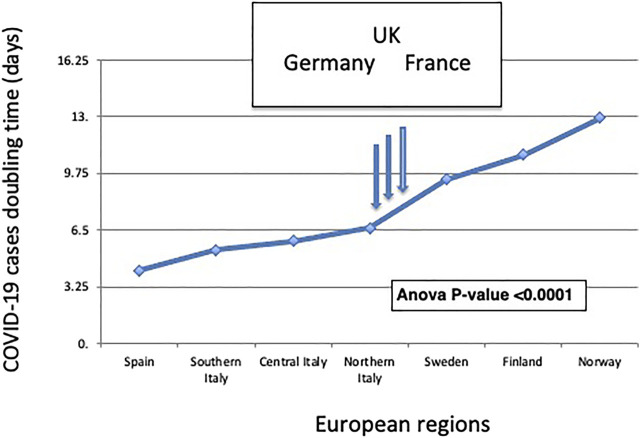
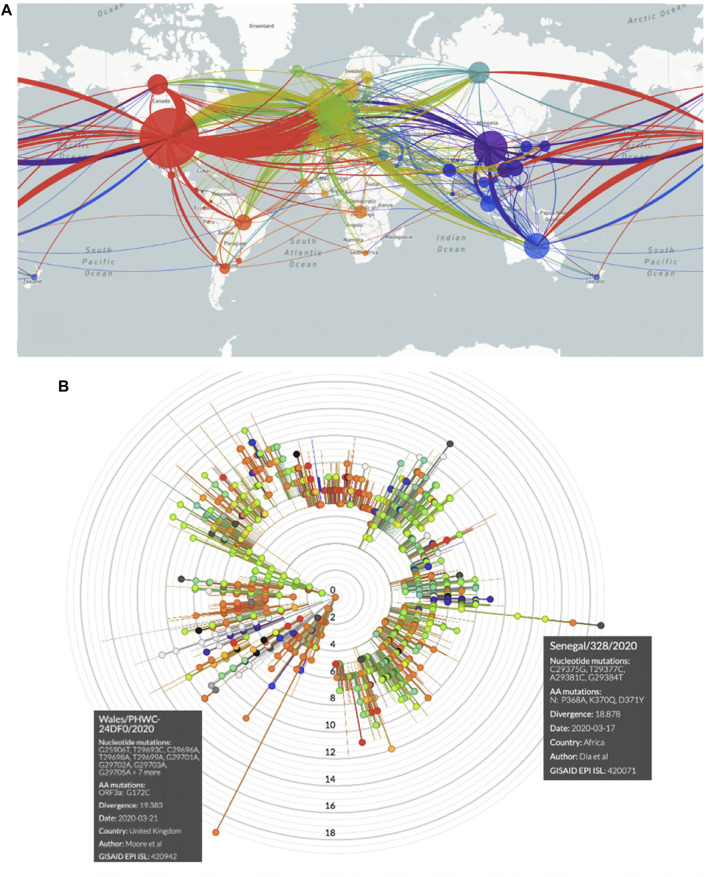
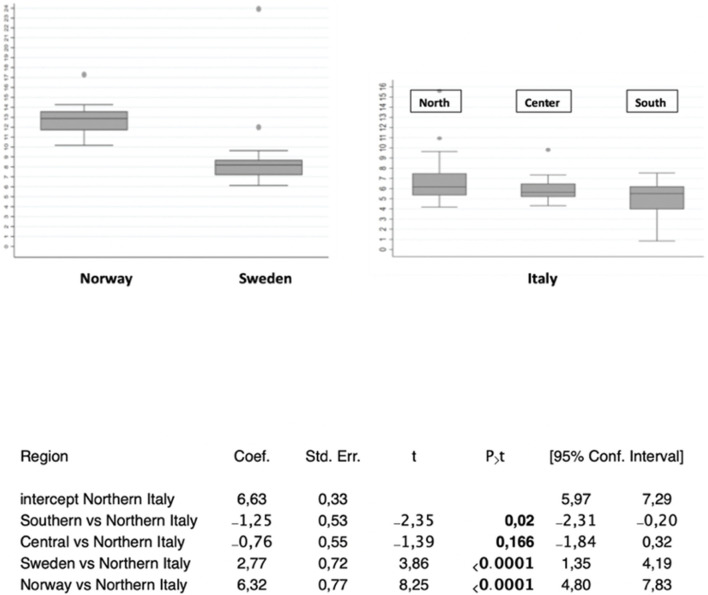
The current propagation models of COVID-19 are poorly consistent with existing epidemiological data and with evidence that the SARS-CoV-2 genome is mutating, for potential aggressive evolution of the disease. We looked for fundamental variables that were missing from current analyses. Among them were regional climate heterogeneity, viral evolution processes versus founder effects, and large-scale virus containment measures. We challenged regional versus genetic evolution models of COVID-19 at a whole-population level, over 168,089 laboratory-confirmed SARS-CoV-2 infection cases in Italy, Spain, and Scandinavia at early time-points of the pandemic. Diffusion data in Germany, France, and the United Kingdom provided a validation dataset of 210,239 additional cases. Mean doubling time of COVID-19 cases was 6.63 days in Northern versus 5.38 days in Southern Italy. Spain extended this trend of faster diffusion in Southern Europe, with a doubling time of 4.2 days. Slower doubling times were observed in Sweden (9.4 days), Finland (10.8 days), and Norway (12.95 days). COVID-19 doubling time in Germany (7.0 days), France (7.5 days), and the United Kingdom (7.2 days) supported the North/South gradient model. Clusters of SARS-CoV-2 mutations upon sequential diffusion were not found to clearly correlate with regional distribution dynamics. Acquisition of mutations upon SARS-CoV-2 spreading failed to explain regional diffusion heterogeneity at early pandemic times. Our findings indicate that COVID-19 transmission rates are rather associated with a sharp North/South climate gradient, with faster spreading in Southern regions. Thus, warmer climate conditions may not limit SARS-CoV-2 infectivity. Very cold regions may be better spared by recurrent courses of SARS-CoV-2 infection.
当前的新冠病毒传播模型与现有的流行病学数据以及新冠病毒基因组正在发生突变的证据严重不符,这意味着该疾病可能会发生激进的演变。我们寻找了当前分析中缺失的基本变量。其中包括区域气候异质性、病毒进化过程与奠基者效应,以及大规模的病毒控制措施。在疫情早期,我们在意大利、西班牙和斯堪的纳维亚半岛的168089例实验室确诊的新冠病毒感染病例的全人群水平上,对新冠病毒的区域与基因进化模型提出了质疑。德国、法国和英国的传播数据提供了另外210239例病例的验证数据集。意大利北部新冠病毒病例的平均倍增时间为6.63天,而南部为5.38天。西班牙延续了这种在南欧传播更快的趋势,倍增时间为4.2天。在瑞典(9.4天)、芬兰(10.8天)和挪威(12.95天)观察到了较慢的倍增时间。德国(7.0天)、法国(7.5天)和英国(7.2天)的新冠病毒倍增时间支持了南北梯度模型。在连续传播过程中未发现新冠病毒突变簇与区域分布动态有明显关联。在疫情早期,新冠病毒传播过程中获得的突变无法解释区域传播异质性。我们的研究结果表明,新冠病毒的传播率与南北气候梯度密切相关,在南部地区传播更快。因此,温暖的气候条件可能不会限制新冠病毒的传染性。非常寒冷的地区可能会因新冠病毒的反复感染而更好地幸免。