Liao Guixiang, Zhao Zhihong, Qian Yuting, Ling Xiean, Chen Shanyi, Li Xianming, Kong Feng-Ming Spring
Department of Radiation Oncology, Shenzhen People's Hospital, The Second Clinical Medical College, Jinan University, Shenzhen, China.
Department of Nephrology, Shenzhen People's Hospital, The Second Clinical Medical College, Jinan University, Shenzhen, China.
Front Oncol. 2021 Dec 23;11:774131. doi: 10.3389/fonc.2021.774131. eCollection 2021.
The objective of this study was to explore whether soluble programmed death ligand 1 (sPD-L1) is a potential prognostic biomarker in patients with non-small cell lung cancer (NSCLC).
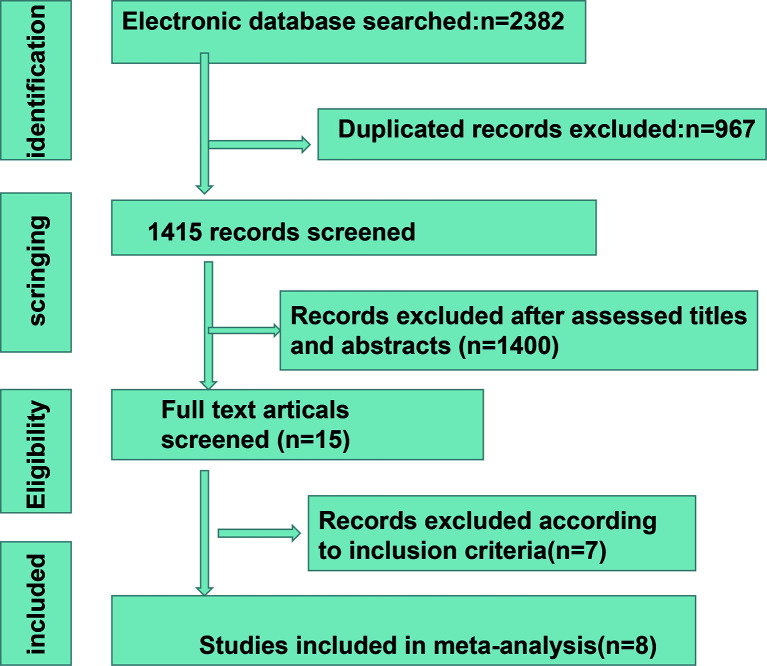
A comprehensive search of electronic databases was carried out. Original studies with inclusion of sPD-L1, progression-free survival, and overall survival in NSCLC were eligible. The primary endpoints were overall survival and progression-free survival. Hazard ratios (HRs) and 95% confidence intervals (CIs) were applied for data analysis.
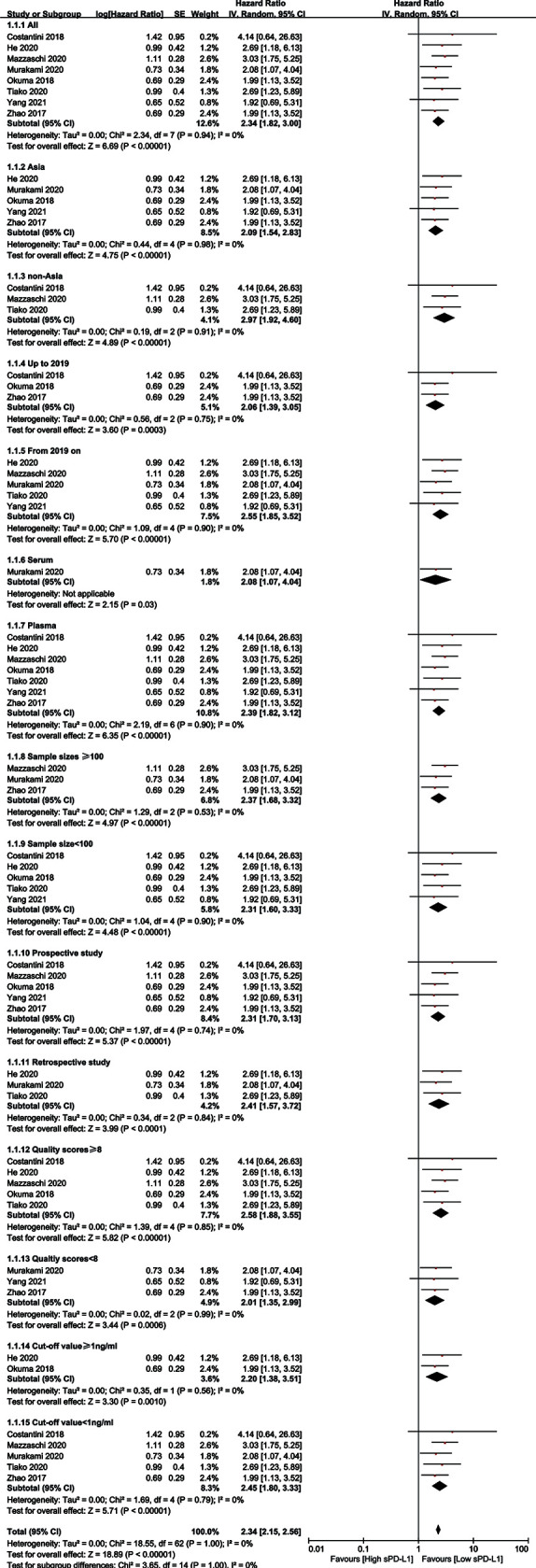
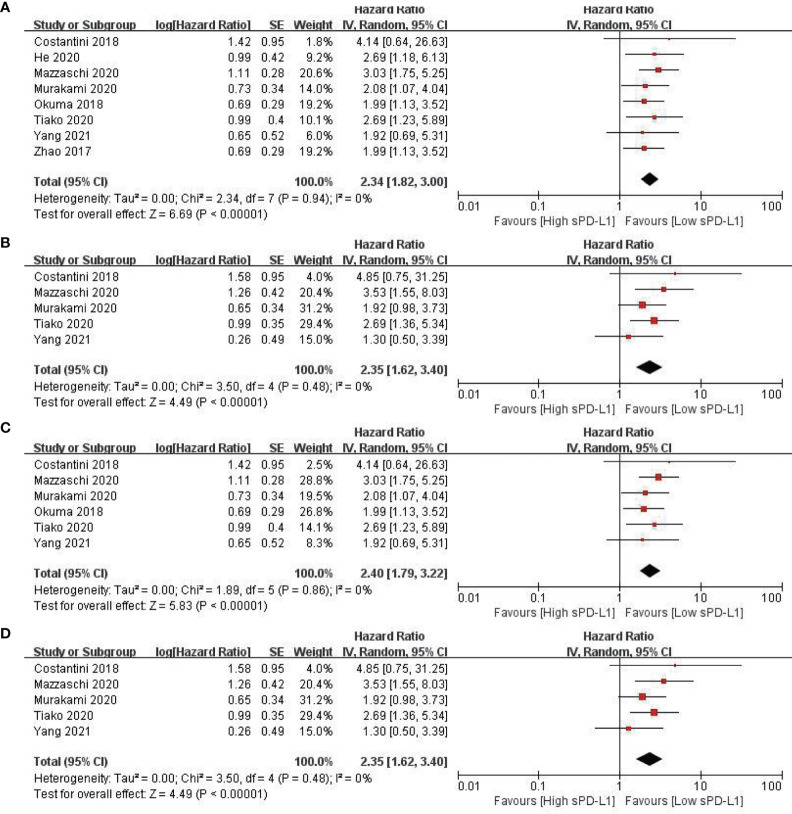
Eight studies involving 710 patients with NSCLC were included in the analysis. A pooled data analysis revealed that high levels of sPD-L1 were correlated with poorer overall survival (HR = 2.34; 95% CI = 1.82-3.00; < 0.001) and progression-free survival (HR = 2.35; 95% CI = 1.62-3.40, < 0.001). A subgroup analysis revealed that high levels of sPD-L1 were correlated with poor overall survival in patients treated with immunotherapy (HR = 2.40; 95% CI = 1.79-3.22; < 0.001).
This pooled analysis of published data suggests that sPD-L1 may serve as a readily available biomarker for survival in NSCLC patients treated with ICI based treatment. Prospective studies with well-designed standard assessment methods should be conducted to validate the prognostic role of sPD-L1 in NSCLC.
https://www.crd.york.ac.uk/prospero/display_record.php?ID=CRD42021283177.
本研究旨在探讨可溶性程序性死亡配体1(sPD-L1)是否是非小细胞肺癌(NSCLC)患者潜在的预后生物标志物。
对电子数据库进行全面检索。纳入包含NSCLC患者的sPD-L1、无进展生存期和总生存期的原始研究。主要终点为总生存期和无进展生存期。采用风险比(HRs)和95%置信区间(CIs)进行数据分析。
分析纳入了八项涉及710例NSCLC患者的研究。汇总数据分析显示,高水平的sPD-L1与较差的总生存期(HR = 2.34;95% CI = 1.82 - 3.00;< 0.001)和无进展生存期(HR = 2.35;95% CI = 1.62 - 3.40,< 0.001)相关。亚组分析显示,高水平的sPD-L1与接受免疫治疗患者的不良总生存期相关(HR = 2.40;95% CI = 1.79 - 3.22;< 0.001)。
这项对已发表数据的汇总分析表明,sPD-L1可能是接受免疫检查点抑制剂(ICI)治疗的NSCLC患者生存情况的一个现成生物标志物。应开展采用精心设计的标准评估方法的前瞻性研究,以验证sPD-L1在NSCLC中的预后作用。
https://www.crd.york.ac.uk/prospero/display_record.php?ID=CRD42021283177 。