Yao Shiyi, Yung Patrick Shu Hang, Lui Pauline Po Yee
Department of Orthopaedics and Traumatology, The Chinese University of Hong Kong, Shatin, Hong Kong SAR, China.
Front Bioeng Biotechnol. 2021 Dec 22;9:756930. doi: 10.3389/fbioe.2021.756930. eCollection 2021.
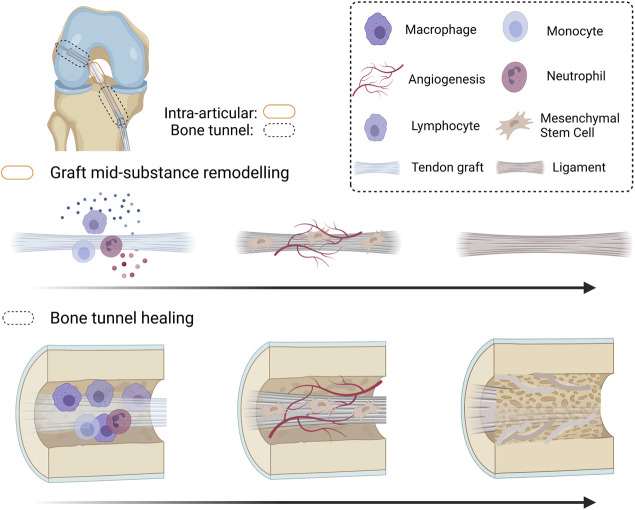
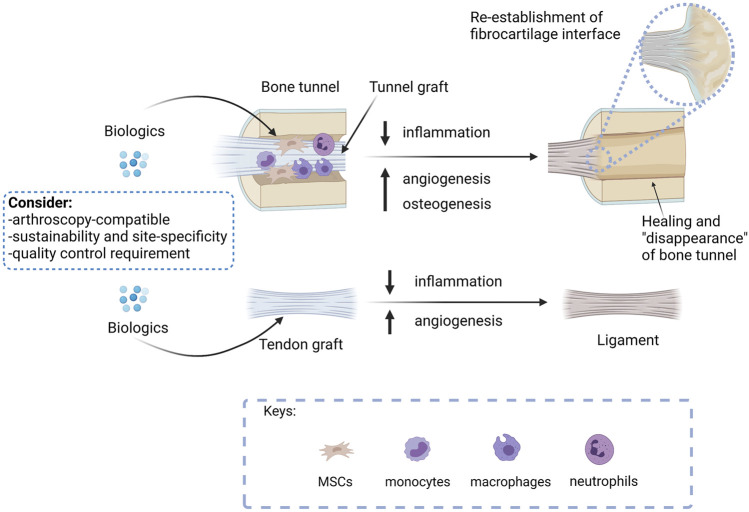
Anterior cruciate ligament (ACL) tear is common in sports and accidents, and accounts for over 50% of all knee injuries. ACL reconstruction (ACLR) is commonly indicated to restore the knee stability, prevent anterior-posterior translation, and reduce the risk of developing post-traumatic osteoarthritis. However, the outcome of biological graft healing is not satisfactory with graft failure after ACLR. Tendon graft-to-bone tunnel healing and graft mid-substance remodeling are two key challenges of biological graft healing after ACLR. Mounting evidence supports excessive inflammation due to ACL injury and ACLR, and tendon graft-to-bone tunnel motion negatively influences these two key processes. To tackle the problem of biological graft healing, we believe that an inductive approach should be adopted, starting from the endpoint that we expected after ACLR, even though the results may not be achievable at present, followed by developing clinically practical strategies to achieve this ultimate goal. We believe that mineralization of tunnel graft and ligamentization of graft mid-substance to restore the ultrastructure and anatomy of the original ACL are the ultimate targets of ACLR. Hence, strategies that are osteoinductive, angiogenic, or anti-inflammatory should drive graft healing toward the targets. This paper reviews pre-clinical and clinical literature supporting this claim and the role of inflammation in negatively influencing graft healing. The practical considerations when developing a biological therapy to promote ACLR for future clinical translation are also discussed.
前交叉韧带(ACL)撕裂在运动和意外事故中很常见,占所有膝关节损伤的50%以上。ACL重建术(ACLR)通常用于恢复膝关节稳定性、防止前后移位以及降低创伤后骨关节炎的发生风险。然而,生物移植物愈合的结果并不理想,ACLR后会出现移植物失败的情况。肌腱移植物与骨隧道的愈合以及移植物中间部分的重塑是ACLR后生物移植物愈合的两个关键挑战。越来越多的证据表明,ACL损伤和ACLR会导致过度炎症,而肌腱移植物与骨隧道的移动会对这两个关键过程产生负面影响。为了解决生物移植物愈合的问题,我们认为应该采用一种诱导性方法,从ACLR后我们期望达到的终点出发,尽管目前可能无法实现这些结果,然后制定临床实用策略来实现这一最终目标。我们认为,隧道移植物的矿化和移植物中间部分的韧带化以恢复原始ACL的超微结构和解剖结构是ACLR的最终目标。因此,具有骨诱导、血管生成或抗炎作用的策略应推动移植物愈合朝着这些目标发展。本文回顾了支持这一观点的临床前和临床文献,以及炎症对移植物愈合产生负面影响的作用。还讨论了开发促进ACLR的生物疗法以便未来进行临床转化时的实际考虑因素。