Bennett Erin E, Kwan Abraham, Gianattasio Kan Z, Engelman Brittany, Dowling N Maritza, Power Melinda C
Department of Epidemiology, Milken Institute School of Public Health George Washington University Washington District of Columbia USA.
Department of Acute and Chronic Care, School of Nursing George Washington University Washington District of Columbia USA.
Alzheimers Dement (N Y). 2021 Dec 31;7(1):e12237. doi: 10.1002/trc2.12237. eCollection 2021.
Ensuring adequate and equitable distribution of resources to support persons living with dementia relies on understanding the burden and distribution of dementia in a population. Our goal was to develop an approach to estimate dementia prevalence at the local level in the United States using publicly available data.
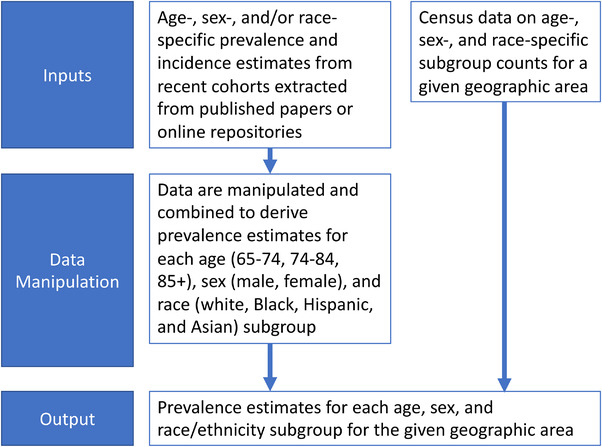
Our approach combines publicly available data on dementia prevalence and demographic data from the US Census to estimate dementia prevalence. We illustrate this approach by estimating dementia prevalence in persons aged 65 and older in Philadelphia, PA; Chicago, IL; and Atlanta, GA.
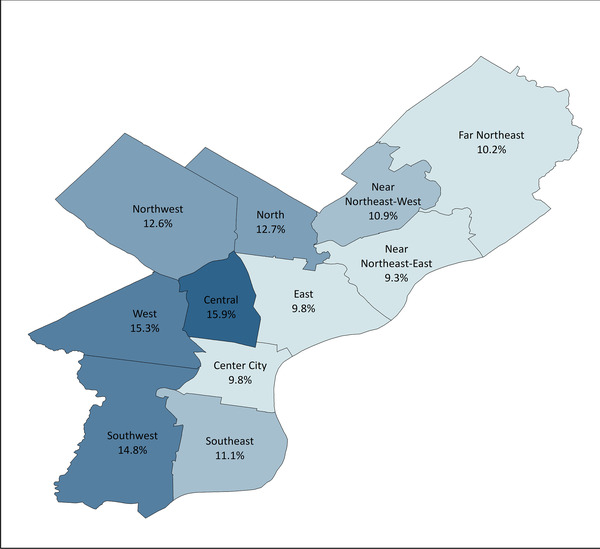
Overall, we estimate the prevalence of dementia among those 65 and older to be 11.9% in Philadelphia, 11.8% Chicago, and 12.3% in Atlanta. Estimates across Philadelphia localities vary from 9.3% to 15.9%.
Our approach provides a cost-effective method to generate estimates of dementia prevalence at the local level.
Brain health needs assessments require understanding of local dementia prevalence.Our approach can be used to estimate dementia prevalence in individual communities.This information can inform decisions about distribution of resources.
确保资源的充分且公平分配以支持痴呆症患者,这依赖于了解人群中痴呆症的负担及分布情况。我们的目标是利用公开可用数据,开发一种在美国地方层面估算痴呆症患病率的方法。
我们的方法将公开可用的痴呆症患病率数据与美国人口普查的人口统计数据相结合,以估算痴呆症患病率。我们通过估算宾夕法尼亚州费城、伊利诺伊州芝加哥和佐治亚州亚特兰大65岁及以上人群的痴呆症患病率来说明这种方法。
总体而言,我们估计费城65岁及以上人群中痴呆症患病率为11.9%,芝加哥为11.8%,亚特兰大为12.3%。费城各地区的估计患病率从9.3%到15.9%不等。
我们的方法提供了一种经济有效的方法来生成地方层面痴呆症患病率的估计值。
脑健康需求评估需要了解地方痴呆症患病率。我们的方法可用于估算各个社区的痴呆症患病率。这些信息可为资源分配决策提供参考。