Dubey Avinash Kumar, Sahoo Jayaprakash, Vairappan Balasubramaniyan, Parameswaran Sreejith, Ps Priyamvada
Department of Nephrology, Jawaharlal Institute of Postgraduate Medical Education and Research, Puducherry, 605006, India.
Department of Endocrinology, Jawaharlal Institute of Postgraduate Medical Education and Research, Puducherry, 605006, India.
Osteoporos Sarcopenia. 2021 Dec;7(4):153-158. doi: 10.1016/j.afos.2021.11.003. Epub 2021 Dec 4.
There is limited literature on the prevalence and determinants of sarcopenia in the Indian predialysis chronic kidney disease (CKD) population. The current study attempts to characterize sarcopenia in CKD stages 3 & 4 using 3-compartment model dual-energy X-ray absorptiometry (DXA).
This is secondary data from a randomized trial on bicarbonate supplementation for preserving muscle mass. A 3-compartment DXA was done to assess body composition in 188 subjects aged 18 to 65, with stable kidney function. Sarcopenia was defined by Asian Working Group criteria - appendicular skeletal mass index < 5.4 kg/m in women and < 7 kg/m in men.
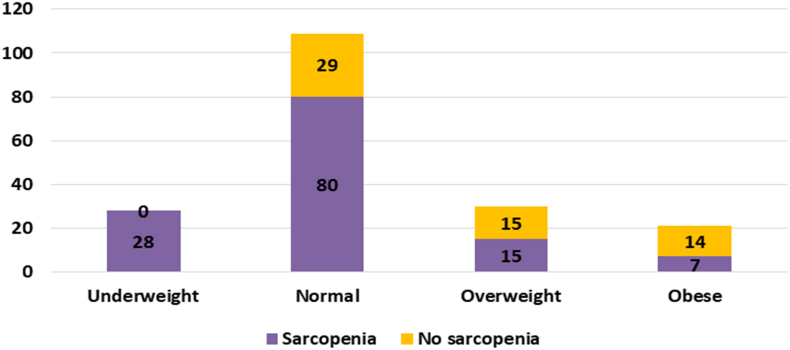
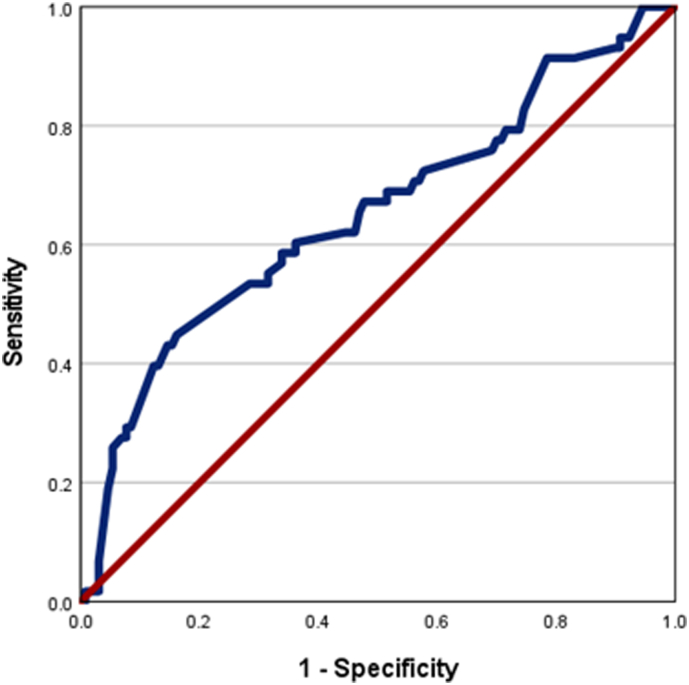
Sarcopenia was present in 69.1% (n = 130). There was no difference in the prevalence of sarcopenia in CKD stage 3 (n = 62; 72.1%) vs CKD stage 4 (n = 68, 66.7%); P = 0.434. A lower body mass index (BMI) (OR 1.69; 95% CI 1.43, 2.01) and lower bicarbonate levels (OR 1.22; 95% CI 1.02, 1.47), and age (OR 0.95; 95% CI 0.91, 0.98) was independently associated with the muscle mass. A BMI cut-off of 18 failed to identify sarcopenia in 78.4% (n = 102) subjects (Kappa statistic 0.396). The receiver operating characteristic curve for mid-arm muscle circumference for identifying sarcopenia was 0.651 (95% CI 0.561, 0.740).
Sarcopenia is highly prevalent in CKD 3 and 4. Sarcopenic individuals are older, with a low BMI and lower bicarbonate levels. The anthropometric parameters and biochemical parameters did not help identify sarcopenia in the predialysis population.
关于印度透析前慢性肾脏病(CKD)人群中肌肉减少症的患病率及决定因素的文献有限。本研究试图使用三室模型双能X线吸收法(DXA)对3期和4期CKD患者的肌肉减少症进行特征描述。
这是一项关于补充碳酸氢盐以维持肌肉量的随机试验的二次数据。对188名年龄在18至65岁、肾功能稳定的受试者进行三室DXA检查以评估身体成分。肌肉减少症根据亚洲工作组标准定义——女性四肢骨骼肌质量指数<5.4kg/m²,男性<7kg/m²。
肌肉减少症的发生率为69.1%(n = 130)。3期CKD(n = 62;72.1%)与4期CKD(n = 68,66.7%)患者的肌肉减少症患病率无差异;P = 0.434。较低的体重指数(BMI)(比值比[OR]1.69;95%置信区间[CI]1.43,2.01)、较低的碳酸氢盐水平(OR 1.22;95%CI 1.02,1.47)以及年龄(OR 0.95;95%CI 0.91,0.98)与肌肉量独立相关。BMI临界值为18时,78.4%(n = 102)的受试者未被诊断为肌肉减少症(卡帕统计量0.396)。用于识别肌肉减少症的上臂肌肉周长的受试者工作特征曲线为0.651(95%CI 0.561,0.740)。
肌肉减少症在3期和4期CKD患者中高度流行。肌肉减少症患者年龄较大,BMI较低且碳酸氢盐水平较低。人体测量参数和生化参数无助于识别透析前人群中的肌肉减少症。