Division of Rheumatology, Brigham and Women's Hospital, Harvard Medical School, Boston, Massachusetts.
Department of Epidemiology, University of Pittsburgh, Pittsburgh, Pennsylvania.
JAMA Netw Open. 2022 Jan 4;5(1):e2142773. doi: 10.1001/jamanetworkopen.2021.42773.
Women in midlife often develop chronic conditions and experience declines in physical health and function. Identifying factors associated with declines in physical health and function among these women may allow for targeted interventions.
To examine the factors associated with clinically important 10-year declines in the physical component summary score (PCS) of the Short Form 36 (SF-36), a widely used patient-reported outcome measure, in women in midlife.
DESIGN, SETTING, AND PARTICIPANTS: This longitudinal cohort study collected data from geographically dispersed sites in the US. Participants were part of the Study of Women's Health Across the Nation (SWAN), a racially and ethnically diverse cohort of women enrolled at or immediately before the menopause transition. Women have been followed for up to 21 years, between 1996 and 2016, with annual visits. Data were analyzed from October 2020 to March 2021.
Demographic indicators, health status measures, and laboratory and imaging assessments.
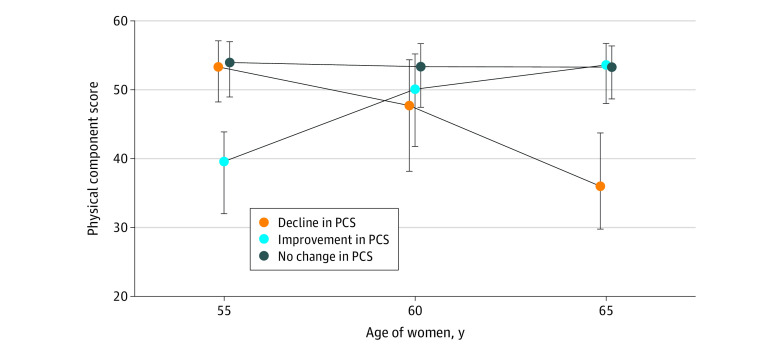
The main outcome was a clinically important decline (≥8 points) on the PCS, based on the 10-year difference in scores between ages 55 and 65 years.
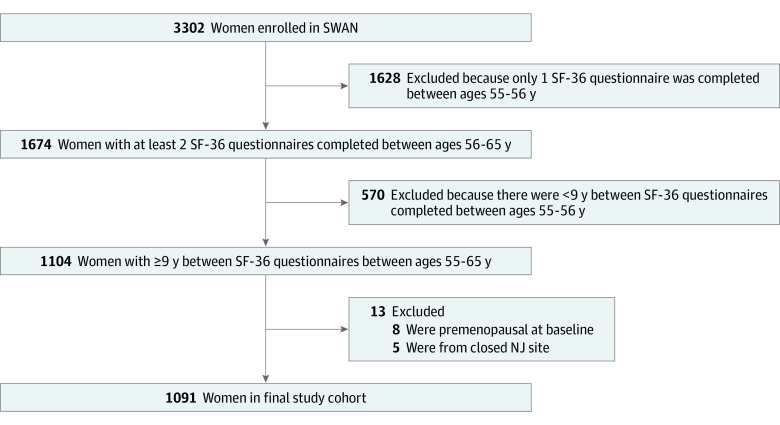
From the SWAN cohort of 3302 women, 1091 women (median [IQR] age, 54.8 [54.3-55.4] years; 264 [24.2%] Black women; 126 [11.6%] Chinese women; 135 [12.4%] Japanese women; 566 [51.9%] White women) were eligible for analyses based on duration of follow-up and availability of SF-36 data. At age 55, women had a median (IQR) body mass index (BMI; calculated as weight in kilograms divided by height in meters squared) of 27.0 (23.2-32.6), a median (IQR) baseline PCS of 53.1 (46.8-56.7), 108 women (9.9%) were current smokers, and 938 women (86.3%) had at least 1 comorbidity. Between ages 55 and 65 years, the median (IQR) change in PCS was -1.02 (-6.11 to 2.53) points with 206 women (18.9%) experiencing declines of 8 points or more. In multivariable models, factors associated with clinically important decline included higher baseline PCS (odds ratio [OR], 1.08; 95% CI, 1.06-1.11), greater BMI (OR, 1.06; 95% CI, 1.03-1.09), less educational attainment (OR, 1.87; 95% CI, 1.32-2.65), current smoking (OR, 1.93; 95% CI, 1.14-3.26), osteoarthritis (OR, 1.46; 95% CI, 1.01-2.09), clinically significant depressive symptoms (OR, 2.03; 95% CI, 1.34-3.09), and cardiovascular disease (OR, 2.06; 95% CI, 1.26-3.36).
In this cohort study, clinically important declines in women's physical health and function were relatively common between ages 55 and 65 years. Several variables associated with these declines were identified as potentially useful components in a clinical score identifying women at increased risk of physical health and functional declines.
女性在中年时常会患上慢性疾病,并经历身体和功能健康的下降。确定与这些女性身体健康和功能下降相关的因素可能有助于进行有针对性的干预。
检查与女性中年时身体健康综合评分(PCS)的 10 年临床重要下降相关的因素,身体健康综合评分是一种广泛使用的患者报告结果衡量标准。
设计、地点和参与者:这项纵向队列研究从美国各地的地理分散地点收集数据。参与者是女性健康研究(SWAN)的一部分,这是一个种族和民族多样化的女性队列,在绝经过渡期间或之前立即入组。女性已经随访了长达 21 年,从 1996 年到 2016 年,每年进行一次访问。数据分析于 2020 年 10 月至 2021 年 3 月进行。
人口统计学指标、健康状况衡量标准以及实验室和影像学评估。
主要结果是基于年龄在 55 岁至 65 岁之间评分差异的 10 年,PCS 上的临床显著下降(≥8 分)。
在 SWAN 队列的 3302 名女性中,根据随访时间和 SF-36 数据的可用性,1091 名女性(中位数[IQR]年龄,54.8[54.3-55.4]岁;264 名[24.2%]黑人女性;126 名[11.6%]中国女性;135 名[12.4%]日本女性;566 名[51.9%]白人女性)符合分析条件。在 55 岁时,女性的 BMI(体重公斤数除以身高米数的平方)中位数(IQR)为 27.0(23.2-32.6),PCS 基线中位数(IQR)为 53.1(46.8-56.7),108 名女性(9.9%)为当前吸烟者,938 名女性(86.3%)有至少 1 种合并症。在 55 岁至 65 岁之间,PCS 的中位数(IQR)变化为-1.02(-6.11 至 2.53)点,有 206 名女性(18.9%)下降了 8 分或更多。在多变量模型中,与临床显著下降相关的因素包括更高的基线 PCS(优势比[OR],1.08;95%CI,1.06-1.11)、更大的 BMI(OR,1.06;95%CI,1.03-1.09)、较低的教育程度(OR,1.87;95%CI,1.32-2.65)、当前吸烟(OR,1.93;95%CI,1.14-3.26)、骨关节炎(OR,1.46;95%CI,1.01-2.09)、临床显著抑郁症状(OR,2.03;95%CI,1.34-3.09)和心血管疾病(OR,2.06;95%CI,1.26-3.36)。
在这项队列研究中,女性在 55 岁至 65 岁之间身体和功能健康的临床显著下降相对常见。确定了与这些下降相关的几个变量,它们可能是识别身体和功能健康下降风险增加的女性的临床评分中的有用组成部分。