Department of Psychology, New York University, New York, New York, United States of America.
Center for Neural Sciences, New York University, New York, New York, United States of America.
PLoS Comput Biol. 2022 Jan 10;18(1):e1009771. doi: 10.1371/journal.pcbi.1009771. eCollection 2022 Jan.
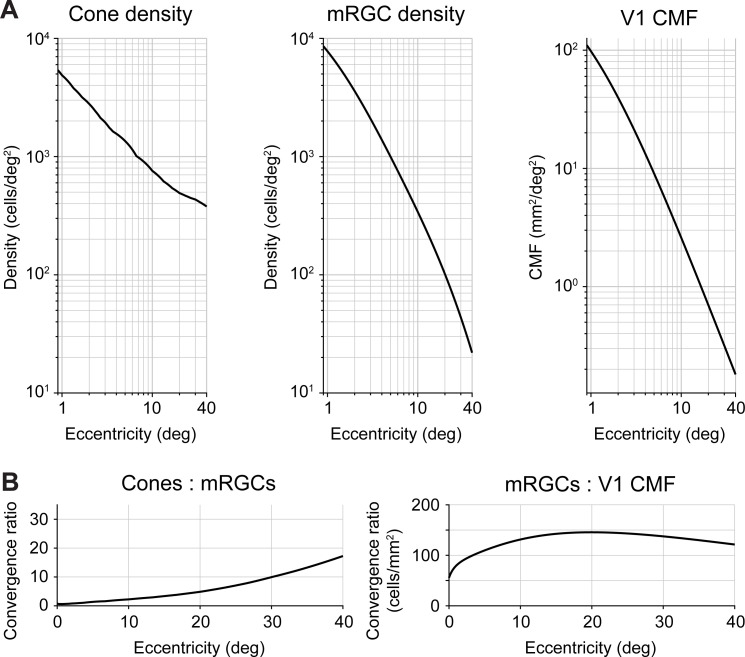
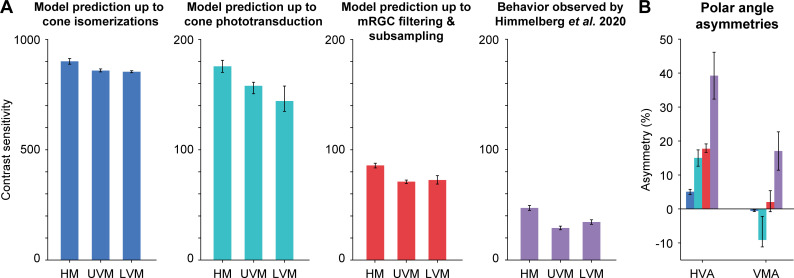
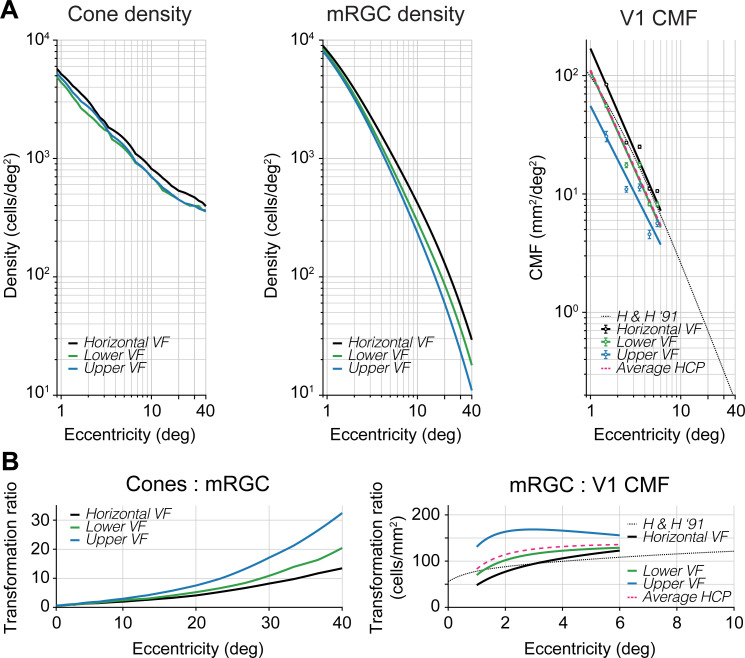
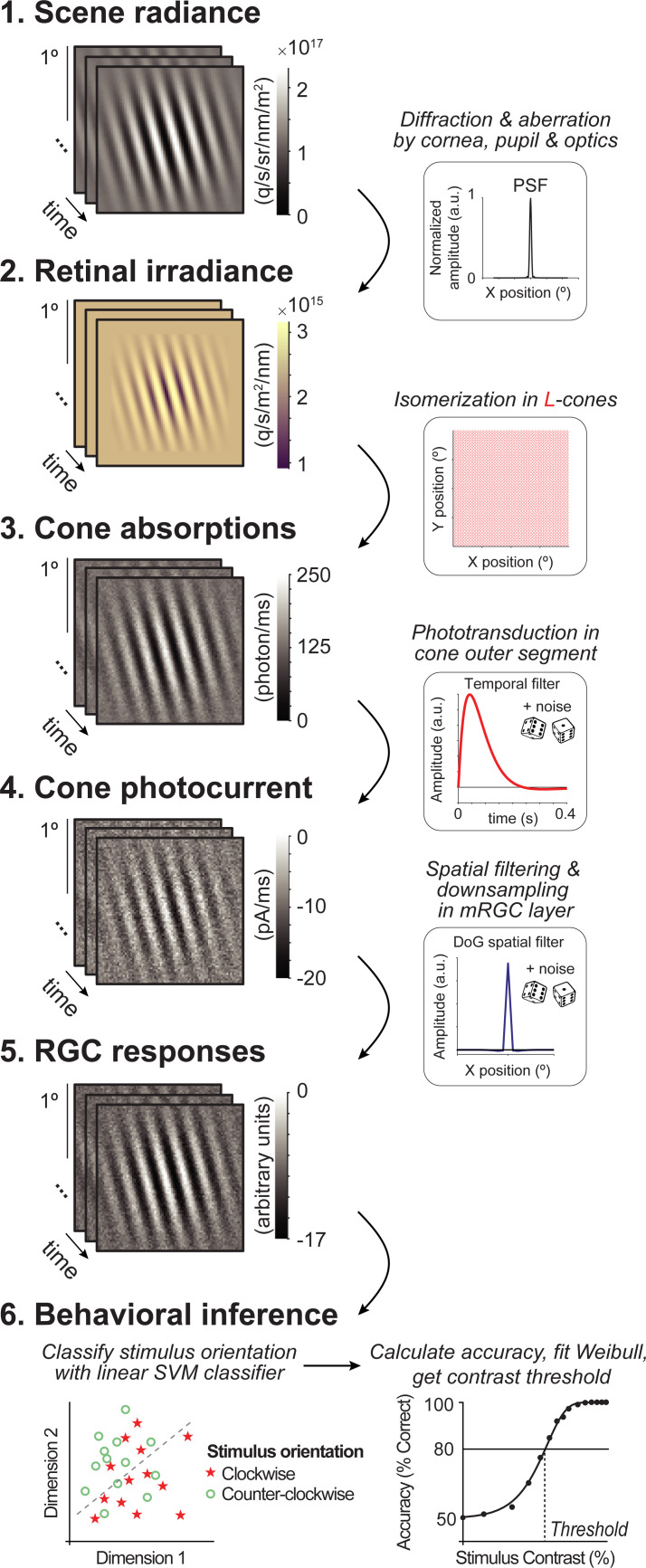
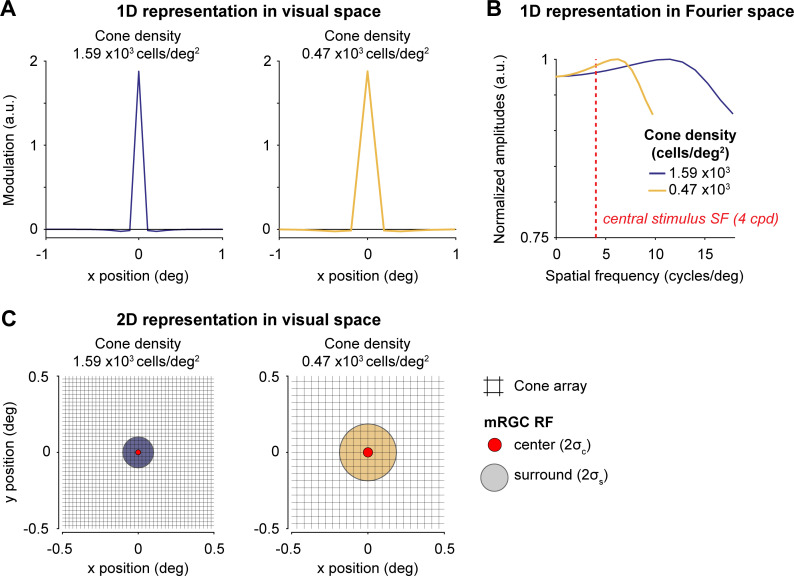
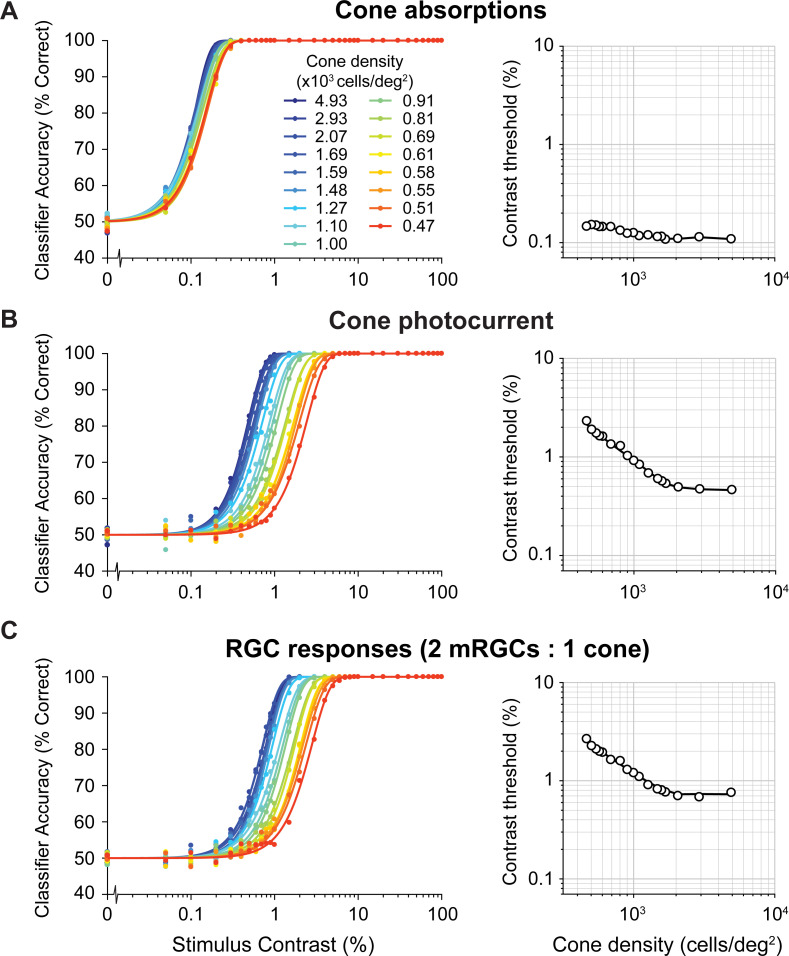
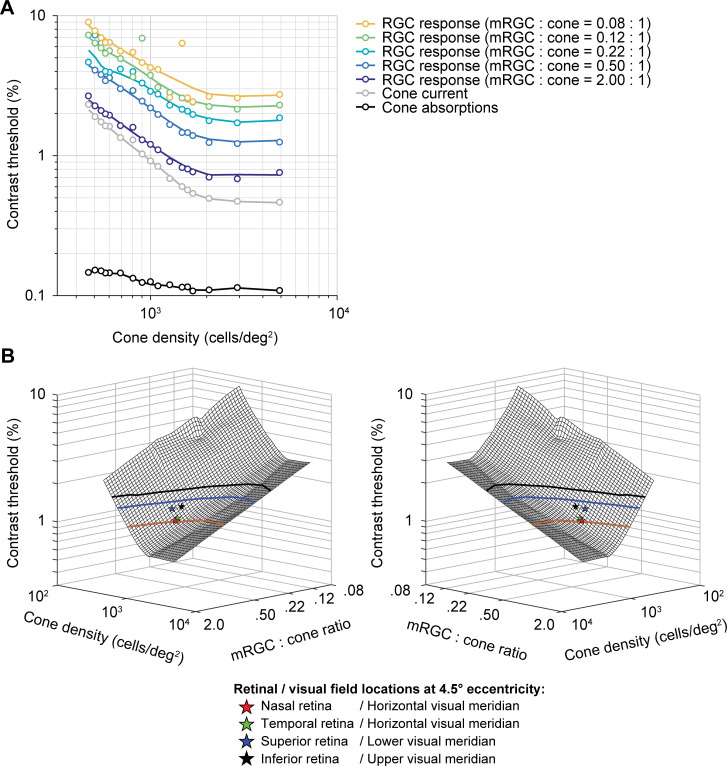
Visual performance varies around the visual field. It is best near the fovea compared to the periphery, and at iso-eccentric locations it is best on the horizontal, intermediate on the lower, and poorest on the upper meridian. The fovea-to-periphery performance decline is linked to the decreases in cone density, retinal ganglion cell (RGC) density, and V1 cortical magnification factor (CMF) as eccentricity increases. The origins of polar angle asymmetries are not well understood. Optical quality and cone density vary across the retina, but recent computational modeling has shown that these factors can only account for a small percentage of behavior. Here, we investigate how visual processing beyond the cone photon absorptions contributes to polar angle asymmetries in performance. First, we quantify the extent of asymmetries in cone density, midget RGC density, and V1 CMF. We find that both polar angle asymmetries and eccentricity gradients increase from cones to mRGCs, and from mRGCs to cortex. Second, we extend our previously published computational observer model to quantify the contribution of phototransduction by the cones and spatial filtering by mRGCs to behavioral asymmetries. Starting with photons emitted by a visual display, the model simulates the effect of human optics, cone isomerizations, phototransduction, and mRGC spatial filtering. The model performs a forced choice orientation discrimination task on mRGC responses using a linear support vector machine classifier. The model shows that asymmetries in a decision maker's performance across polar angle are greater when assessing the photocurrents than when assessing isomerizations and are greater still when assessing mRGC signals. Nonetheless, the polar angle asymmetries of the mRGC outputs are still considerably smaller than those observed from human performance. We conclude that cone isomerizations, phototransduction, and the spatial filtering properties of mRGCs contribute to polar angle performance differences, but that a full account of these differences will entail additional contribution from cortical representations.
视功能在视野周围变化。与周边相比,在中央凹处最佳,在等离区,水平方向最佳,下方次之,上方最差。中央凹至周边的功能下降与随着离焦增加而出现的视锥细胞密度、视网膜神经节细胞(RGC)密度和 V1 皮层放大因子(CMF)的减少有关。极角不对称的起源尚不清楚。视网膜上的光学质量和视锥细胞密度存在差异,但最近的计算模型表明,这些因素只能解释行为的一小部分。在这里,我们研究了视锥细胞光子吸收之外的视觉处理如何导致性能的极角不对称。首先,我们量化了视锥细胞密度、小细胞 RGC 密度和 V1 CMF 的不对称程度。我们发现,极角不对称和离焦梯度都从视锥细胞增加到小细胞 RGC,从小细胞 RGC 增加到皮层。其次,我们扩展了我们之前发表的计算观察器模型,以量化视锥细胞的光转导和小细胞 RGC 的空间滤波对视行为不对称的贡献。从视觉显示器发射的光子开始,该模型模拟了人类光学、视锥细胞异构化、光转导和小细胞 RGC 空间滤波的作用。该模型使用线性支持向量机分类器对小细胞 RGC 响应进行强制选择方向辨别任务。该模型表明,在评估光电流时,决策者在极角的表现不对称性大于在评估异构化时,在评估小细胞 RGC 信号时更大。尽管如此,小细胞 RGC 输出的极角不对称性仍然远小于从人类表现观察到的。我们得出的结论是,视锥细胞异构化、光转导和小细胞 RGC 的空间滤波特性导致了极角性能的差异,但要完全解释这些差异,还需要皮质代表的额外贡献。