Lehmann Jens, Rothmund Maria, Riedl David, Rumpold Gerhard, Grote Vincent, Fischer Michael J, Holzner Bernhard
Department of Psychiatry, Psychotherapy, Psychosomatics and Medical Psychology, University Hospital of Psychiatry II, Medical University of Innsbruck, 6020 Innsbruck, Austria.
Ludwig Boltzmann Institute for Rehabilitation Research, 1140 Vienna, Austria.
Cancers (Basel). 2021 Dec 24;14(1):84. doi: 10.3390/cancers14010084.
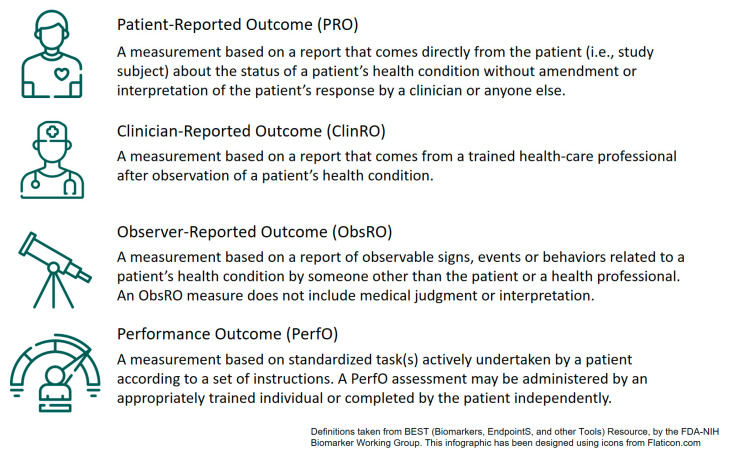
The aim of cancer rehabilitation is to help patients regain functioning and social participation. In order to evaluate and optimize rehabilitation, it is important to measure its outcomes in a structured way. In this article, we review the different types of clinical outcome assessments (COAs), including Clinician-Reported Outcomes (ClinROs), Observer-Reported Outcomes (ObsROs), Performance Outcomes (PerfOs), and Patient-Reported Outcomes (PROs). A special focus is placed on PROs, which are commonly defined as any direct report from the patient about their health condition without any interpretation by a third party. We provide a narrative review of available PRO measures (PROMs) for relevant outcomes, discuss the current state of PRO implementation in cancer rehabilitation, and highlight trends that use PROs to benchmark value-based care. Furthermore, we provide examples of PRO usage, highlight the benefits of electronic PRO (ePRO) collection, and offer advice on how to select, implement, and integrate PROs into the cancer rehabilitation setting to maximize efficiency.
癌症康复的目的是帮助患者恢复功能并重新参与社会活动。为了评估和优化康复效果,以结构化方式衡量其结果非常重要。在本文中,我们回顾了不同类型的临床结局评估(COA),包括临床医生报告结局(ClinRO)、观察者报告结局(ObsRO)、功能结局(PerfOs)和患者报告结局(PRO)。特别关注的是PRO,它通常被定义为患者对自身健康状况的任何直接报告,无需第三方进行解读。我们对相关结局的可用PRO测量工具(PROM)进行叙述性综述,讨论癌症康复中PRO实施的现状,并强调使用PRO来衡量基于价值医疗的趋势。此外,我们提供PRO使用的示例,突出电子PRO(ePRO)收集的益处,并就如何选择、实施PRO并将其整合到癌症康复环境中以实现效率最大化提供建议。