Isci Damla, D'Uonnolo Giulia, Wantz May, Rogister Bernard, Lombard Arnaud, Chevigné Andy, Szpakowska Martyna, Neirinckx Virginie
Laboratory of Nervous System Diseases and Therapy, GIGA Neuroscience, GIGA Institute, University of Liège, 4000 Liege, Belgium.
Immuno-Pharmacology and Interactomics, Department of Infection and Immunity, Luxembourg Institute of Health, 1445 Strassen, Luxembourg.
Cancers (Basel). 2021 Dec 28;14(1):130. doi: 10.3390/cancers14010130.
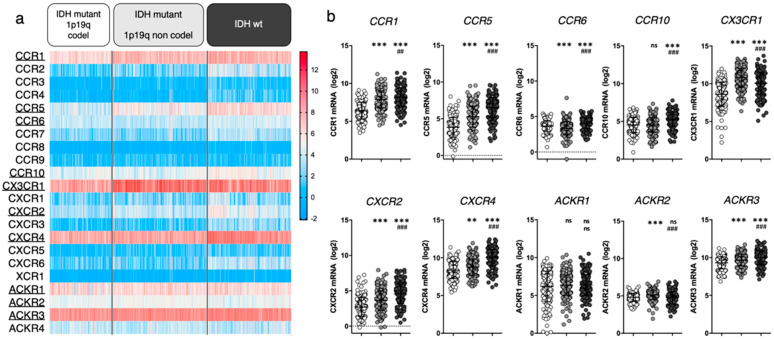
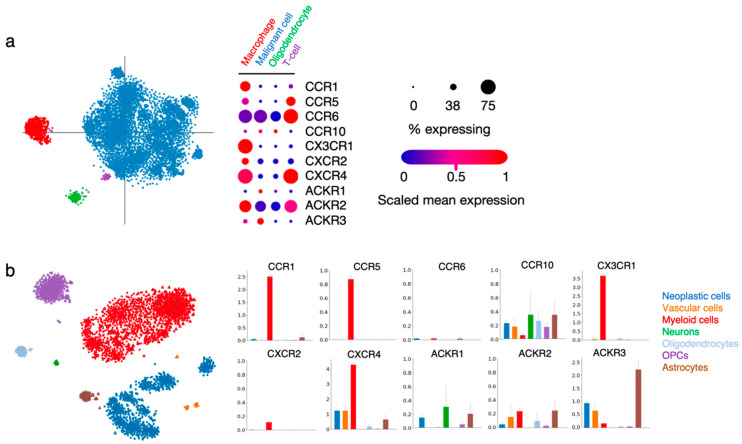
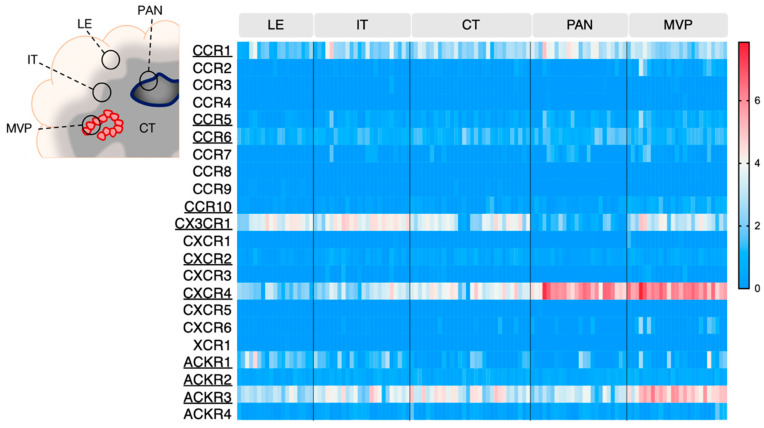
Gliomas are severe brain malignancies, with glioblastoma (GBM) being the most aggressive one. Despite continuous efforts for improvement of existing therapies, overall survival remains poor. Over the last years, the implication of chemokines and their receptors in GBM development and progression has become more evident. Recently, large amounts of clinical data have been made available, prompting us to investigate chemokine receptors in GBM from a still-unexplored patient-oriented perspective. This study aims to highlight and discuss the involvement of chemokine receptors-CCR1, CCR5, CCR6, CCR10, CX3CR1, CXCR2, CXCR4, ACKR1, ACKR2, and ACKR3-most abundantly expressed in glioma patients based on the analysis of publicly available clinical datasets. Given the strong intratumoral heterogeneity characterizing gliomas and especially GBM, receptor expression was investigated by glioma molecular groups, by brain region distribution, emphasizing tissue-specific receptor functions, and by cell type enrichment. Our study constitutes a clinically relevant and patient-oriented guide that recapitulates the expression profile and the complex roles of chemokine receptors within the highly diversified glioma landscape. Additionally, it strengthens the importance of patient-derived material for development and precise amelioration of chemokine receptor-targeting therapies.
神经胶质瘤是严重的脑恶性肿瘤,其中胶质母细胞瘤(GBM)是最具侵袭性的一种。尽管人们不断努力改进现有疗法,但总体生存率仍然很低。在过去几年中,趋化因子及其受体在GBM发生和发展中的作用变得更加明显。最近,大量临床数据已经可用,促使我们从一个尚未探索的以患者为导向的角度研究GBM中的趋化因子受体。本研究旨在基于对公开可用临床数据集的分析,突出并讨论趋化因子受体——CCR1、CCR5、CCR6、CCR10、CX3CR1、CXCR2、CXCR4、ACKR1、ACKR2和ACKR3——在神经胶质瘤患者中最丰富表达的情况。鉴于神经胶质瘤尤其是GBM具有强烈的肿瘤内异质性,通过神经胶质瘤分子组、脑区分布(强调组织特异性受体功能)以及细胞类型富集来研究受体表达。我们的研究构成了一份具有临床相关性且以患者为导向的指南,概括了趋化因子受体在高度多样化的神经胶质瘤格局中的表达谱和复杂作用。此外,它强化了患者来源材料对于开发和精确改进趋化因子受体靶向疗法的重要性。