Cool Taylor, Baena Alessandra Rodriguez Y, Forsberg E Camilla
Program in Molecular, Cell, and Developmental Biology, Institute for the Biology of Stem Cells, University of California Santa Cruz, Santa Cruz, CA 95064, USA.
Institute for the Biology of Stem Cells, Department of Biomolecular Engineering, University of California Santa Cruz, Santa Cruz, CA 95064, USA.
Cancers (Basel). 2021 Dec 30;14(1):184. doi: 10.3390/cancers14010184.
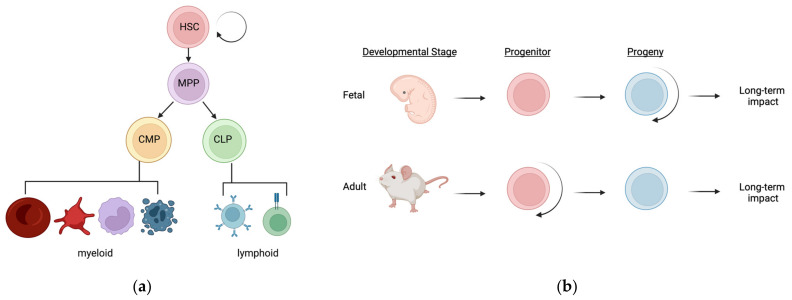
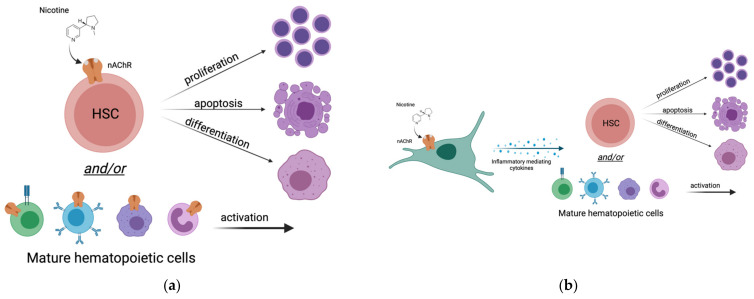
Hematopoiesis is a tightly regulated process orchestrated by cell-intrinsic and cell-extrinsic cues. Over the past several decades, much effort has been focused on understanding how these cues regulate hematopoietic stem cell (HSC) function. Many endogenous key regulators of hematopoiesis have been identified and extensively characterized. Less is known about the mechanisms of long-term effects of environmental toxic compounds on hematopoietic stem and progenitor cells (HSPCs) and their mature immune cell progeny. Research over the past several decades has demonstrated that tobacco products are extremely toxic and pose huge risks to human health by causing diseases like cancer, respiratory illnesses, strokes, and more. Recently, electronic cigarettes have been promoted as a safer alternative to traditional tobacco products and have become increasingly popular among younger generations. Nicotine, the highly toxic compound found in many traditional tobacco products, is also found in most electronic cigarettes, calling into question their purported "safety". Although it is known that nicotine is toxic, the pathophysiology of disease in exposed people remains under investigation. One plausible contributor to altered disease susceptibility is altered hematopoiesis and associated immune dysfunction. In this review, we focus on research that has addressed how HSCs and mature blood cells respond to nicotine, as well as identify remaining questions.
造血作用是一个由细胞内在和外在信号精心调控的过程。在过去几十年里,大量努力都集中在理解这些信号如何调节造血干细胞(HSC)功能上。许多造血作用的内源性关键调节因子已被识别并得到广泛表征。关于环境有毒化合物对造血干细胞和祖细胞(HSPCs)及其成熟免疫细胞后代的长期影响机制,我们了解得较少。过去几十年的研究表明,烟草制品极具毒性,会引发癌症、呼吸系统疾病、中风等疾病,对人类健康构成巨大风险。最近,电子烟被宣传为比传统烟草制品更安全的替代品,并在年轻一代中越来越受欢迎。许多传统烟草制品中含有的剧毒化合物尼古丁,在大多数电子烟中也能找到,这让人质疑它们所谓的“安全性”。尽管已知尼古丁有毒,但接触尼古丁人群中疾病的病理生理学仍在研究中。疾病易感性改变的一个可能原因是造血作用改变及相关免疫功能障碍。在这篇综述中,我们重点关注了关于造血干细胞和成熟血细胞如何对尼古丁作出反应的研究,并确定了尚存的问题。