North-Western Tuscany Blood Bank, Pisa University Hospital, 56124 Pisa, Italy.
Department of Medicine and Surgery, University of Insubria, 21100 Varese, Italy.
Int J Mol Sci. 2021 Dec 21;23(1):29. doi: 10.3390/ijms23010029.
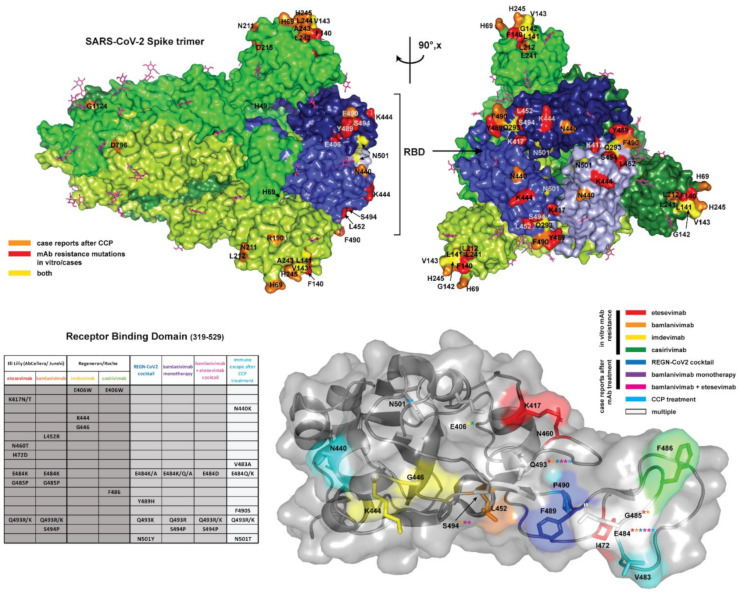
The accelerated SARS-CoV-2 evolution under selective pressure by massive deployment of neutralizing antibody-based therapeutics is a concern with potentially severe implications for public health. We review here reports of documented immune escape after treatment with monoclonal antibodies and COVID-19-convalescent plasma (CCP). While the former is mainly associated with specific single amino acid mutations at residues within the receptor-binding domain (e.g., E484K/Q, Q493R, and S494P), a few cases of immune evasion after CCP were associated with recurrent deletions within the N-terminal domain of the spike protein (e.g., ΔHV69-70, ΔLGVY141-144 and ΔAL243-244). The continuous genomic monitoring of non-responders is needed to better understand immune escape frequencies and the fitness of emerging variants.
大量使用中和抗体类治疗药物对 SARS-CoV-2 进行选择压力下的加速进化令人担忧,可能会对公共健康产生严重影响。我们在此回顾了治疗后出现的有记录的免疫逃逸的报告,包括单克隆抗体和 COVID-19 恢复期血浆(CCP)。前者主要与受体结合域内特定氨基酸残基的单一突变有关(例如,E484K/Q、Q493R 和 S494P),而少数 CCP 后免疫逃逸的病例与 Spike 蛋白 N 端结构域内的重复缺失有关(例如,ΔHV69-70、ΔLGVY141-144 和 ΔAL243-244)。需要对无应答者进行持续的基因组监测,以更好地了解免疫逃逸的频率和新出现变体的适应性。