Diretoria Técnica e Qualidade, Maternidade e Cirurgia Nossa Senhora do Rocio-HR, Campo Largo, PR, Brasil.
Laboratório de Ciência e Tecnologia Aplicada è Saúde, Instituto Carlos Chagas, Fundação Oswaldo Cruz, Curitiba, PR, Brasil.
Braz J Med Biol Res. 2024 Oct 7;57:e13627. doi: 10.1590/1414-431X2024e13627. eCollection 2024.
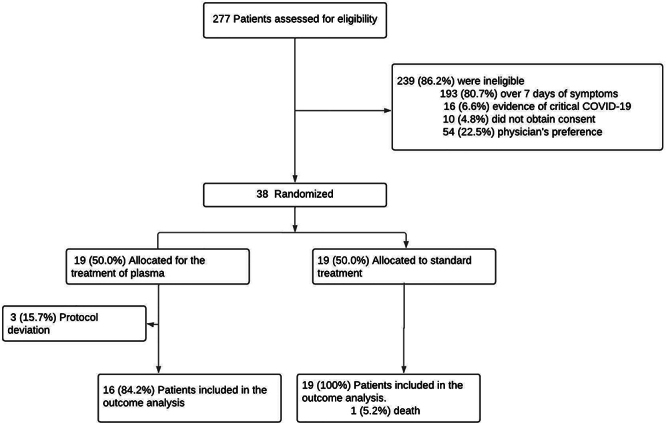
The COVID-19 pandemic has driven the search for alternative therapies, including convalescent plasma, historically used in infectious diseases. Despite results in other diseases, its effectiveness against COVID-19 remains uncertain with conflicting results in clinical trials. A pragmatic, single-center, prospective, and open randomized controlled trial was carried out in a hospital in Brazil, with the aim of evaluating the impact of convalescent plasma on the clinical improvement of patients hospitalized with COVID-19. The World Health Organization (WHO) ordinal scale was used to measure clinical improvement, focusing on the reduction in disease severity by up to 2 points, while antibody and C-reactive protein levels were monitored over time. After hospital admission, participants were randomized 1:1 to receive convalescent plasma and standard treatment or to be part of the control group with standard treatment. Follow-up was carried out on days 1, 3, 7, 14 and/or at discharge. From January 14 to April 4, 2022, 38 patients were included, but 3 were excluded due to protocol deviations, resulting in a total of 35 patients: 19 in the control group and 16 in the plasma group. There was no significant difference in clinical improvement between the convalescent plasma group and the control group, nor in secondary outcomes. The study had limitations due to the small number of patients and limited representation of COVID-19 cases. Broader investigations are needed to integrate therapies into medical protocols, both for COVID-19 and other diseases. Conducting randomized studies is challenging due to the complexity of medical conditions and the variety of treatments available.
COVID-19 大流行推动了替代疗法的研究,包括在传染病中历史上使用的恢复期血浆。尽管在其他疾病中取得了结果,但在临床试验中结果相互矛盾,其对 COVID-19 的有效性仍不确定。巴西的一家医院进行了一项实用的、单中心的、前瞻性的、开放的随机对照试验,旨在评估恢复期血浆对 COVID-19 住院患者临床改善的影响。研究使用世界卫生组织(WHO)等级量表来衡量临床改善,重点是疾病严重程度降低 2 分,同时监测抗体和 C 反应蛋白水平随时间的变化。住院后,参与者按 1:1 随机分为接受恢复期血浆和标准治疗组或标准治疗对照组。随访在第 1、3、7、14 天和/或出院时进行。从 2022 年 1 月 14 日至 4 月 4 日,共纳入 38 名患者,但因违反方案,有 3 名患者被排除,最终共有 35 名患者入组:对照组 19 名,血浆组 16 名。在临床改善方面,恢复期血浆组与对照组之间没有显著差异,次要结局也没有差异。由于患者数量较少且 COVID-19 病例代表性有限,该研究存在局限性。需要更广泛的研究将治疗方法纳入医疗方案,包括 COVID-19 和其他疾病。由于医疗条件的复杂性和可用治疗方法的多样性,进行随机研究具有挑战性。