Khan Shams Tabrez, Adil Syed Farooq, Shaik Mohammed Rafi, Alkhathlan Hamad Z, Khan Merajuddin, Khan Mujeeb
Department of Agricultural Microbiology, Faculty of Agricultural Sciences, Aligarh Muslim University, Aligarh 2002002, UP, India.
Department of Chemistry, College of Science, King Saud University, P.O. Box 2455, Riyadh 11451, Saudi Arabia.
Plants (Basel). 2021 Dec 30;11(1):109. doi: 10.3390/plants11010109.
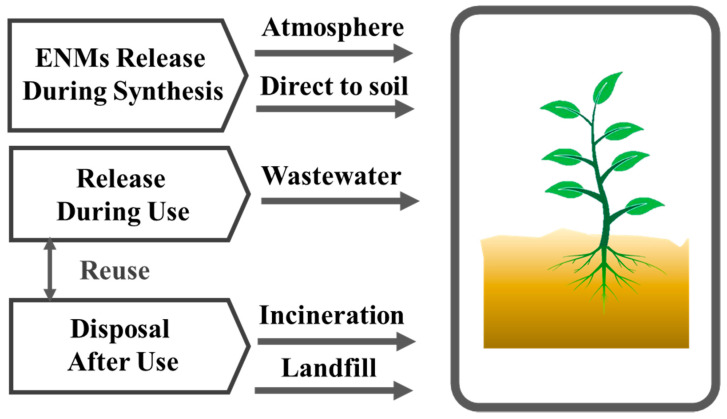
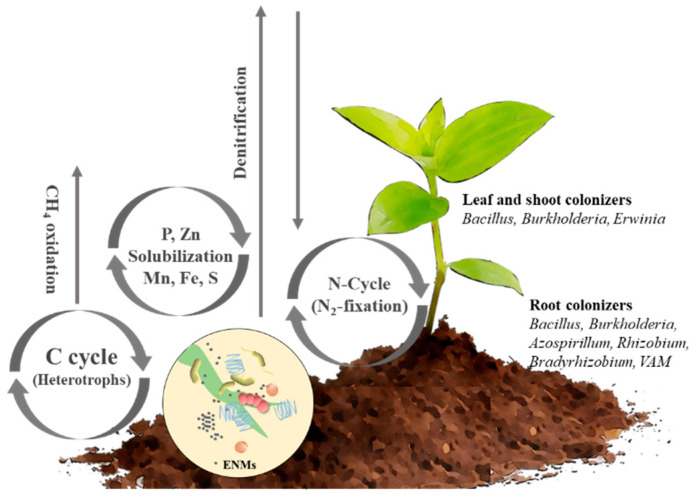
A staggering number of nanomaterials-based products are being engineered and produced commercially. Many of these engineered nanomaterials (ENMs) are finally disposed into the soil through various routes in enormous quantities. Nanomaterials are also being specially tailored for their use in agriculture as nano-fertilizers, nano-pesticides, and nano-based biosensors, which is leading to their accumulation in the soil. The presence of ENMs considerably affects the soil microbiome, including the abundance and diversity of microbes. In addition, they also influence crucial microbial processes, such as nitrogen fixation, mineralization, and plant growth promoting activities. ENMs conduct in soil is typically dependent on various properties of ENMs and soil. Among nanoparticles, silver and zinc oxide have been extensively prepared and studied owing to their excellent industrial properties and well-known antimicrobial activities. Therefore, at this stage, it is imperative to understand how these ENMs influence the soil microbiome and related processes. These investigations will provide necessary information to regulate the applications of ENMs for sustainable agriculture and may help in increasing agrarian production. Therefore, this review discusses several such issues.
大量基于纳米材料的产品正在被设计并进行商业化生产。许多这类工程纳米材料(ENM)最终通过各种途径大量进入土壤。纳米材料还被专门定制用于农业,如纳米肥料、纳米农药和基于纳米的生物传感器,这导致它们在土壤中积累。工程纳米材料的存在极大地影响土壤微生物群落,包括微生物的丰度和多样性。此外,它们还影响关键的微生物过程,如固氮、矿化和促进植物生长的活动。工程纳米材料在土壤中的行为通常取决于其自身的各种特性以及土壤的特性。在纳米颗粒中,银和氧化锌因其优异的工业性能和众所周知的抗菌活性而被广泛制备和研究。因此,在现阶段,了解这些工程纳米材料如何影响土壤微生物群落及相关过程至关重要。这些研究将为规范工程纳米材料在可持续农业中的应用提供必要信息,并可能有助于提高农业产量。因此,本综述讨论了几个此类问题。