Nazir Ammara, Latif Shoomaila, Adil Syed Farooq, Kuniyil Mufsir, Imran Muhammad, Hatshan Mohammad Rafe, Kanwal Farah, Shaik Baji
Centre for Inorganic Chemistry, School of Chemistry, University of the Punjab, Lahore 54590, Pakistan.
School of Physical Sciences, University of the Punjab, Lahore 54590, Pakistan.
Materials (Basel). 2021 Dec 28;15(1):213. doi: 10.3390/ma15010213.
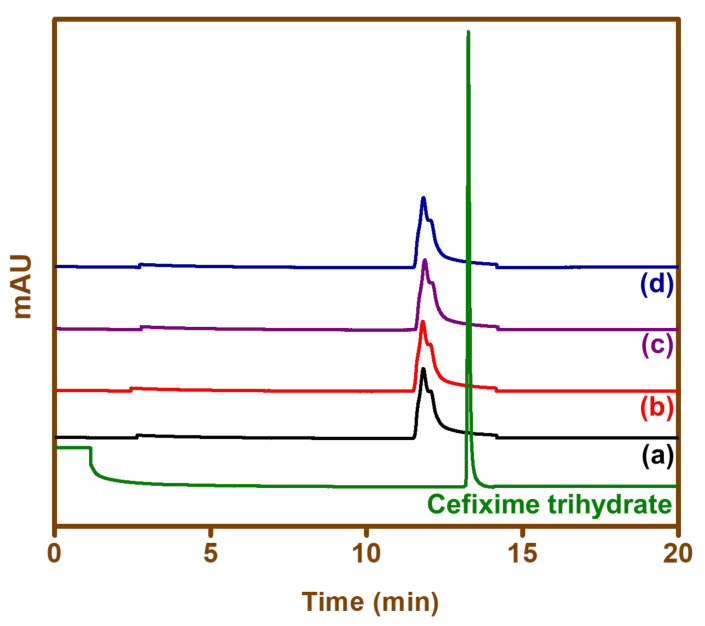
The present work was carried out to synthesize bismuth ferrite (BFO) nanoparticles by combustion synthesis, and to evaluate the photocatalytic activity of synthesized bismuth ferrite nanoparticles against cefixime trihydrate. BFO nanoparticles were successfully synthesized using bismuth (III) nitrate and iron (III) nitrate by a combustion synthesis method employing different types of fuels such as maltose, succinic acid, cinnamic acid, and lactose. The effects of the different types of fuels on the morphology and size of the bismuth ferrite nanoparticles were investigated. Characterization of the as-obtained bismuth ferrite nanoparticles was carried out by different techniques such as X-ray diffraction (XRD), scanning electron microscopy (SEM), Energy-Dispersive Spectroscopy (EDS), N-sorption analysis, Fourier-transform infrared spectroscopy (FT-IR), and ultraviolet-visible (UV-vis) spectroscopy. Photoluminescence studies were also carried out for the various bismuth ferrite nanoparticles obtained. Degradation of cefixime trihydrate was investigated under sunlight to evaluate the photocatalytic properties of the bismuth ferrite nanoparticles, and it was found that the bismuth ferrite nanoparticles followed first-order degradation kinetics in solar irradiation in the degradation of antibiotic, cefixime trihydrate.
本研究旨在通过燃烧合成法制备铋铁氧体(BFO)纳米颗粒,并评估合成的铋铁氧体纳米颗粒对三水合头孢克肟的光催化活性。采用燃烧合成法,以硝酸铋(III)和硝酸铁(III)为原料,使用麦芽糖、琥珀酸、肉桂酸和乳糖等不同类型的燃料成功合成了BFO纳米颗粒。研究了不同类型燃料对铋铁氧体纳米颗粒形态和尺寸的影响。通过X射线衍射(XRD)、扫描电子显微镜(SEM)、能量色散光谱(EDS)、N吸附分析、傅里叶变换红外光谱(FT-IR)和紫外可见(UV-vis)光谱等不同技术对所得铋铁氧体纳米颗粒进行了表征。还对获得的各种铋铁氧体纳米颗粒进行了光致发光研究。在阳光下研究了三水合头孢克肟的降解情况,以评估铋铁氧体纳米颗粒的光催化性能,结果发现铋铁氧体纳米颗粒在抗生素三水合头孢克肟的降解过程中,在太阳辐射下遵循一级降解动力学。