Merlino Valentina Maria, Massaglia Stefano, Borra Danielle, Mimosi Antonio, Cornale Paolo
Department of Agricultural, Forest and Food Sciences, University of Turin, Largo Paolo Braccini 2, 10095 Grugliasco, Italy.
Foods. 2021 Dec 29;11(1):77. doi: 10.3390/foods11010077.
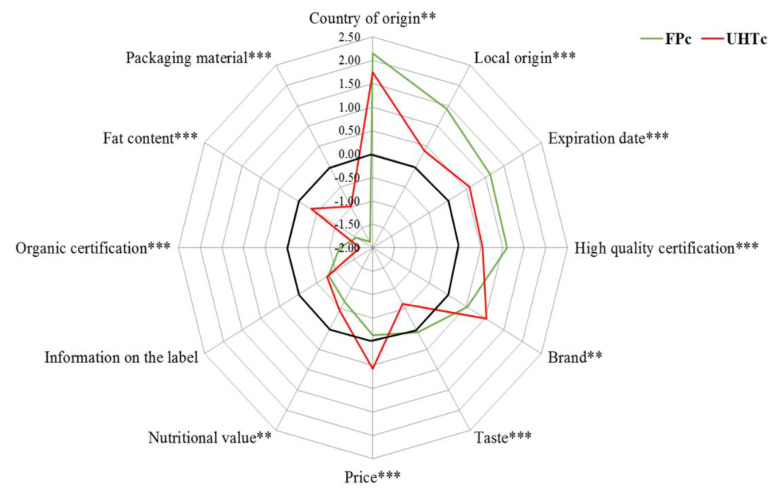
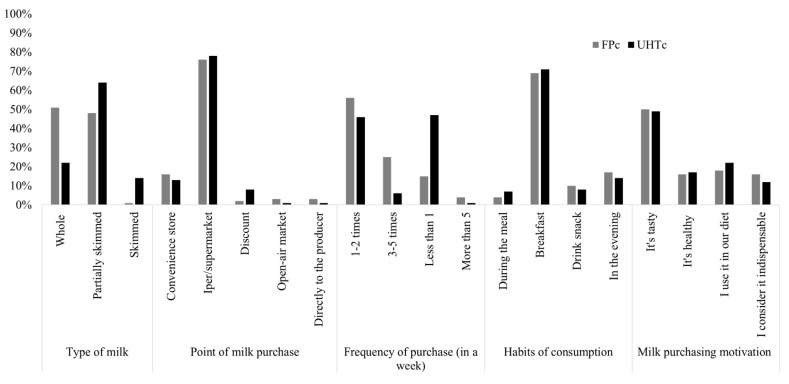
The cow's milk market is going through a critical period characterised by a continuous contraction in consumption as a consequence of the lack of competitiveness on the market of the conventional product (commodity) versus numerous specialties. This paper aimed to define the profiles of milk consumers in terms of individual preferences (assessed using the best-worst scaling methodology) and socio-demographic features. A survey was conducted in several stores of large-scale retail, convenience stores, and open-air markets distributed in north-west Italy to collect data from 1216 respondents. For milk shopper purchasing habits, two consumer groups were defined and compared in terms of preferences: the fresh pasteurized milk consumer (FPc) (56% of the total sample) and the ultra-high temperature treated milk consumer (UHT) (35%). A series of two-ways multivariate analysis of variance (MANOVA) were conducted to assess the effect of individuals' socio-demographic characteristics and the type of milk chosen on the consumer preferences, simultaneously. Significant differences in milk purchasing habits and preferences emerged when comparing the two consumer groups (UHT and FP). Empirical evidence of the study supported the starting hypothesis, suggesting the significance or relevance of the consumer socio-demographic characteristic, as well as their interaction effect with the type of milk on the level of importance given to the considered milk quality attributes. On the contrary, the gender results were not significant for the milk preferences definition. The assessment of consumer preferences, associated with the individuals' socio-demographic characteristics could have important implications for outlining more effective marketing strategies based on a more targeted communication (i.e., related to the sustainability dimension of the local product, nutritional value and brand), leading the consumer back to the commodity rediscovery concerning individuals' features and habits.
牛奶市场正处于一个关键时期,其特点是由于传统产品(大宗商品)在市场上缺乏竞争力,与众多特色产品相比,消费量持续萎缩。本文旨在根据个人偏好(使用最佳-最差尺度法评估)和社会人口特征来定义牛奶消费者的概况。在意大利西北部的几家大型零售商店、便利店和露天市场进行了一项调查,以收集1216名受访者的数据。对于牛奶购买者的购买习惯,定义了两个消费者群体,并在偏好方面进行了比较:新鲜巴氏杀菌牛奶消费者(FPc)(占总样本的56%)和超高温处理牛奶消费者(UHT)(35%)。进行了一系列双因素多变量方差分析(MANOVA),以同时评估个人的社会人口特征和所选牛奶类型对消费者偏好的影响。比较这两个消费者群体(UHT和FP)时,牛奶购买习惯和偏好出现了显著差异。该研究的实证证据支持了最初的假设,表明消费者社会人口特征的重要性或相关性,以及它们与牛奶类型在对所考虑的牛奶质量属性赋予的重要性水平上的交互作用。相反,性别结果在牛奶偏好定义方面并不显著。对消费者偏好的评估,与个人的社会人口特征相关,可能对制定更有效的营销策略具有重要意义,这些策略基于更有针对性的沟通(即与当地产品的可持续性维度、营养价值和品牌相关),引导消费者重新发现与个人特征和习惯相关的大宗商品。