Hassan Talal, Merlino Valentina Maria, Badino Paola, Odore Rosangela, Shahid Muhammad Qamer, Amerio Alberto, Renna Manuela
Department of Veterinary Sciences, University of Turin, Grugliasco, TO, Italy.
Department of Agricultural, Forest and Food Sciences, University of Turin, Grugliasco, TO, Italy.
BMC Public Health. 2024 Dec 18;24(1):3463. doi: 10.1186/s12889-024-21002-w.
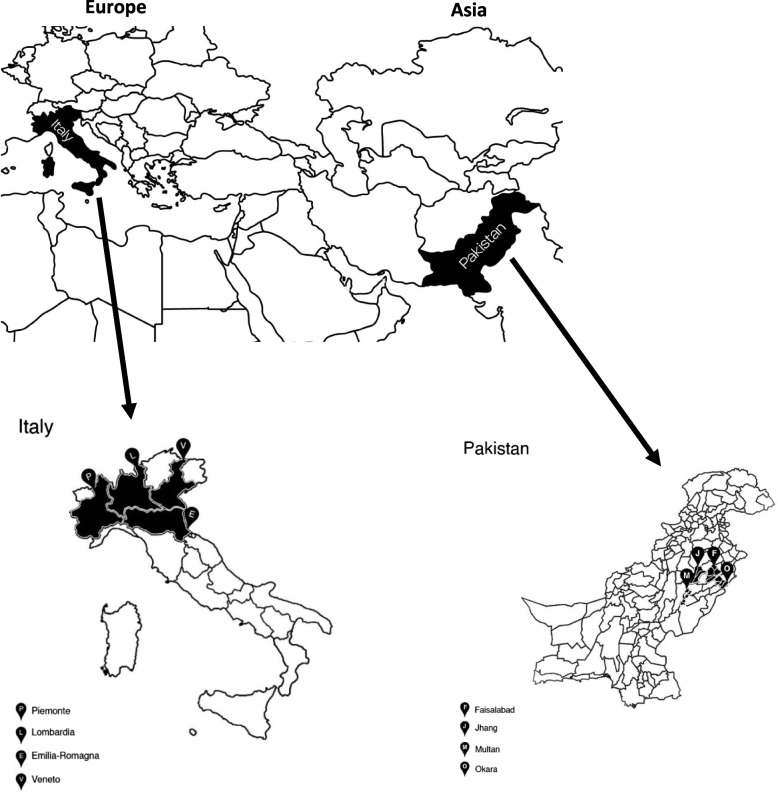
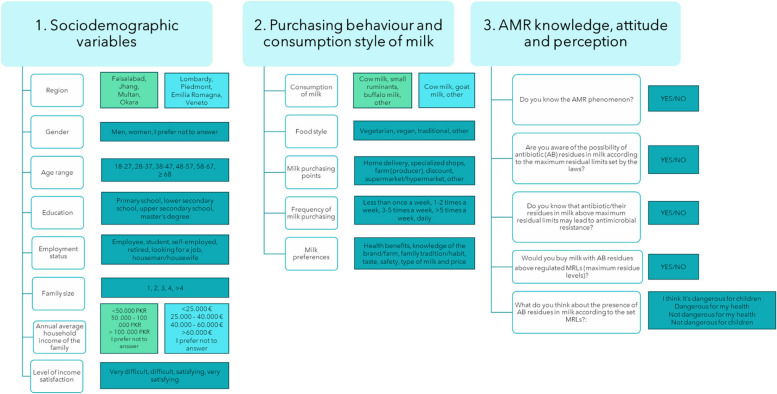
Antimicrobials are extensively used in livestock to treat common diseases, including mastitis and other bacterial infections, with around 80% of food-producing animals receiving such treatments. Despite a ban in the EU since 2006, antibiotics are still used globally for growth promotion, exacerbating antimicrobial resistance (AMR). From the consumers' point of view, the potential exposure to resistant zoonotic bacteria in animal-derived food products may represent a threat to public health. However, consumers' knowledge and attitude vary across socio-demographic characteristics and geographical location. This study aims to evaluate the knowledge, attitudes, and perceptions (KAP) of milk consumers regarding AMR in Pakistan (as a representative of low-to-middle income countries (LMICs)), compared to Italy (as a representative of high-income countries (HICs)).Data were collected via surveys from 401 Pakistani and 550 Italian milk consumers, focusing on socio-demographics, milk purchasing habits, and awareness of antibiotic residues and AMR. The study identified three principal components (PCs) influencing milk consumption: milk quality attributes and tradition, family-dependence, and eating style-dependence. A cluster analysis categorized consumers into four groups: "Attentive to milk quality attributes," "Loyal to milk," "Undecided consumer," and "Milk is essential in my food pattern."Italian consumers predominantly belonged to the "Attentive to milk quality attributes" group, valuing safety and health benefits, and were the most informed about AMR. Pakistani consumers, primarily belonging to the "Loyal to milk" group, exhibited high purchasing frequency influenced by family size but showed limited awareness about AMR risks. The "Undecided consumer" group, a mix of Italian and Pakistani individuals, lacked strong preferences and displayed moderate awareness of AMR, influenced by habitual consumption patterns.This research underscores the need for targeted educational campaigns to raise awareness about AMR and antibiotic residues in milk, particularly in LMICs. Survey findings can help to identify targeted action plans and boost policy development on AMR. Enhancing consumer knowledge through the One-Health approach could mitigate AMR risks and promote informed decision-making in milk consumption across different socio-economic contexts.
抗菌药物在牲畜中被广泛用于治疗常见疾病,包括乳腺炎和其他细菌感染,约80%的食用动物接受此类治疗。尽管自2006年起欧盟已实施禁令,但抗生素仍在全球范围内用于促进生长,加剧了抗菌药物耐药性(AMR)。从消费者的角度来看,动物源性食品产品中潜在的耐药人畜共患病细菌暴露可能对公众健康构成威胁。然而,消费者的知识和态度因社会人口特征和地理位置而异。本研究旨在评估巴基斯坦(作为低收入和中等收入国家(LMICs)的代表)与意大利(作为高收入国家(HICs)的代表)的牛奶消费者对抗菌药物耐药性的知识、态度和认知(KAP)。通过对401名巴基斯坦和550名意大利牛奶消费者进行调查收集数据,重点关注社会人口统计学、牛奶购买习惯以及对抗生素残留和抗菌药物耐药性的认知。该研究确定了影响牛奶消费的三个主要因素:牛奶质量属性和传统因素、家庭依赖因素以及饮食方式依赖因素。聚类分析将消费者分为四类:“关注牛奶质量属性者”、“忠于牛奶者”、“犹豫不决的消费者”以及“牛奶是我饮食模式中必不可少的部分者”。意大利消费者主要属于“关注牛奶质量属性者”群体,重视安全性和健康益处,并且对抗菌药物耐药性了解最多。巴基斯坦消费者主要属于“忠于牛奶者”群体,受家庭规模影响购买频率较高,但对抗菌药物耐药性风险的认知有限。“犹豫不决的消费者”群体由意大利人和巴基斯坦人混合组成,缺乏强烈偏好,受习惯消费模式影响,对抗菌药物耐药性的认知程度中等。这项研究强调了开展有针对性的教育活动的必要性,以提高人们对牛奶中抗菌药物耐药性和抗生素残留的认识,特别是在低收入和中等收入国家。调查结果有助于确定有针对性的行动计划,并推动抗菌药物耐药性相关政策的制定。通过“同一健康”方法提高消费者知识水平,可以降低抗菌药物耐药性风险,并促进在不同社会经济背景下牛奶消费的明智决策。